
Trunk comparison: Hyundai i10 vs Renault Clio
Key Differences
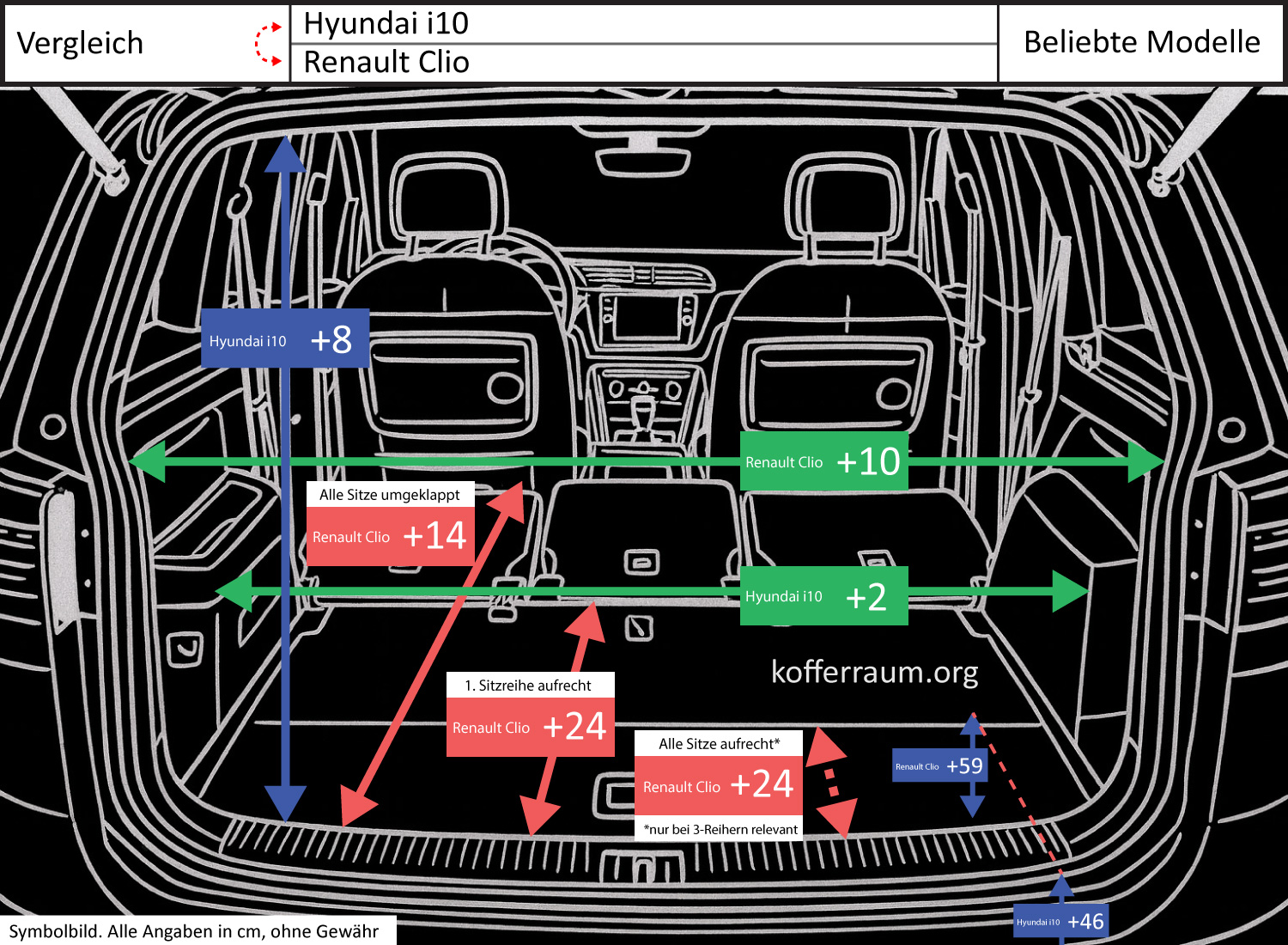
In terms of trunk volume and usability, the Renault Clio clearly stands out: With the seats folded down, the Clio is 5.5 in (12%) longer, and with the front seats upright, even 9.4 in (51%) longer than the Hyundai i10. The trunk depth (loading edge to trunk floor) is 23.2 in (328%) greater in the Clio, meaning significantly more interior space below the loading edge.
The width of the trunk opening is 3.9 in (11%) wider in the Clio, while the width at the narrowest point is only about 2% greater in the i10 (negligible).
Advantage Hyundai i10: The height of the trunk opening is 3.1 in (11%) higher in the i10, and the loading edge itself sits 18.1 in (192%) higher above the road than in the Clio.
Implications for Usability
Everyday practicality and loading: The Renault Clio offers noticeably more usable cargo space overall—especially when using the rear seats folded down or loading large luggage.
The greater length with folded seats and significantly larger depth make the Clio more suitable for longer or bulkier loads (e.g., furniture parts, skis, longer luggage). The wider trunk opening makes loading wide items easier.
Loading ergonomics: The lower loading edge of the Clio makes lifting heavy items easier; in the Hyundai i10, more lifting is required due to the significantly higher loading edge. This is especially noticeable during repeated loading and unloading or with heavy shopping.
Form factor and bulky items: The Hyundai i10 has a higher trunk opening height—which helps when passing through tall but not too deep items.
Overall, the i10 is more compact and practical for smaller, bulky parts with a larger diameter (but less depth), while the Clio offers clear advantages in length, depth, and opening width for larger, longer, and bulkier loads.
Conclusion: For regularly transporting larger or longer items and for easier loading (lower loading edge), the Renault Clio is the better choice.
The Hyundai i10 only scores to a limited extent with a higher opening height; the significantly higher loading edge and smaller interior make it less suitable for extensive transport.