
Trunk comparison: Hyundai i10 vs Skoda Kamiq
Key Differences
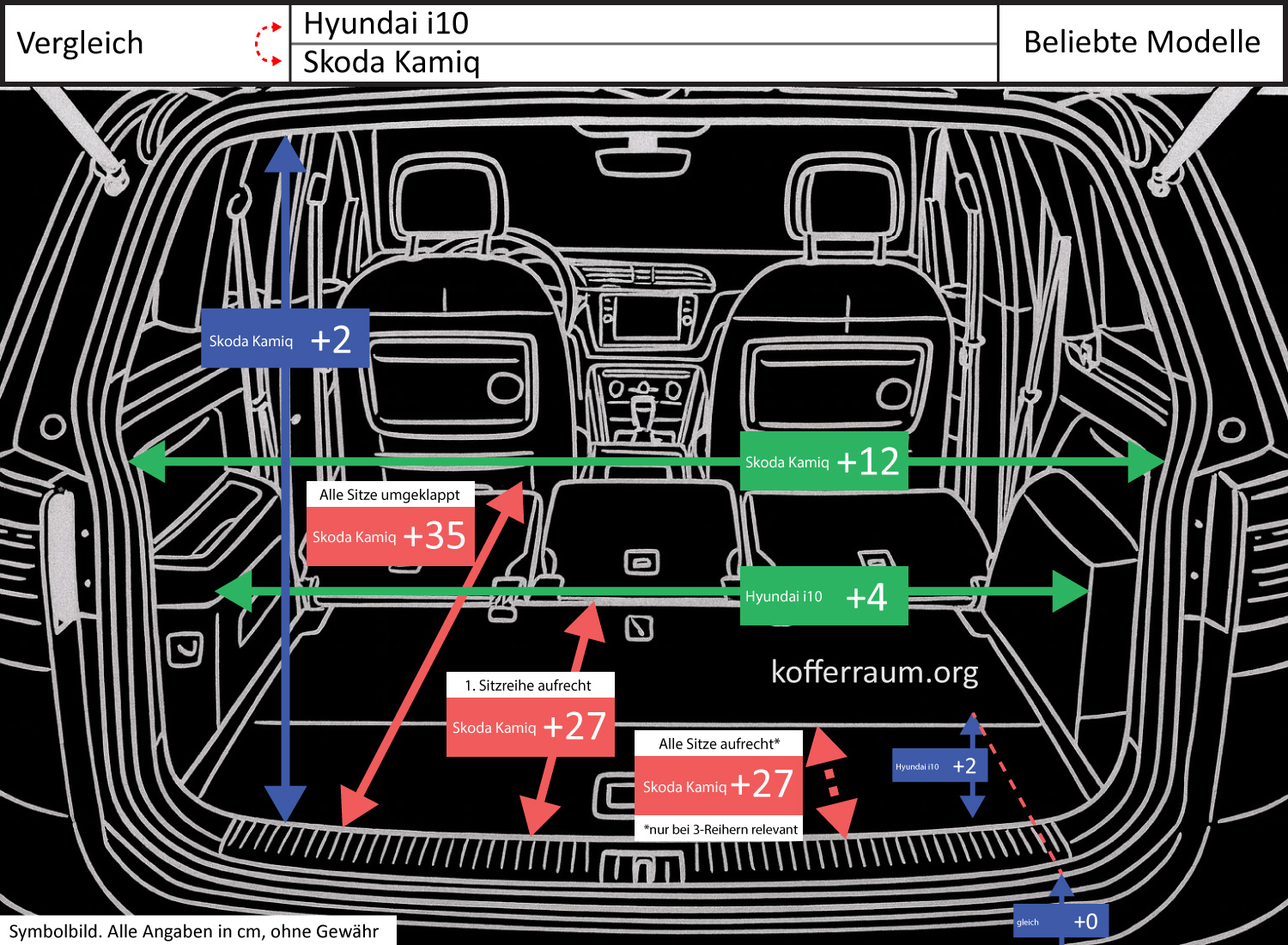
In terms of volume and dimensions of the cargo space, the Škoda Kamiq leads: With the seats folded down, the Kamiq's trunk is 13.8 in (≈30%) longer than the Hyundai i10's, and with the first row of seats upright, it is even 10.6 in (≈57%) longer.
The width of the Kamiq's trunk opening is also 4.7 in (≈13%) larger than that of the i10. On the other hand, the Hyundai i10 has a greater loading depth (loading edge to trunk floor) and is 0.8 in (≈13%) deeper here than the Kamiq.
Smaller differences: the height of the trunk opening (+0.8 in/2% in favor of the Kamiq) and the narrowest trunk width (+1.6 in/4% in favor of the i10) are negligible; the loading edge height of both models is the same.
Impact on Usability
Due to the significantly greater length with folded seats and the wider loading opening, the Kamiq is clearly better suited for long or bulky loads (e.g., furniture panels, bicycles, or long boxes). The larger opening width makes loading and unloading wide items easier and reduces hassle when fitting them in.
The Hyundai i10 scores with its greater loading depth: items sit a bit deeper in the cargo area, which can help when stacking small to medium loads or securely storing boxes near the loading edge. Overall, the i10 remains less suitable for very long or high-volume transports due to its more compact interior length.
Since loading edge height and the smaller width differences hardly matter, they practically do not affect daily usability.
Conclusion: For regular transport of long or wide items, the Škoda Kamiq is the better choice; for occasional city use with smaller cargo needs, the Hyundai i10 is sufficient and slightly more practical for stacking dense loads due to its somewhat deeper loading floor.