
Trunk comparison: Hyundai i10 vs Tesla Model 3
Key Differences and Impact on Usability
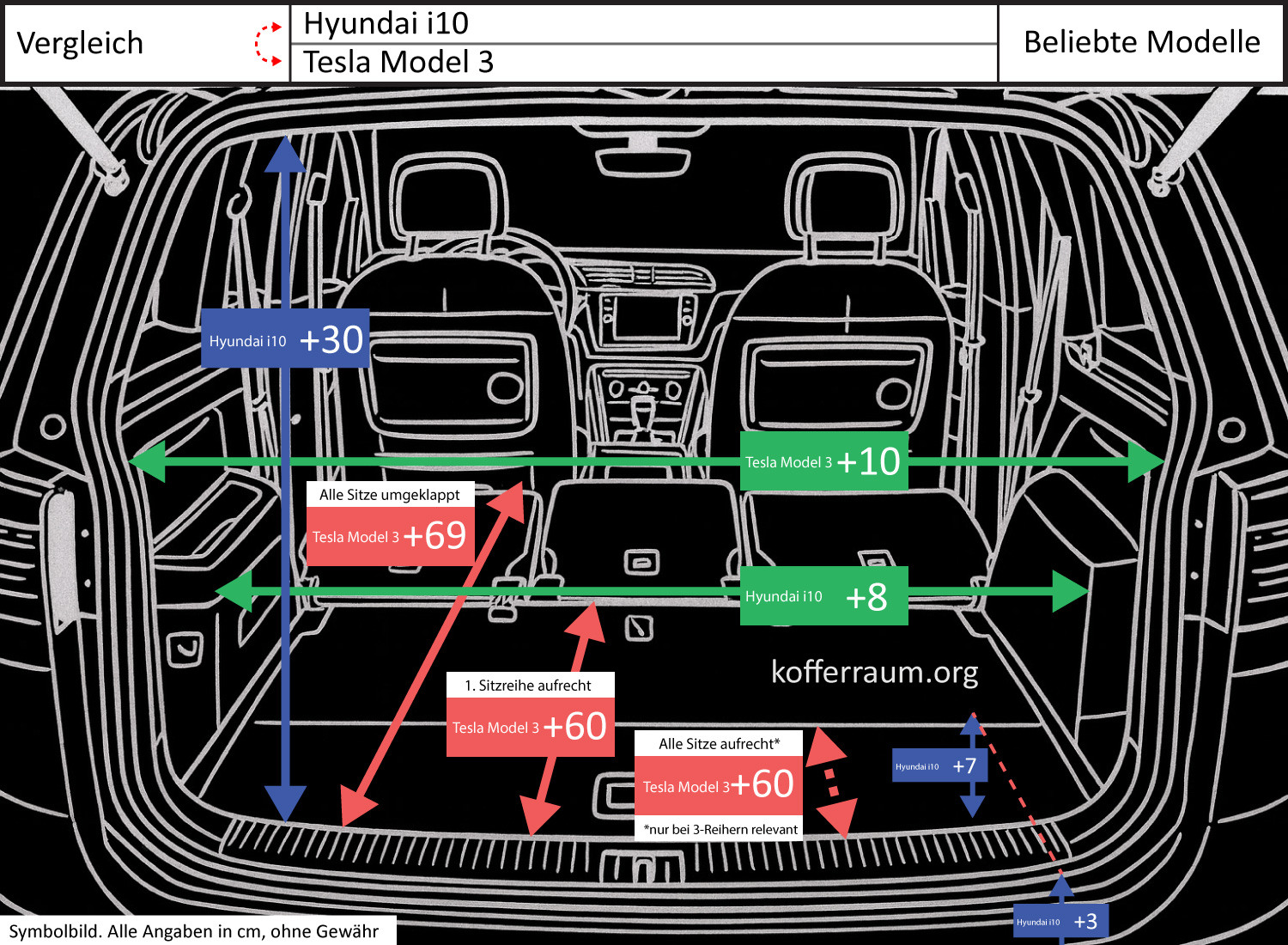
The Tesla Model 3 offers significantly more cargo length: when all seats are folded down, the trunk of the Tesla is 27.2 in or +58% longer, and when the front row is upright, it is 23.6 in or +128% longer than the Hyundai i10. This clearly gives the Tesla an advantage when transporting long items (e.g., slats, skis, long furniture parts) and when storing more luggage without having to remove seats or repack extensively.
The shape of the cargo area differs: the width of the Tesla's trunk opening is 3.9 in or +11% larger, making it easier to load wider items. In contrast, the Hyundai i10 has a significantly higher trunk opening (+11.8 in / +58%) and a greater depth from the loading edge to the trunk floor (+2.8 in / +64%).
This means the i10 better accommodates tall or bulky, but not necessarily very long items, and the higher opening often makes it easier to lift bulky loads inside.
Other differences are minor: the loading edge of the i10 is only 1.2 in (4%) higher than the Tesla's, and the narrowest width inside the i10's trunk is 3.1 in (8%) larger—both under 10% and therefore of little practical relevance. Overall, the usage profile is as follows: For long loads and more trunk volume with folded seats, the Tesla is the better choice; for easy storage of tall or bulky items and easier lifting thanks to a higher opening, the Hyundai i10 scores. Depending on the frequent use case (long goods vs. tall/bulky goods), this decides which car is more practical.