
Trunk comparison: Hyundai i10 vs Volvo XC60


Key Differences (highlighted)
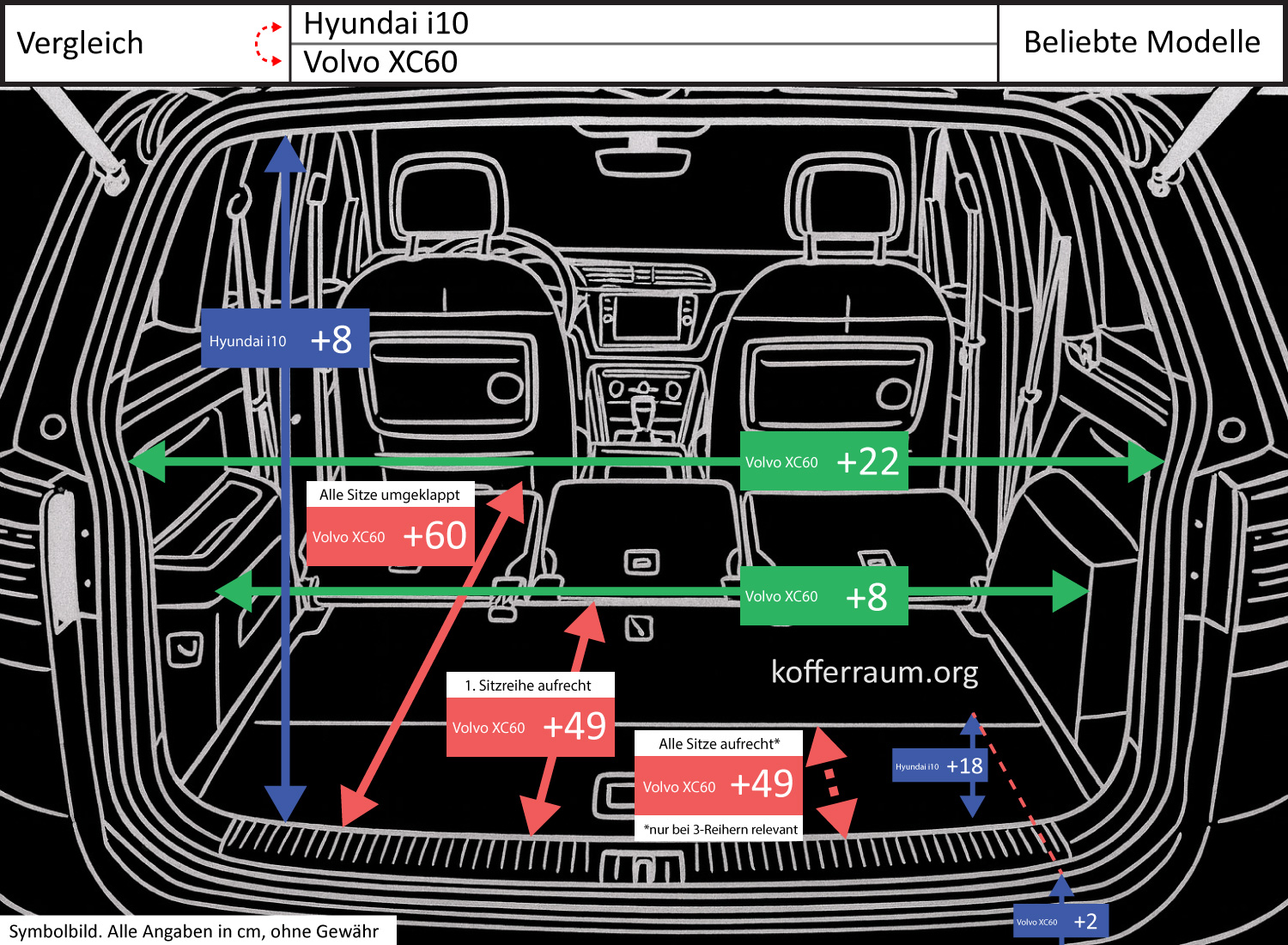
The Volvo XC60 offers a significantly longer cargo area: with the seats folded down, it is 23.6 in (51%) longer, and with the first row upright 19.3 in (104%) longer than the Hyundai i10. The width of the trunk opening is 8.7 in (24%) larger on the XC60. In contrast, the height of the trunk opening is 3.1 in (11%) larger on the Hyundai i10, and the depth of the trunk (loading edge to trunk floor) is 7.1 in (1700%) greater on the i10.
Impact on Usability
Long and wide items: The XC60 clearly has the advantage.
The significantly greater loading length (both with folded seats and with the rear bench occupied) plus the wider opening make it easier to store long items (e.g., furniture parts, skis, long packages) and increase flexible usability with variable seat configurations.
Tall items and "deep" cargo: The i10 offers a higher trunk opening and a significantly deeper well (loading edge → floor). This helps accommodate tall cargo because the entry height of the opening allows more room above, and the deep recess in the cargo area provides better support for stacked or unstable loads.
However, the deep recess can make loading and unloading bulky, heavy items somewhat more cumbersome, as they need to be lowered or lifted further.
Small differences: The loading edge of the XC60 is only slightly (0.8 in) higher above the ground, and the narrowest width differs by 3.1 in — these values are relatively small and have little impact on everyday usability compared to the differences mentioned above.
In summary: For long and wide cargo, the Volvo XC60 is the more practical choice; for items that require more vertical space from above or need to be securely placed in a deeper well, the Hyundai i10 is advantageous. Smaller deviations in loading edge height and narrowest width are secondary.