
Trunk comparison: Hyundai i10 vs VW Caddy Wagon
Key Differences
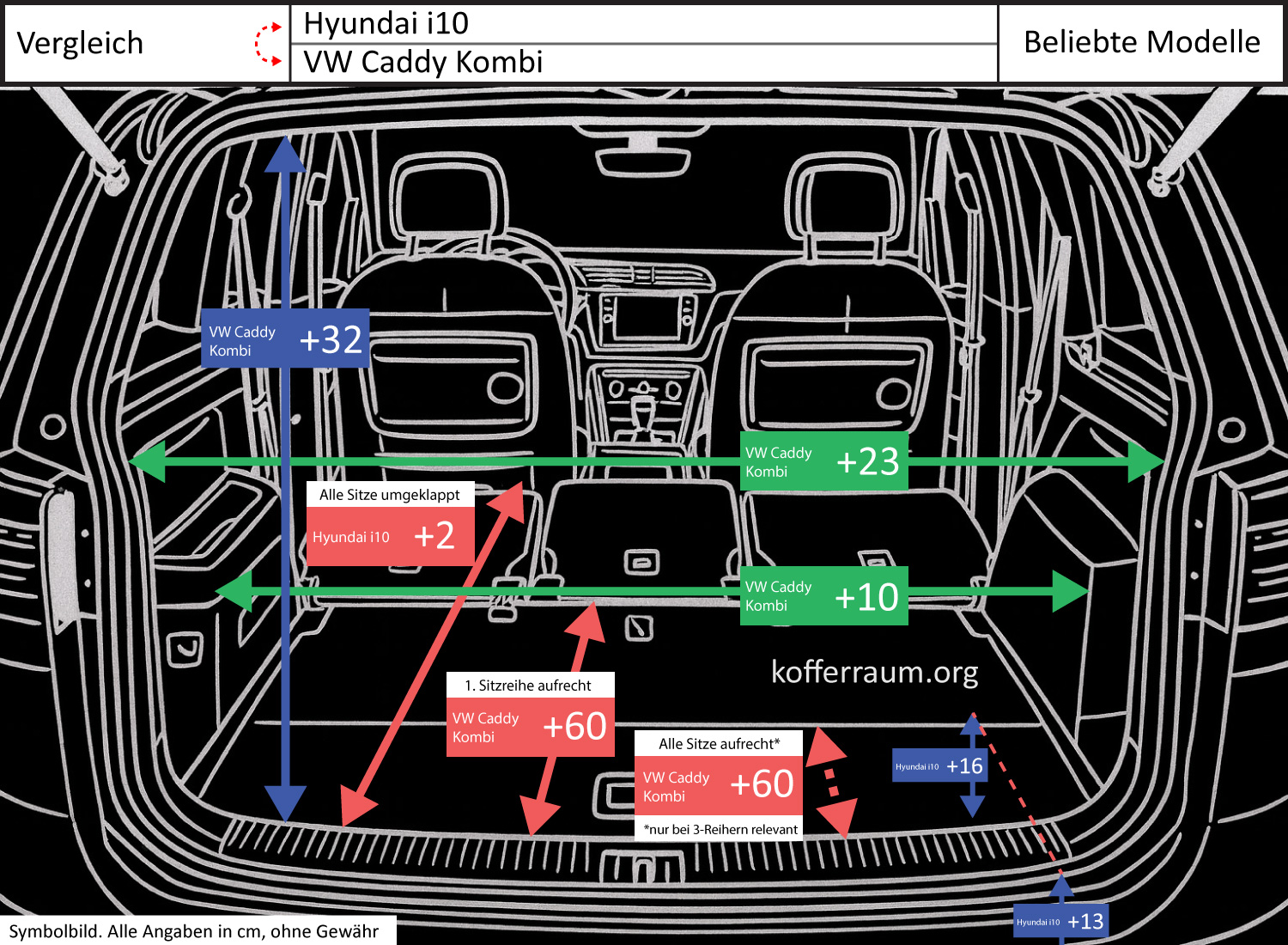
The most noticeable differences concern the space and the shape of the trunk opening: The VW Caddy Wagon has a trunk that is 23.6 in (≈128%) longer than the Hyundai i10 with the front seats upright. The trunk opening of the Caddy is also 12.6 in (≈39%) higher and the opening width is 9.1 in (≈26%) larger.
In contrast, the Hyundai i10 stands out with a greater depth between the loading edge and the trunk floor: this is 6.3 in (≈800%) larger than in the Caddy. Additionally, the loading edge of the i10 is 5.1 in (≈23%) higher above the ground.
Impact on Usability
Practical relevance of the differences: The VW Caddy Wagon clearly has the advantage for long, tall, or wide cargo.
The significantly greater interior length with seats upright makes it more practical for transport tasks without folding the seats (e.g., crates, tools, skis with longer distance). Larger opening height and width make loading bulky items easier and reduce angle issues when loading.
The Hyundai i10, on the other hand, offers a deeper cargo area below the loading edge. This is advantageous for flat or low-profile items that can be placed "deeper" and can lower the center of gravity of the load.
Combined with the 5.1 in higher loading edge, however, this means: the lifting or hoisting height when loading is higher, and there is a step at the transition from the loading edge to the interior — both make lifting heavy or bulky loads more difficult.
In summary: For regularly transporting long, tall, or wide items, the VW Caddy Wagon is the more practical choice. The Hyundai i10 can score points with small, flat, or low-lying loads but is less comfortable when loading heavier or bulky items due to the higher loading edge and narrower opening.