
Trunk comparison: Hyundai i10 vs VW ID.3
Key Differences
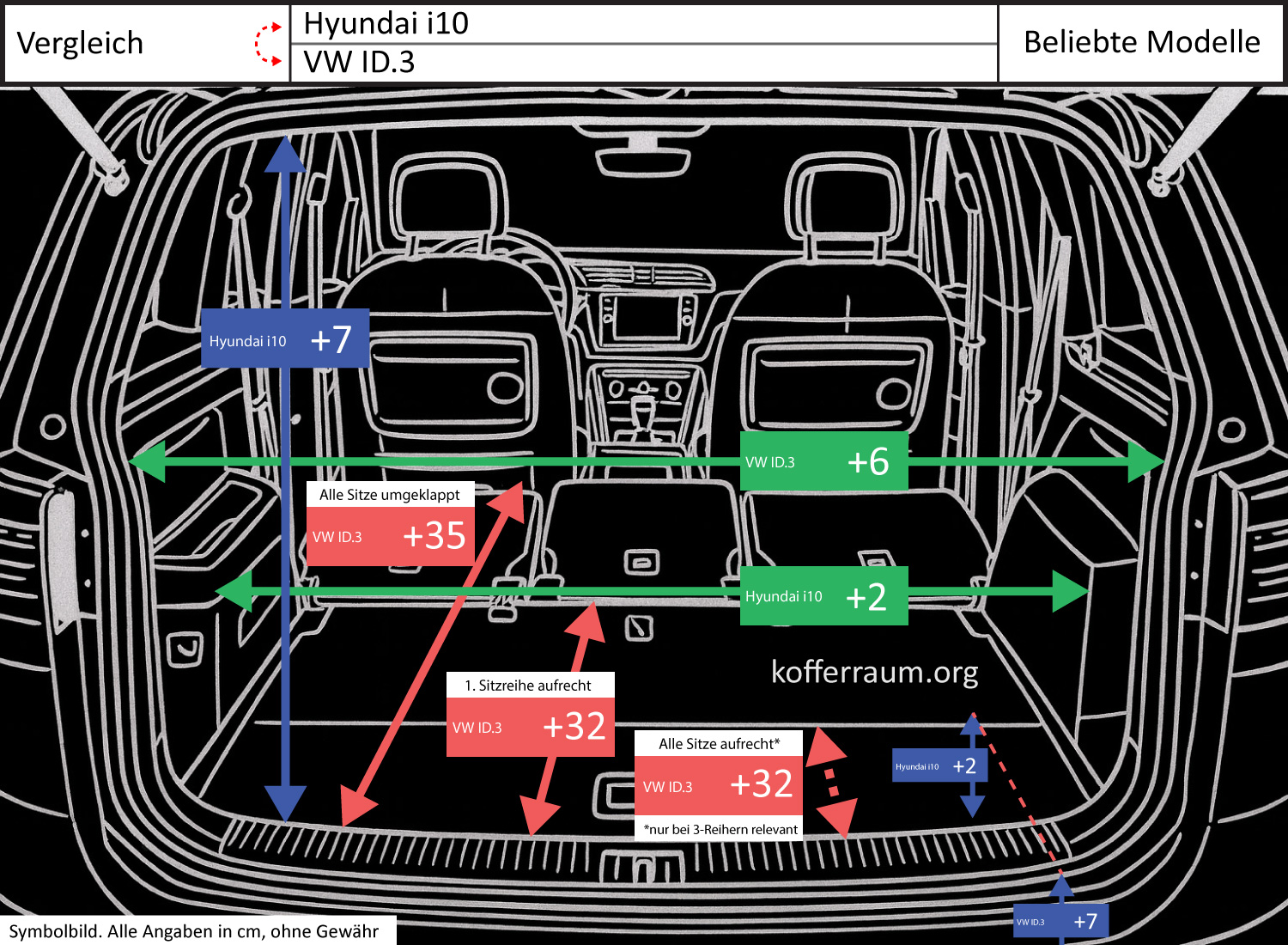
The VW ID.3 offers significantly more cargo length: with the seats folded down, the trunk of the ID.3 is 13.8 in (+30%) longer, and with the first row of seats upright, it is even 12.6 in (+68%) longer than the Hyundai i10. The Hyundai i10, on the other hand, has a larger trunk depth measurement (loading edge to trunk floor): this depth is 0.8 in (+13%) greater in the i10 than in the ID.3. Other values (e.g., trunk opening height, loading edge height, widths) differ only in the single-digit to a maximum of 10% range and are therefore less pronounced.
Impact on Usability
The significantly greater cargo length of the ID.3 makes it more practical for long or bulky items: furniture parts, long moldings, skis, or several large suitcases are more likely to fit in the ID.3 — both with folded rear seats and without.
If longer loads need to be transported regularly, the ID.3 is the better choice.
The i10 scores points despite its shorter length with somewhat more depth in the cargo area and a higher trunk opening. The greater depth (0.8 in / 13%) creates more storage space below the loading edge and makes it easier to store flat or higher stacked items.
Combined with the lower loading edge of the i10 (the ID.3 is about 2.8 in higher), loading and unloading heavy or bulky items in everyday use is more ergonomic.
Width differences are minor: the narrowest point is minimally wider in the i10, while the opening is slightly larger in the ID.3 — this only affects usability with very wide items.
In summary: For long/longer cargo and higher overall capacity, the VW ID.3 is clearly superior. For frequent, ergonomic loading and unloading of heavy or high-stacked items in the city, the Hyundai i10 offers practical advantages.