
Trunk comparison: Hyundai i10 vs VW ID.4
Key Differences and Practical Consequences
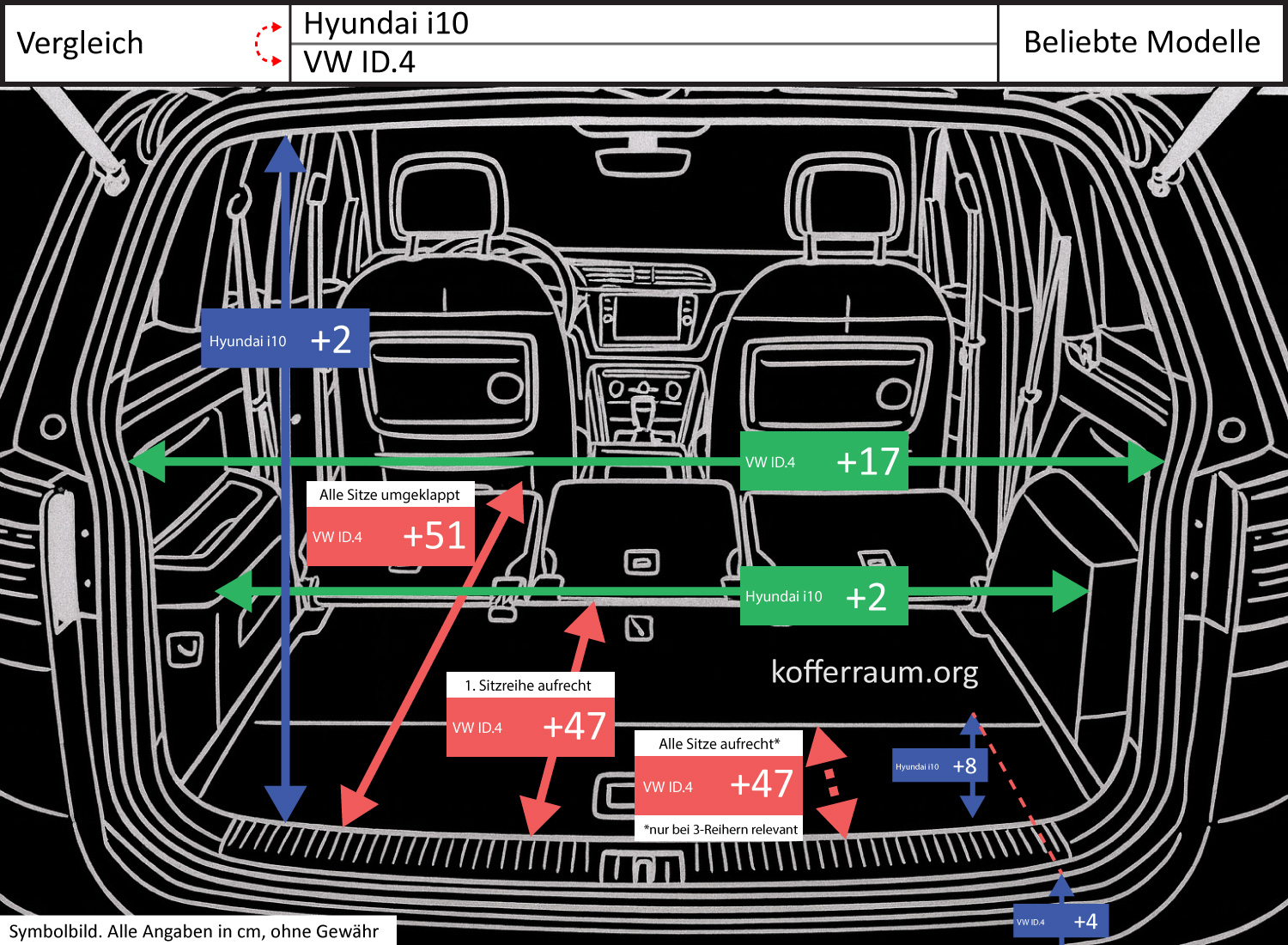
The VW ID.4 offers significantly more cargo length: with the seats folded down, the trunk of the ID.4 is 20.1 in (43%) longer and with the first row of seats upright even 18.5 in (100%) longer than the Hyundai i10. In practice, this means the ID.4 can accommodate long items (e.g., slats, long boxes, bicycles with seats folded) and considerably more luggage, while the i10 quickly reaches its limits with longer loads.
The width of the trunk opening is 6.7 in (19%) larger on the ID.4 than on the i10. This makes sliding in wider items (suitcases, furniture parts, strollers) much easier; with the i10, wide parts can be more difficult to load and unload due to the narrower opening, even though the interior width at the narrowest point is slightly larger in the i10.
Regarding trunk depth (loading edge to trunk floor), the Hyundai i10 has a trunk floor that is 3.1 in (80%) deeper than the ID.4. Practically, this means items loaded in the i10 sit lower and are better concealed; additionally, the volume for taller cargo can be limited.
At the same time, the loading edge of the ID.4 is 1.6 in (6%) higher above the ground, making lifting heavy items during loading somewhat more strenuous; however, this difference is relatively small.
Other dimensions such as the opening height (+0.8 in in favor of the i10, 3%) or the narrowest interior width (+0.8 in in favor of the i10, 2%) are minor and have little impact in everyday use.
Conclusion: For users who regularly want to transport longer or wider loads, the VW ID.4 is the better choice due to its significantly greater cargo length and wider opening.
The Hyundai i10 scores with a deeper load floor and lower loading edge height, which makes hiding luggage easier and reduces lifting effort somewhat — practical for everyday city use and smaller transports.