Trunk comparison: Hyundai i10 vs VW Tiguan
Key Differences
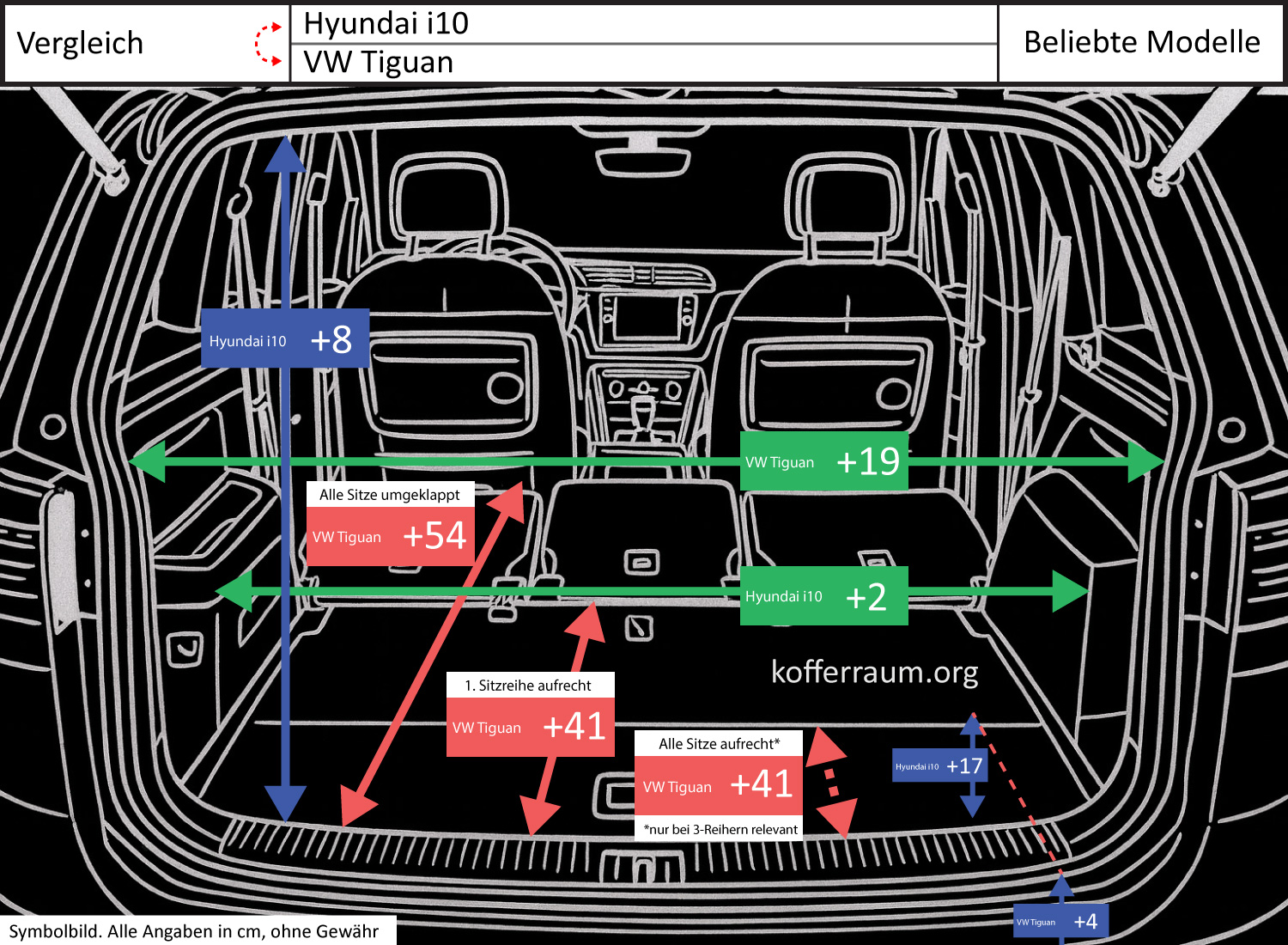
The VW Tiguan offers significantly more cargo length: with the seats folded down, the Tiguan's trunk is 21.3 in (46%) longer than the Hyundai i10's, and with the first row upright, it is even 16.1 in (87%) longer.
The width of the trunk opening is 7.5 in (21%) larger on the Tiguan, while the narrowest width inside the trunk is only slightly (+0.8 in / 2%) larger on the i10. The height of the trunk opening is 3.1 in (11%) larger on the i10 than on the Tiguan.
Also notable is the greater depth between the loading edge and the trunk floor in the i10: here, the i10 has a value 6.7 in (1700%) higher compared to the Tiguan. The loading edge height of the Tiguan is only slightly higher (+1.6 in / 6%).
Impact on Usability
For transport tasks requiring length and opening width (e.g., long furniture pieces, slats, sports equipment), the VW Tiguan clearly has the advantage: the significantly longer cargo areas both with folded seats and with the first row upright, as well as the larger opening width, make loading bulky and elongated items easier.
The Tiguan is therefore better suited for situations where maximum cargo space or loading long parts is important.
The Hyundai i10 scores with vertical dimensions and the internal depth: the larger height of the trunk opening makes it easier to maneuver tall items through the opening, and the greater depth between the loading edge and trunk floor means that loaded items can sit deeper inside the vehicle (less overhang beyond the loading edge).
This is advantageous when heavy or tall items need to be placed stably and deeper in the cargo area. For a low loading edge height (easier lifting), the i10 is also slightly better, as the Tiguan's loading edge is only minimally higher.
In short: Those who regularly transport long or wide loads benefit from the Tiguan. Those who more often have tall or deep-sitting, compact loads and need a high opening will find advantages in the i10.