
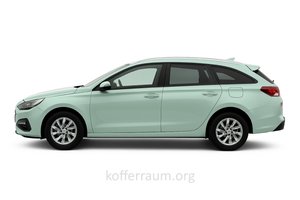
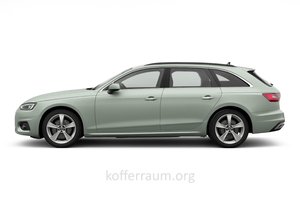
Trunk comparison: Hyundai Elantra GT Wagon vs Durchschnitt Wagon
Key Differences
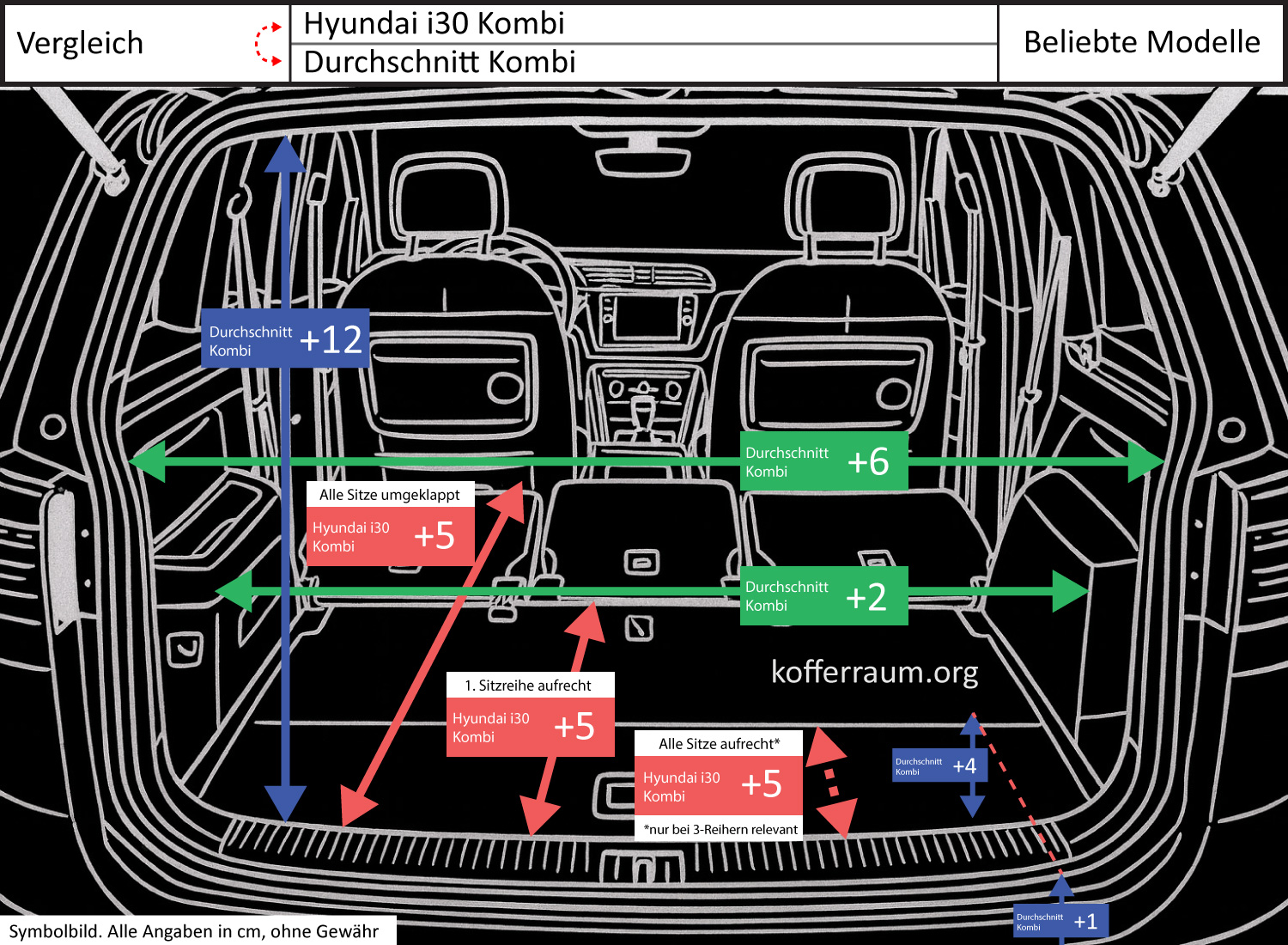
Only two values are significantly above 10%: The height of the trunk opening is +4.7 in (18%) higher in the average wagon than in the Hyundai i30 wagon, and the trunk depth (distance from loading edge → trunk floor) is +1.6 in (300%) greater in the average wagon than in the Hyundai i30 wagon.
Other smaller deviations: the i30 has a slightly longer loading floor with folded seats (+2 in / 3%) and with the first row of seats upright (+2 in / 5%); the average wagon is slightly wider at the narrowest point and at the opening width (+0.8 in / 2% and +2.4 in / 6%, respectively), and the loading edge is on average +0.4 in higher (+2%).
Impact on Usability
Lower trunk opening (Hyundai): The 4.7 in lower opening height reduces the maximum height of items that can be loaded through the opening.
This makes loading tall boxes, shelving units, or standing furniture more difficult or impossible, even though the overall length of the cargo space is slightly larger. For regular transport of tall, bulky items, the average wagon is therefore more practical.
Significantly shallower trunk depth in the Hyundai: The greater depth of the average wagon means more "recess" behind the loading edge.
Practically, this means items sit deeper in the cargo space and are better protected or out of sight; there is more room for stackable or inconspicuous cargo below the opening.
The shallower well area of the i30 causes cargo to lie closer to the opening, be more visible, and have less vertical reserve for storing tall items.
Combined effects: Although the i30 wagon offers a slightly longer usable length, the lower opening and shallower depth limit the ability to comfortably and securely transport tall or bulky items.
For long, flat cargo (e.g., skis, panels), the i30 can be advantageous; for frequent loading of tall boxes, stacked crates, or bulky structures, the average wagon is more helpful.