
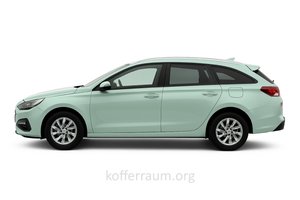
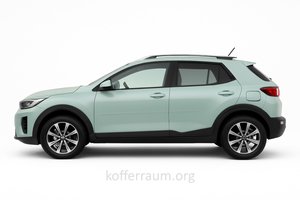
Trunk comparison: Hyundai Elantra GT Wagon vs Kia Stonic
Biggest Differences (highlighted: >10%)
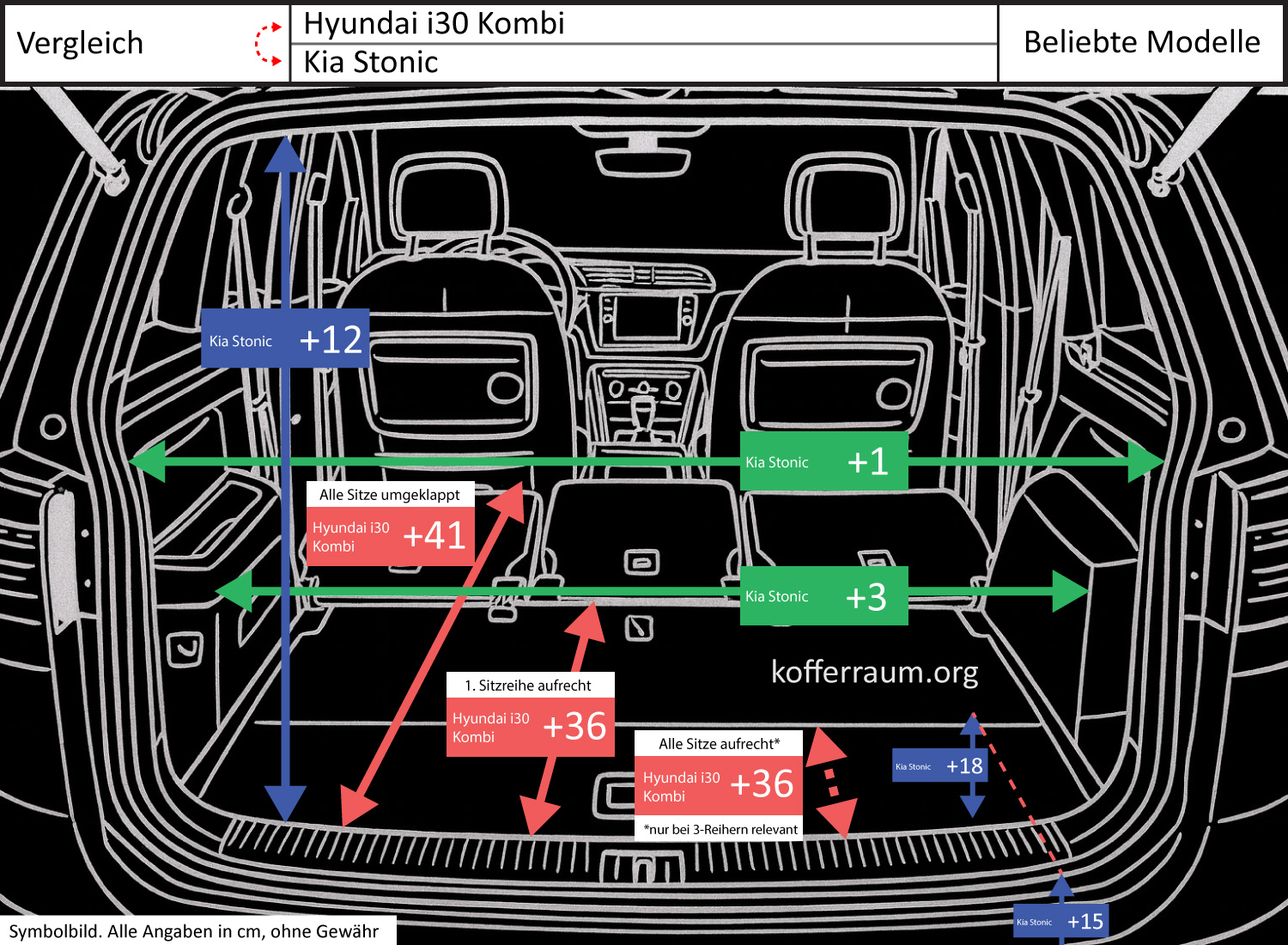
Trunk length with seats folded down: The Hyundai i30 Wagon offers a trunk space that is 16.1 in (30%) longer than the Kia Stonic. This makes the i30 significantly better suited for long items (e.g., slats, furniture parts, skis).
Trunk length with front row upright: With the front row upright, the i30 Wagon is even 14.2 in (52%) longer. In everyday use (shopping, suitcases, boxes), the i30 provides more usable depth behind the seats.
Height of the trunk opening: The opening of the Kia Stonic is 4.7 in (18%) higher than the i30. This makes it easier to load taller items through the rear opening without having to tilt them excessively.
Depth of the trunk (loading edge → trunk floor): The Kia Stonic has a significantly greater distance here (+7.1 in / 1700% according to specifications). Practically, this means a deeper trunk floor relative to the loading edge, creating a kind of deeper "valley" in the cargo area.
Loading edge height above road: The loading edge of the Kia Stonic is 5.9 in (24%) higher than that of the Hyundai i30 Wagon. This is relevant for lifting and loading heavy items.
The width differences (narrowest point +1.2 in / opening width +0.4 in in favor of the Kia) are about ~1–3% each and are therefore practically negligible.
Impact on usability
Hyundai i30 Wagon – Practical advantages: - Significantly longer trunk space (with seats folded and with front row upright) makes the i30 the better choice for transporting long or elongated cargo (furniture, hardware store materials, sports equipment). - Lower loading edge facilitates loading and unloading heavy items: less lifting effort, more ergonomic daily use.
Kia Stonic – Advantages and limitations: - Higher trunk opening offers more vertical clearance when loading tall items through the rear hatch. - Significantly deeper trunk floor (greater distance loading edge→floor) can provide more concealed storage or a lower shelf surface, but combined with the higher loading edge, it is disadvantageous when lifting heavy loads: items must be lifted higher, and reaching the deep floor can be cumbersome. - Overall, the Stonic is better suited if vertical loading (tall, not too heavy items) is important or if one benefits from the deeper "well" in the trunk; for frequent lifting of heavy/long items, it is less comfortable.
Conclusion: For long or frequently loaded heavy items and overall easier loading and unloading, the Hyundai i30 Wagon is more practical.
The Kia Stonic offers advantages in vertical loading and a deeper trunk floor but has practical limitations when handling heavy or bulky cargo due to the higher loading edge and deeper floor.