
Trunk comparison: Hyundai Elantra GT Wagon vs Renault Clio
Biggest Differences (>10%)
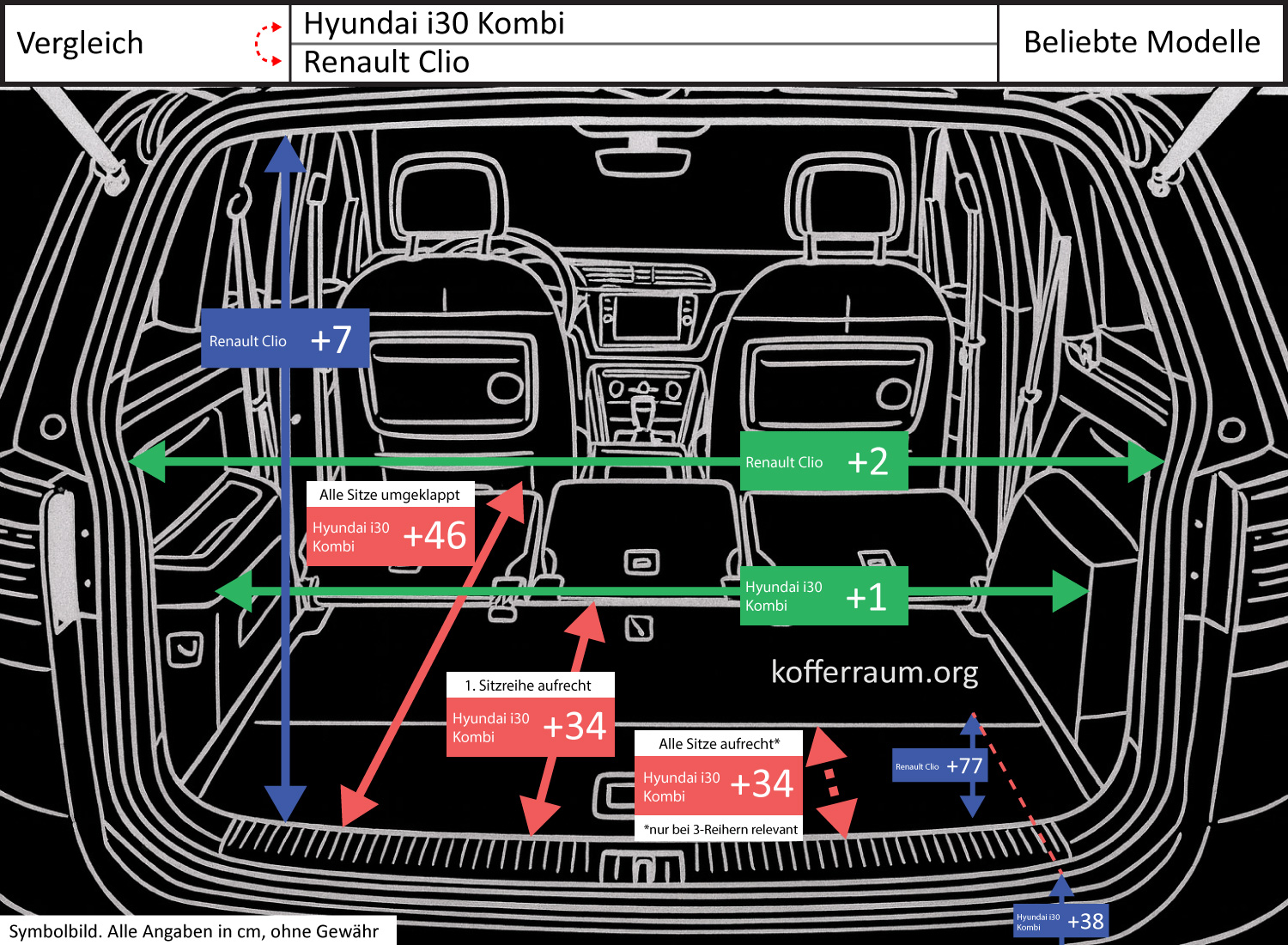
The Hyundai i30 Wagon offers significantly more loading length: with the seats folded down, the trunk is 18.1 in (35%) longer and with the first row upright, 13.4 in (48%) longer than the Renault Clio. This directly affects the ability to transport long items.
Furthermore, the loading edge of the Hyundai is 15 in (158%) higher above the road than the Clio, which influences lifting loads.
It is also noticeable that the depth of the trunk (loading edge to trunk floor) is given as 30.3 in (7600%) larger in the Renault Clio, indicating a significantly deeper cargo area below the loading edge.
Other Differences (less than 10%)
The trunk opening of the Clio is 2.8 in (10%) higher than the i30, the narrowest interior width in the i30 is 0.4 in larger, and the width of the opening in the Clio is 0.8 in larger. These differences are minor and only marginally affect usability.
Implications for Usability
Because the i30 Wagon offers significantly longer loading surfaces, it is better suited for long items such as furniture, slats, skis, or several large suitcases.
The higher loading edge of the i30 improves ground clearance and can make placing external cargo more stable, but it also means more lifting effort when loading heavy items and makes sliding bulky parts through at a shallow angle more difficult.
The Renault Clio scores with the significantly deeper cargo area below the loading edge (the stated difference is very large) and a slightly higher trunk opening.
This makes it advantageous for tall or bulky but not particularly long items that need to stand vertically. Additionally, the lower loading edge of the Clio is ergonomically better for lifting heavy loads.
In short: i30 Wagon = clear advantage in loading length and transporting long items. Clio = better for deep, bulky cargo and easier lifting due to lower loading edge. Smaller width and opening differences are negligible.