
Trunk comparison: Hyundai Elantra GT Wagon vs Volvo XC60

Key Differences and Impact on Usability
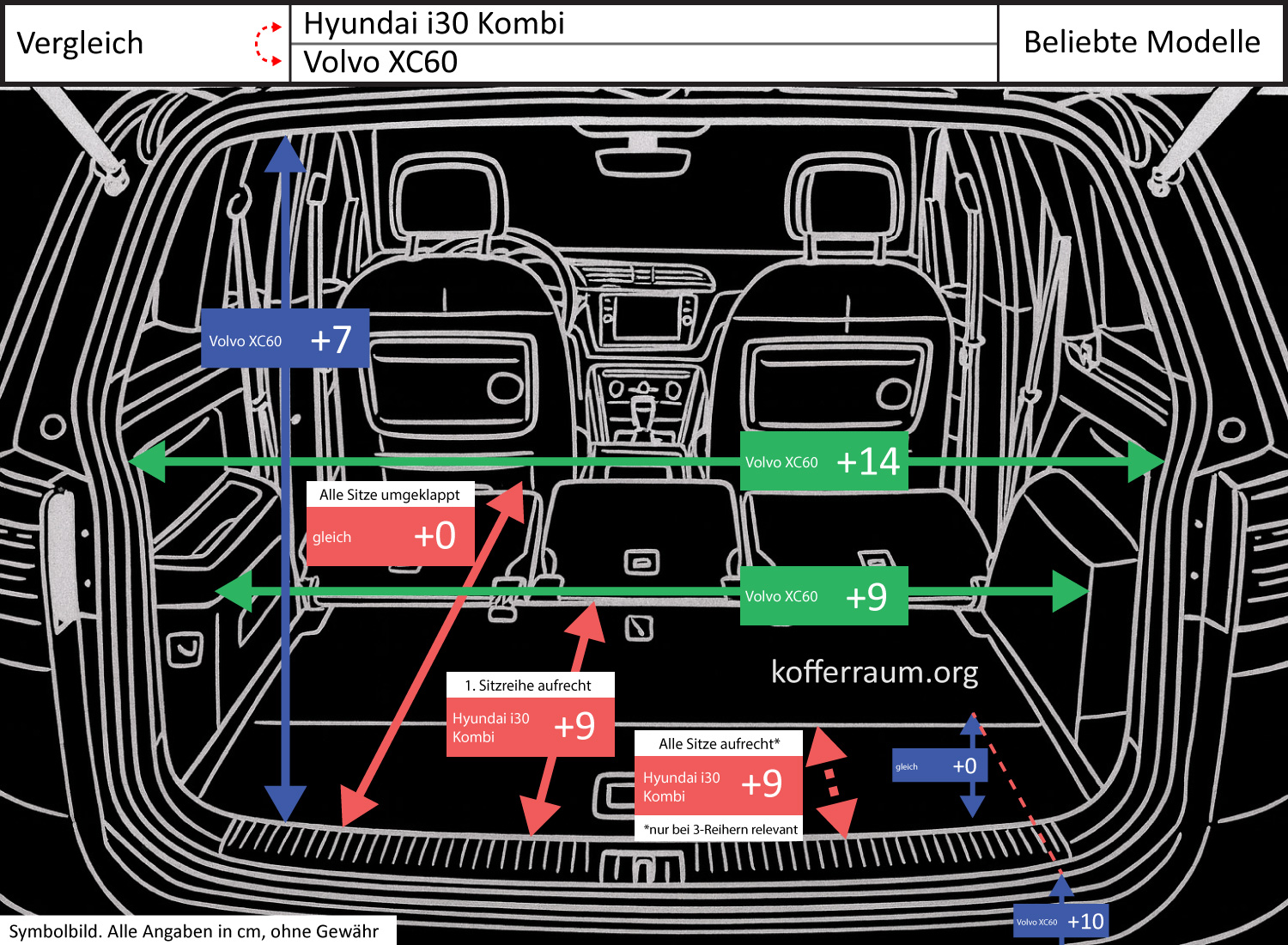
Both models have the same trunk length and the same depth (loading edge → floor) with the rear seats folded down.
When the rear seat row is upright, the Hyundai i30 Wagon offers a slightly longer cargo space (+3.5 in / 9%) than the Volvo XC60, which makes transporting longer, flat items without folding the seats somewhat easier.
The loading edge of the Volvo XC60 is significantly higher (+3.9 in / 16%) than that of the Hyundai. This means heavy or bulky cargo must be lifted higher in the Volvo, making loading and unloading more difficult—especially with regular use or for people with limited strength.
A higher loading edge can also mean more ground clearance; however, for pure usability when loading, it is disadvantageous.
The width of the trunk opening on the Volvo is significantly larger (+5.5 in / 14%). This makes it easier to load wide or bulky items.
Combined with the generally greater width at the narrowest point (+3.5 in / 9% in favor of Volvo, just under the 10% mark), the Volvo is better suited for bulky, wide cargo such as strollers, large boxes, or furniture, provided that lifting over the higher loading edge is not an obstacle.
In summary: For frequent transport of heavy items or comfortable loading with limited strength, the Hyundai i30 Wagon is advantageous due to the lower loading edge.
For transporting wider or more voluminous cargo, the Volvo XC60 offers practical benefits thanks to the wider opening and overall greater width, despite the higher loading edge.