
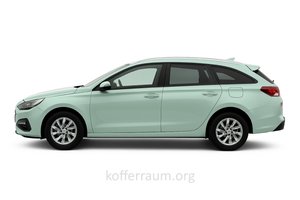
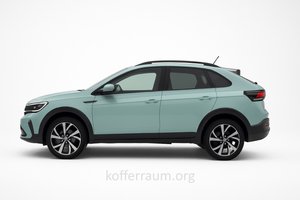
Trunk comparison: Hyundai Elantra GT Wagon vs VW Taigo
Key Differences (≥10%)
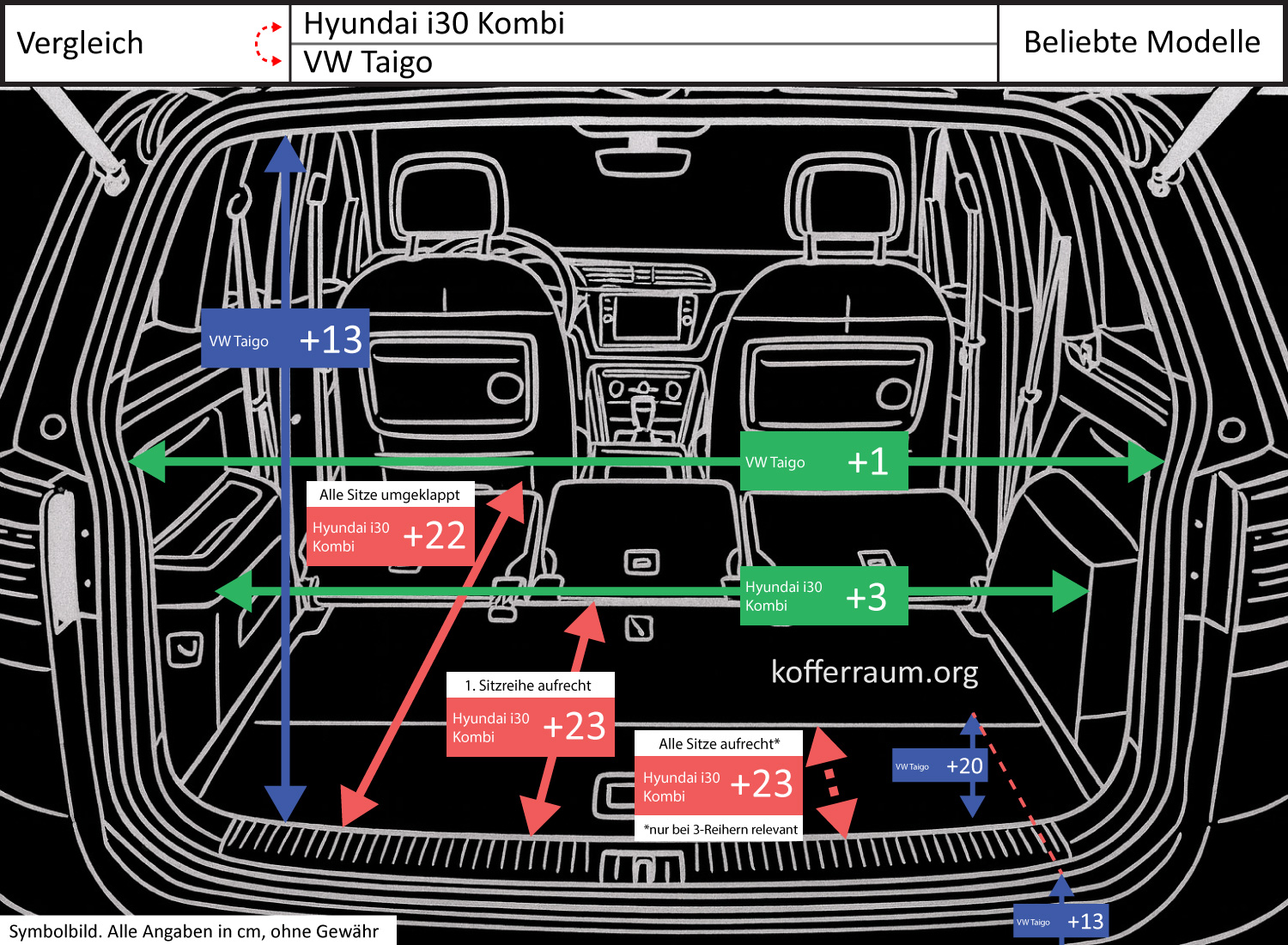
The Hyundai i30 Wagon offers significantly more loading length: +8.7 in (14%) with the seats folded down and +9.1 in (28%) with the first row upright compared to the VW Taigo.
The VW Taigo has greater vertical accessibility: the height of the trunk opening is +5.1 in (19%) higher, the depth between the loading edge and trunk floor is +7.9 in (1900%) greater, and the loading edge itself is +5.1 in (21%) higher above the road than in the i30.
Implications for Usability
Loading length (Hyundai i30 Wagon): The significantly greater length makes the i30 Wagon more practical for long items (e.g., slats, skis, furniture parts). If you regularly need to transport longer loads or want a loading area with as continuous a floor as possible, the i30 is clearly advantageous.
Vertical capacity and handling (VW Taigo): The higher trunk opening and greater depth from edge to floor facilitate handling tall or bulky items that need to be loaded standing up or upright.
However, the Taigo's loading edge is significantly higher — meaning heavy or bulky items must be lifted higher when loading, making loading and unloading more strenuous and less ergonomic.
Practical summary: - For longer, flat, or heavy items, the i30 Wagon is overall more practical (more length + lower loading edge). - For tall, bulky items or when more vertical space at the opening is needed, the Taigo offers advantages but pays for these with a higher loading edge and thus more difficult lifting.
Smaller Differences (<10%)
The width at the narrowest point is 1.2 in (+3%) greater in the i30, and the width of the trunk opening is only 0.4 in (+1%) greater in the Taigo. These differences are minor and usually negligible in everyday use.