
Trunk comparison: Hyundai IONIQ vs Durchschnitt Subcompact
Key Differences
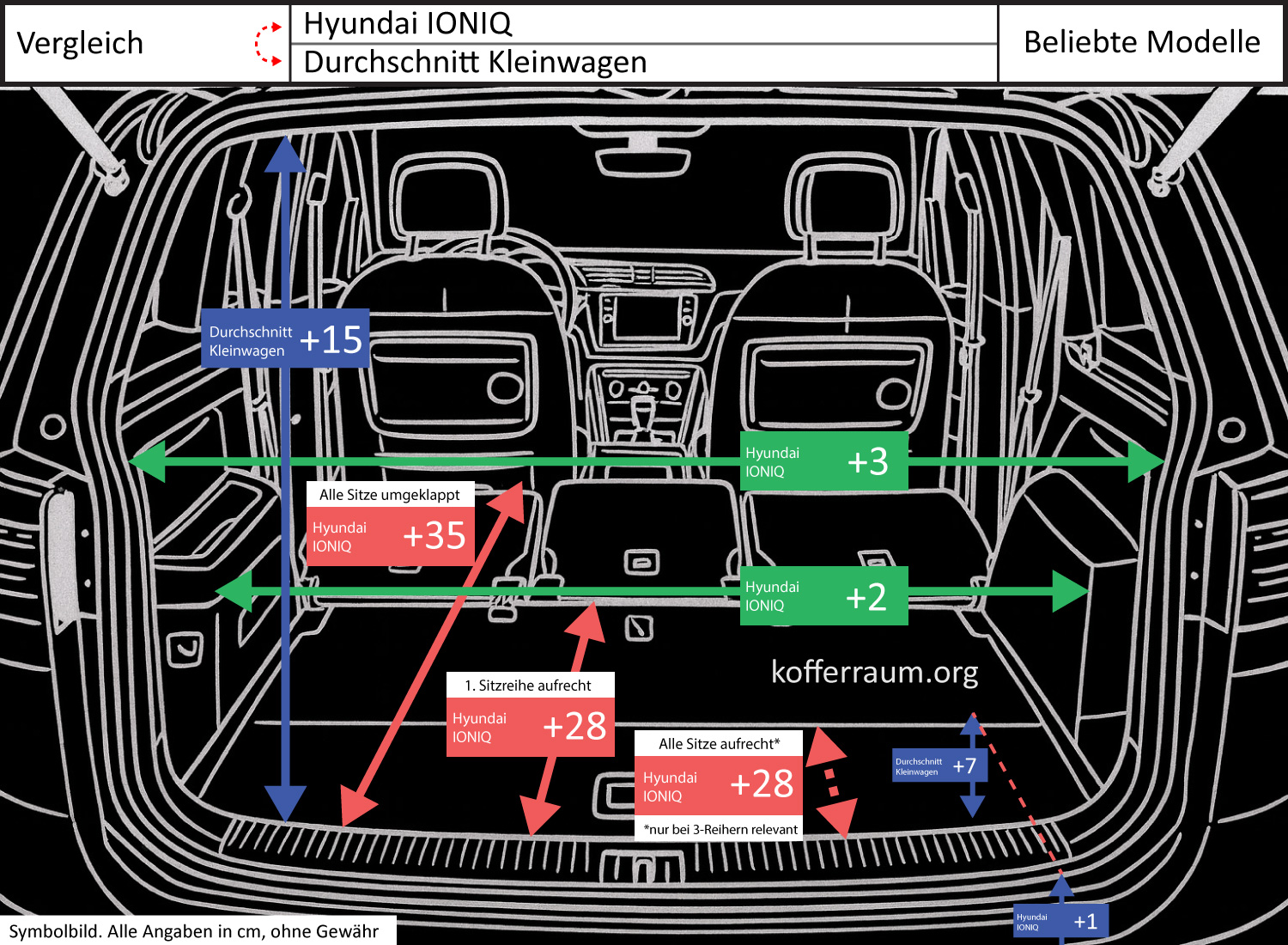
In terms of cargo space, the Hyundai IONIQ offers clear length advantages: with the seats folded down, the IONIQ's trunk is 13.8 in (27%) longer, and with the first row of seats upright, it is even 11 in (44%) longer than the average subcompact.
In contrast, the average subcompact has a significantly higher trunk opening: the opening is 5.9 in (23%) taller. Additionally, the depth (distance from loading edge to trunk floor) of the average subcompact is 2.8 in (58%) greater than that of the IONIQ.
Impact on Usability
The greater cargo length of the IONIQ makes it clearly better suited for long items (e.g., boards, skis, long boxes) and for storing larger amounts of luggage along the vehicle's longitudinal axis — both with folded seats and in everyday use with the seat row upright.
This means more flexibility when transporting long or flat loads.
The higher trunk opening and greater depth of the average subcompact, on the other hand, favor loading tall or bulky items: the higher opening makes it easier to load bulky goods standing up, and the deeper cargo well offers more usable vertical space or a "deeper" storage compartment.
This can be practical when transporting crates, beverage cases, or tall boxes.
The other differences (loading edge height +1%, narrowest width +2%, opening width +3%) are minor and hardly noticeable in practice.
Conclusion: IONIQ = advantage in length and flat, elongated cargo. Average subcompact = advantage in vertical capacity and handling tall, bulky items.