
Trunk comparison: Hyundai IONIQ vs Renault Clio
Key Differences
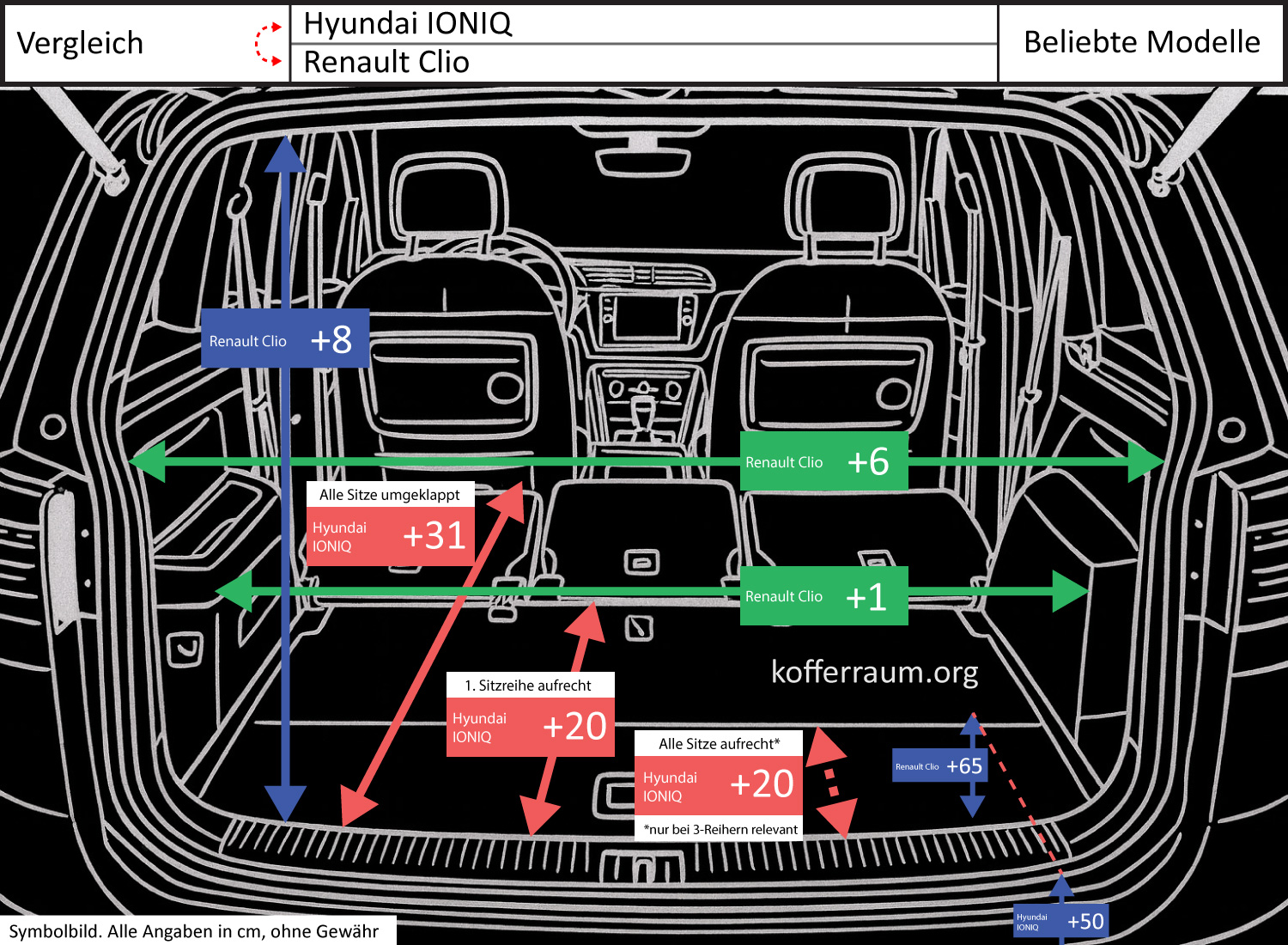
The Hyundai IONIQ offers significantly more loading length: with the seats folded down, the trunk is +12.2 in (23%) longer, and with the front seats upright, it is +7.9 in (28%) longer than the Renault Clio.
The Renault Clio, on the other hand, has a higher opening and a deeper cargo well: the height of the trunk opening is +3.1 in (12%) higher than the IONIQ, and the depth of the trunk (loading edge to trunk floor) is +25.6 in (542%) greater.
The loading edge of the IONIQ is +19.7 in (208%) higher above the road than the Clio. Width differences are marginal: the narrowest point is only +0.4 in (1%) wider on the Clio, and the opening width on the Clio is +2.4 in (6%) wider — both under 10% and negligible for most uses.
What impact does this have on usability?
- Longer loading area in the IONIQ: Due to the significantly greater loading length, the IONIQ is better suited for long items (e.g., skis, slats, long packages, or small furniture). Even when transporting long, flat luggage, there is more space in the IONIQ without needing to completely remove seats.
- Lower loading edge and deeper cargo well in the Clio: The significantly lower loading edge in the Clio makes lifting heavy items easier — loading and unloading is more ergonomic.
The much greater depth (loading edge → floor) means items sit deeper and can be stacked more tightly; this can reduce shifting and is suitable for tall cargo placed below the opening.
However, a very deep trunk floor can make removing very flat or heavy items more difficult because you have to reach further into the interior.
- Higher trunk opening in the Clio: The +3.1 in higher opening facilitates inserting tall or bulky items through the opening; combined with the deeper cargo well, this often results in more usable vertical clearance at the loading point.
- Ergonomics vs. cargo space shape: The IONIQ scores with straightforward usable length — ideal for long loads. The Clio scores with better lifting ergonomics (lower loading edge) and a deeper cargo well, which is advantageous for bulky or taller stacks.
Which configuration is better depends on the preferred use: long, flat goods → IONIQ; frequent lifting of heavy items or tall/bulky loads with limited width → Clio.
- Width: Since the width differences are small (<10%), they hardly affect usability in practice.