
Trunk comparison: Hyundai IONIQ vs Skoda Elroq

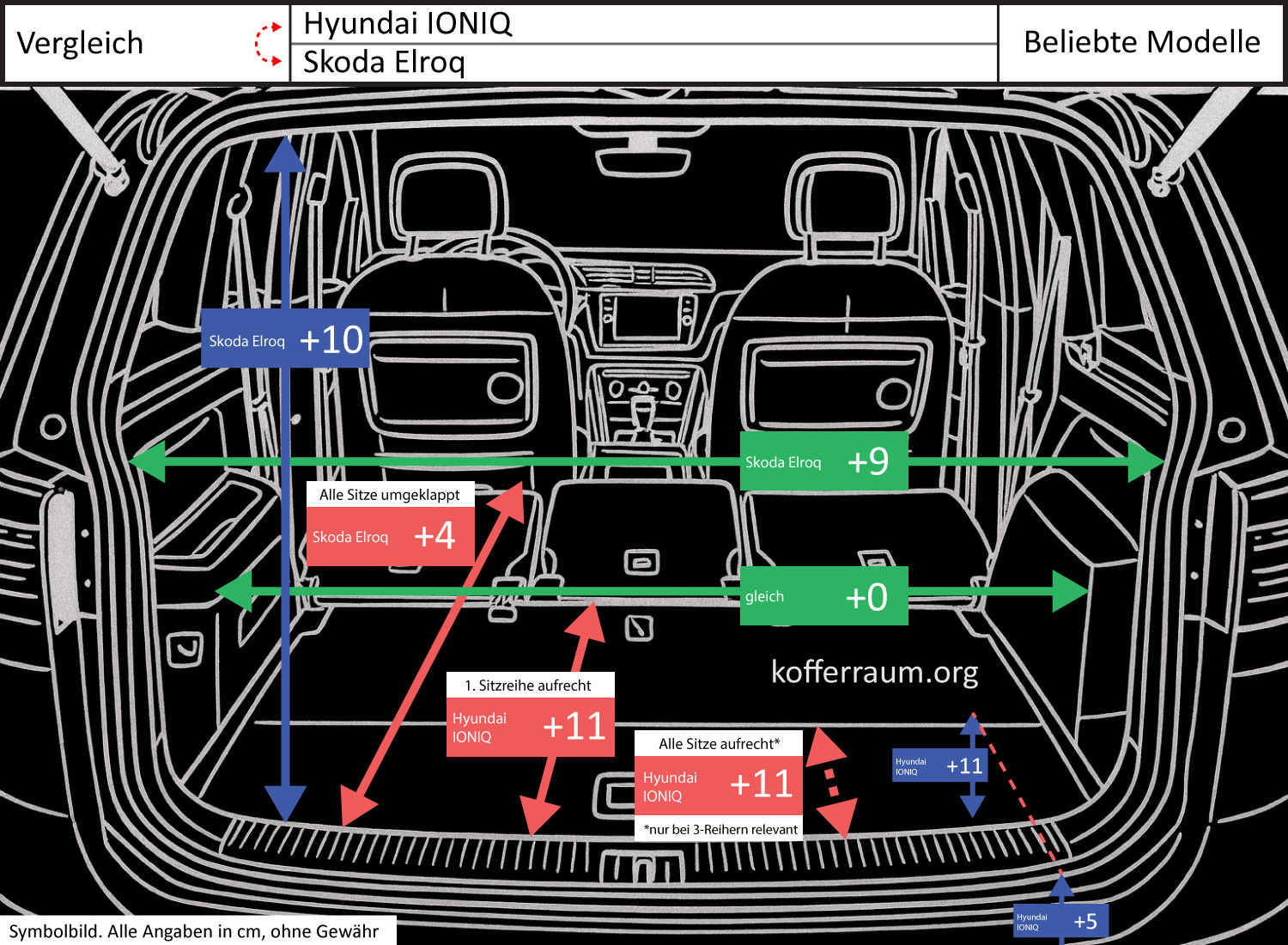
Trunk length with rear seats upright (Hyundai IONIQ: +4.3 in / +14%)
With the rear seats upright, the Hyundai IONIQ offers about 4.3 in (14%) more trunk length than the Škoda Elroq.
This makes the IONIQ more practical for long items that need to be transported without folding the seats down (e.g., skis, long boxes, or furniture parts). The Elroq only reaches comparable lengths with the seats folded down.
Height of the trunk opening (Škoda Elroq: +3.9 in / +15%)
The opening of the Elroq is about 3.9 in (15%) higher than that of the IONIQ. This makes loading tall or bulky items easier and improves ergonomics when loading while standing.
For tall crates, plants, or bulky car parts, the Elroq is more convenient in everyday use; the IONIQ limits the maximum height of loadable items more.
Depth of the trunk (loading edge → floor) (Hyundai IONIQ: +4.3 in / +1100%)
The Hyundai IONIQ has a significantly greater depth from the loading edge area to the trunk floor—indicated as +4.3 in (shown here as +1100%).
Practically, this means more usable interior space below the loading edge and a deeper floor: volume and center of gravity are improved, items can be recessed or concealed deeper.
Conversely, lifting heavy loads over the loading edge requires more strength and bending, and unloading can be less comfortable. In practice, the IONIQ is better suited for larger volumes, the Elroq for lighter, more ergonomic loading.
Additional notes (smaller differences)
The width at the narrowest point is the same. The Elroq has a trunk opening that is 3.5 in (about 10%) wider—just shy of the 10% mark, so not highlighted as significant. With the rear seats fully folded down, the Elroq leads by only 1.6 in (2%), which hardly matters in everyday use.
The loading edge of the IONIQ sits about 2 in (7%) higher above the road, which can make lifting slightly harder, but remains under 10% and is therefore less significant.