
Trunk comparison: Hyundai IONIQ vs Skoda Superb Wagon
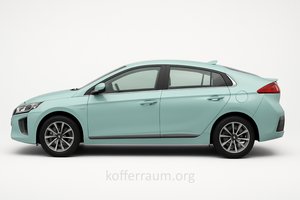
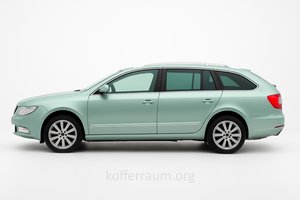
Key Differences
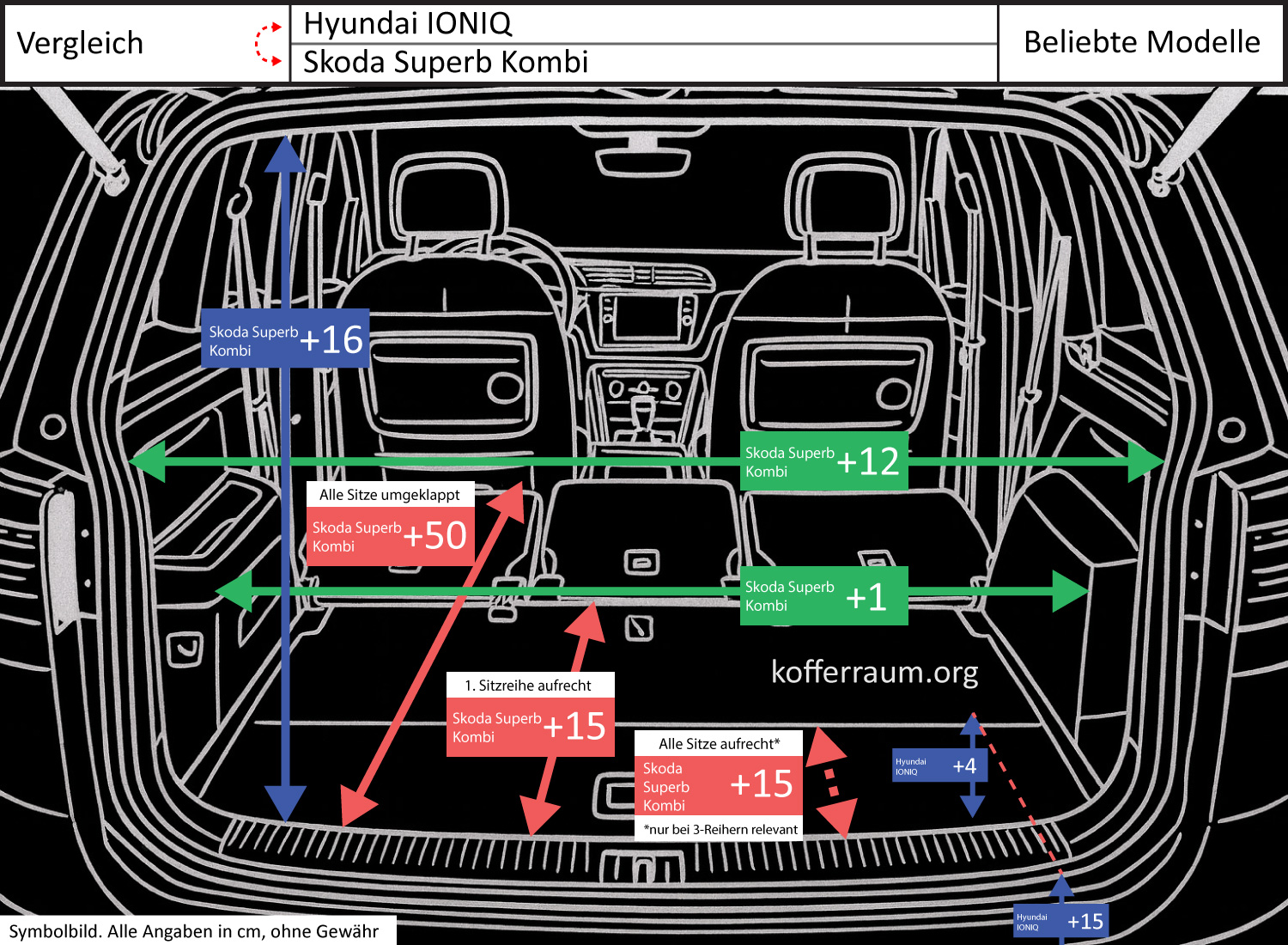
The Škoda Superb Wagon offers significantly more usable cargo space in length: with the seats folded down, the trunk is +19.7 in (31%) longer, and with the first row of seats upright, +5.9 in (16%) longer than the Hyundai IONIQ.
The trunk opening of the Superb is also higher: the opening height of the Superb is +6.3 in (24%) above that of the IONIQ, and the width of the opening is +4.7 in (13%) larger.
In contrast, the Hyundai IONIQ has a deeper trunk floor relative to the loading edge: the depth (loading edge → trunk floor) is +1.6 in (50%) greater in the IONIQ.
Additionally, the loading edge of the IONIQ sits +5.9 in (25%) higher above the road. The narrowest width of the trunk differs hardly at all (+0.4 in / 1% in favor of the Superb).
Impact on Usability
For long or bulky items (e.g., furniture, slats, skis), the Superb is clearly advantageous: the significantly greater interior length with folded seats and the wider and higher opening make it easier to load, slide in, and store longer/taller parts.
The higher opening reduces congestion and bending issues when loading tall cargo.
When loading heavy items, the lower loading edge of the Superb plays a major role: because the loading edge of the IONIQ is +5.9 in (25%) higher, lifting over the edge is more strenuous there.
The deeper trunk floor of the IONIQ (greater depth from loading edge to floor) can accommodate more volume in a vertical area or “sink” small items, but makes lifting in and out less ergonomic because more lifting height must be overcome.
In summary: Those who frequently transport long, wide, or heavy cargo and value easy loading and unloading benefit more from the Škoda Superb Wagon.
The Hyundai IONIQ, on the other hand, offers a deeper trunk area that can be useful for recessed or hidden cargo but is less practical for bulky and heavy loads due to the higher loading edge and narrower opening.