
Trunk comparison: Hyundai IONIQ vs Volvo V90
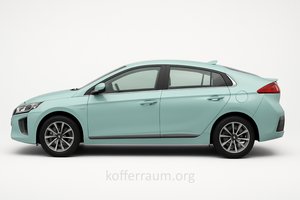
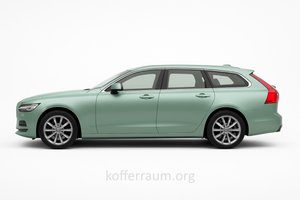
Main Differences
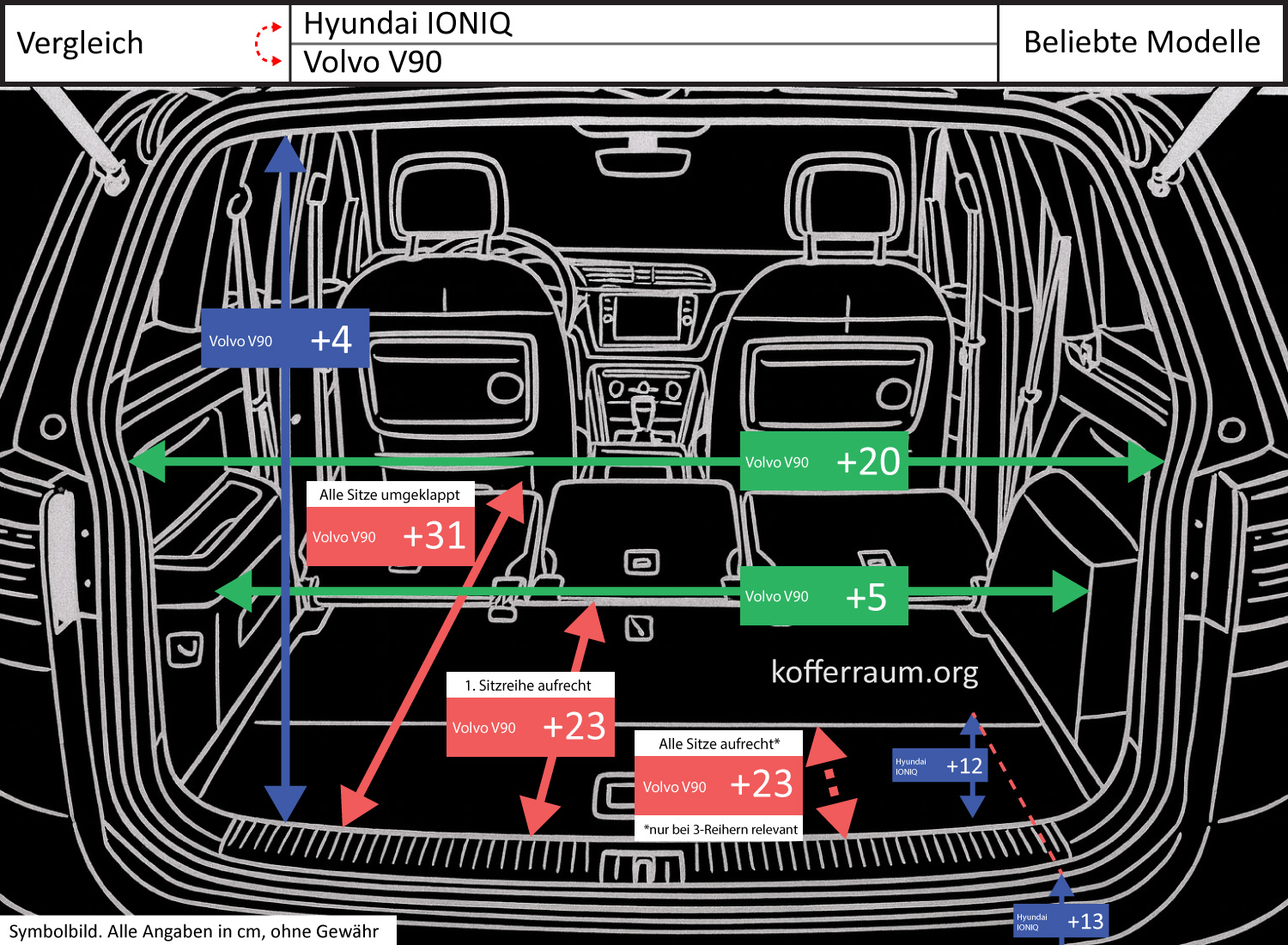
The Volvo V90 offers significantly more cargo space in length: with the seats folded down, the trunk of the V90 is 12.2 in (19%) longer, and with the first row of seats upright, the advantage is 9.1 in (25%).
The width of the trunk opening is 7.9 in (21%) larger on the V90. In contrast, the Hyundai IONIQ has a significantly greater trunk depth (distance from loading edge to trunk floor): the IONIQ exceeds the V90 by 4.7 in (1100%) here.
Additionally, the loading edge of the IONIQ sits 5.1 in (21%) higher above the road than that of the V90.
Impact on Usability
Volvo V90 — Advantages in length and opening: Due to the longer loading area (each +19% and +25%) and the +7.9 in wider opening, the V90 is better suited for long or bulky items (e.g., furniture parts, long boards, skis) as well as for easily sliding wide objects through.
The lower loading edge also makes loading heavy loads easier as less lifting force is required.
Hyundai IONIQ — Advantages in depth, disadvantages when loading: The greater trunk depth means more vertical space below the loading edge, which is useful when stacking boxes or for low-lying loads; items can be further "recessed." However, the loading edge of the IONIQ is significantly higher (+5.1 in), which makes lifting heavy or bulky loads more difficult and loading less convenient.
For frequent loading of heavy loads or very long items, the IONIQ is therefore less comfortable.
Conclusion: For transport tasks involving long or wide items and for easy loading, the Volvo V90 is clearly advantageous. The Hyundai IONIQ offers benefits in interior depth for cargo volume and secure storage of low-lying loads but suffers from the higher loading edge when loading and unloading.