
Trunk comparison: Hyundai IONIQ vs VW ID.3
Key Differences
The most noticeable differences concern the usable length and the vertical dimensions of the trunk.
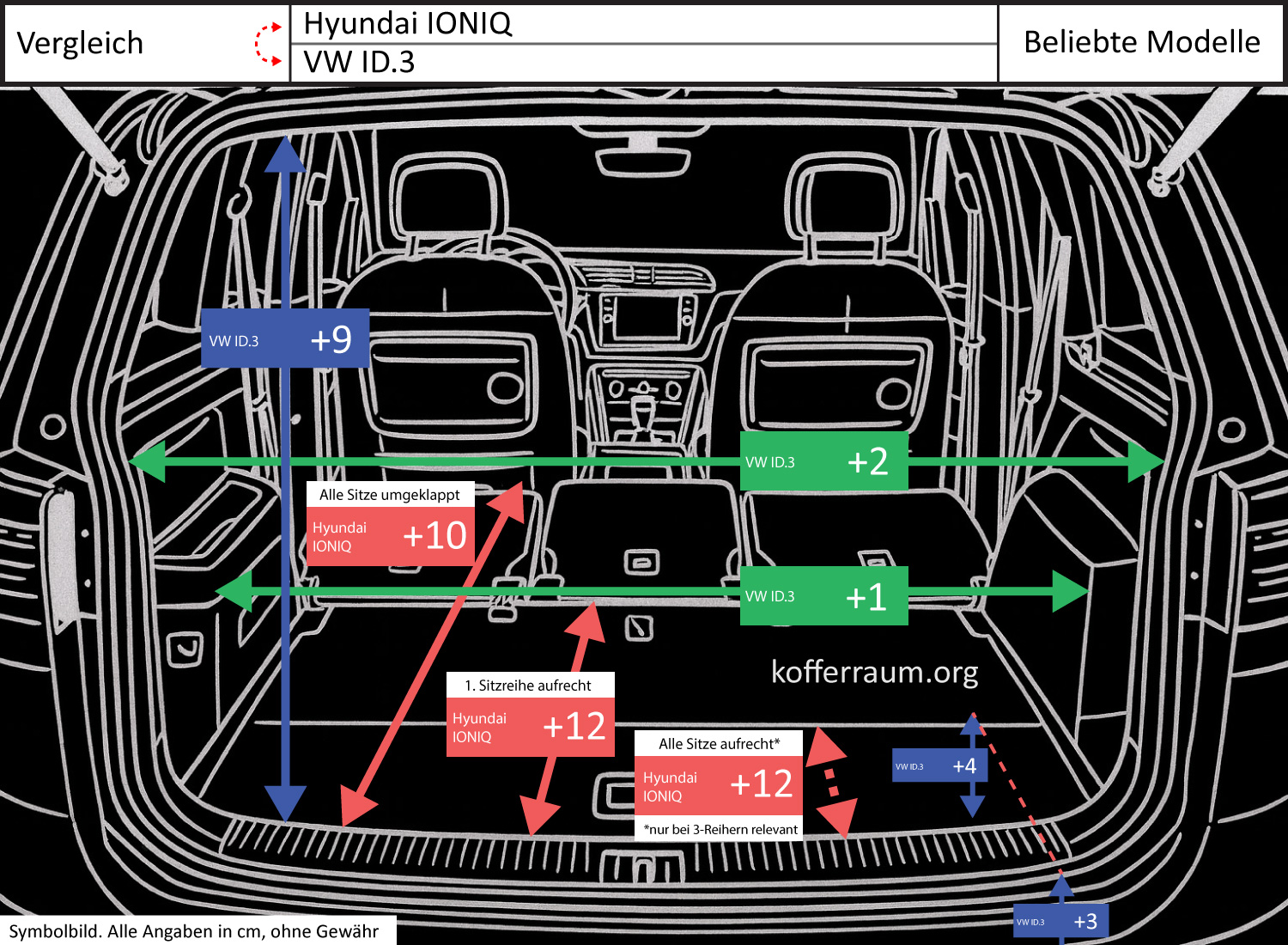
The Hyundai IONIQ offers a +4.7 in (15%) longer cargo area with the front seats upright than the VW ID.3, while the VW ID.3 has a +3.5 in (14%) higher trunk opening and a +1.6 in (33%) deeper trunk well (distance from loading edge to trunk floor).
Smaller deviations: with the seats folded down, the IONIQ is only +3.9 in (7%) longer, the loading edge of the ID.3 is +1.2 in (4%) higher, and the width differences between both models are 1–0.8 in.
Impact on Usability
Due to the greater usable length with the rear bench upright, the IONIQ is better suited for transporting longer items when the rear seats remain occupied (e.g., skis, long boxes, or furniture parts). This means less folding of the seats and more practical loading solutions for length-intensive cargo.
The ID.3, on the other hand, scores with height- and volume-intensive cargo: the higher trunk opening makes it easier to load tall or bulky items without having to tilt them significantly.
The significantly deeper trunk well increases the usable volume vertically and allows for a higher package or stacking volume behind the loading edge. Together, these features make the ID.3 more practical for suitcases, boxes, or bulky household items that require more interior height.
The other differences (loading edge height, width) are minor and have little impact on everyday use. In summary: IONIQ = advantage in usable length with rear bench in place; ID.3 = advantage in loading height, interior height, and thus in transporting tall/bulky cargo.