
Trunk comparison: Hyundai IONIQ vs VW ID.4
Trunk and Opening Dimensions — Key Differences
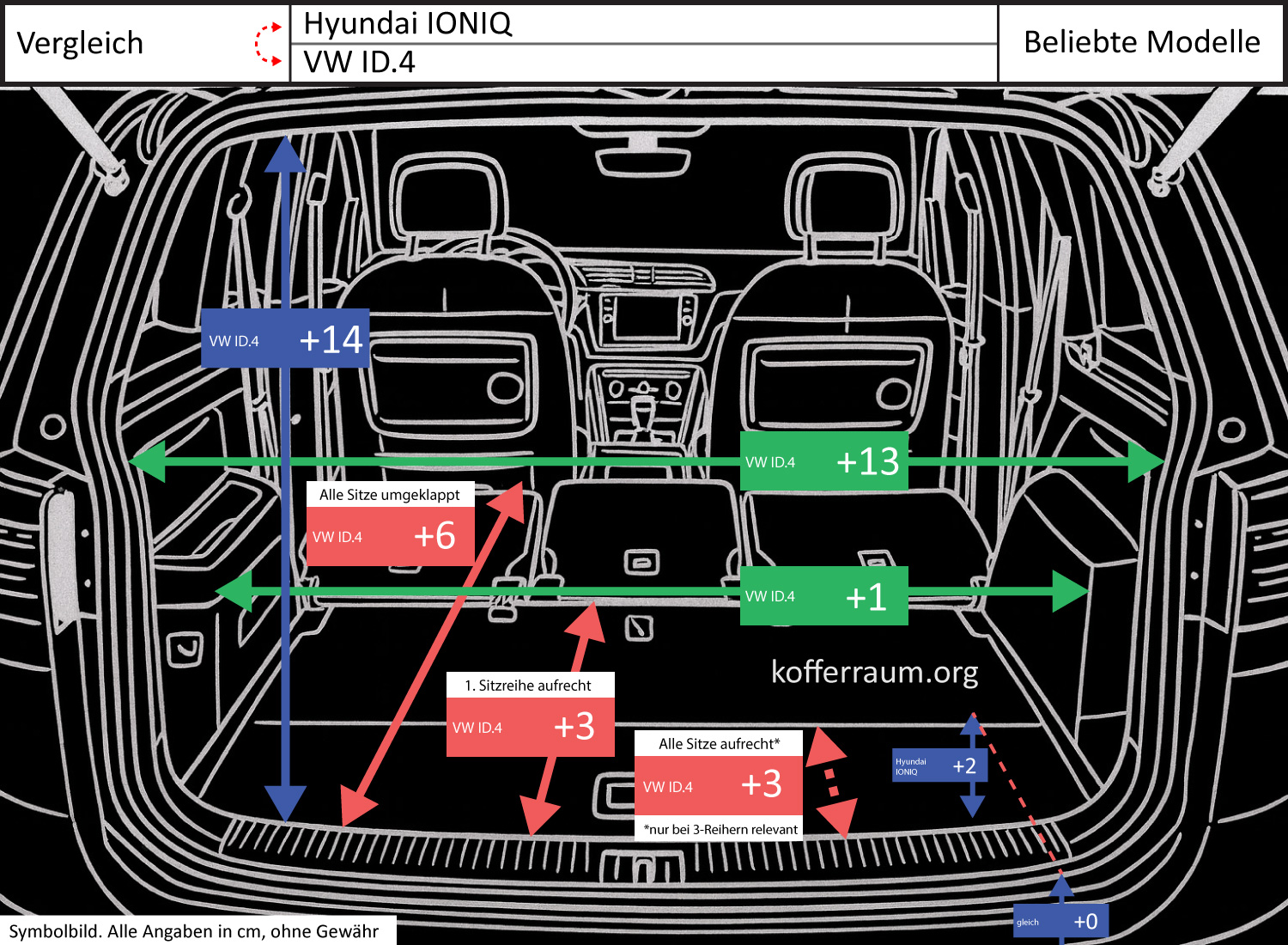
Significant differences concern the trunk opening, the depth from the loading edge to the trunk floor, and the width of the trunk opening.
The opening height of the VW ID.4 is 5.5 in or 21% larger than that of the Hyundai IONIQ. The depth of the trunk (loading edge to trunk floor) is 0.8 in or 20% larger in the Hyundai IONIQ than in the VW ID.4.
The width of the trunk opening of the VW ID.4 is 5.1 in or 14% larger than that of the Hyundai IONIQ.
Impact on Usability
The higher opening on the ID.4 (≈21%) significantly eases loading and unloading bulky or tall items — e.g., crates, bicycles with the front wheel removed, or furniture pieces limited in height. A larger opening reduces twisting when lifting items in and makes loading with a ramp or board easier.
The greater depth in the IONIQ (≈20%) means more space between the loading edge and the floor.
This facilitates stacking taller items directly behind the loading edge and creates a slightly deeper cargo area for items that need to stand upright. A downside: items lying deeper can be harder to reach if they are positioned far forward.
The wider trunk opening of the ID.4 (≈14%) allows loading wider items without maneuvering and is advantageous for bulky, flat parts or larger boxes. Overall, the combination of a wider and taller opening makes the ID.4 more practical for transporting large, bulky, or wide-format cargo.
Smaller differences (length with folded seats +2.4 in / 4%, length with front seats upright +1.2 in / 3%, narrowest width +0.4 in / 1%) as well as the equally high loading edge have only minor practical effects and hardly change the fundamental usability.