
Trunk comparison: Hyundai IONIQ vs VW Passat Wagon
Main Differences (sizes >10% highlighted)
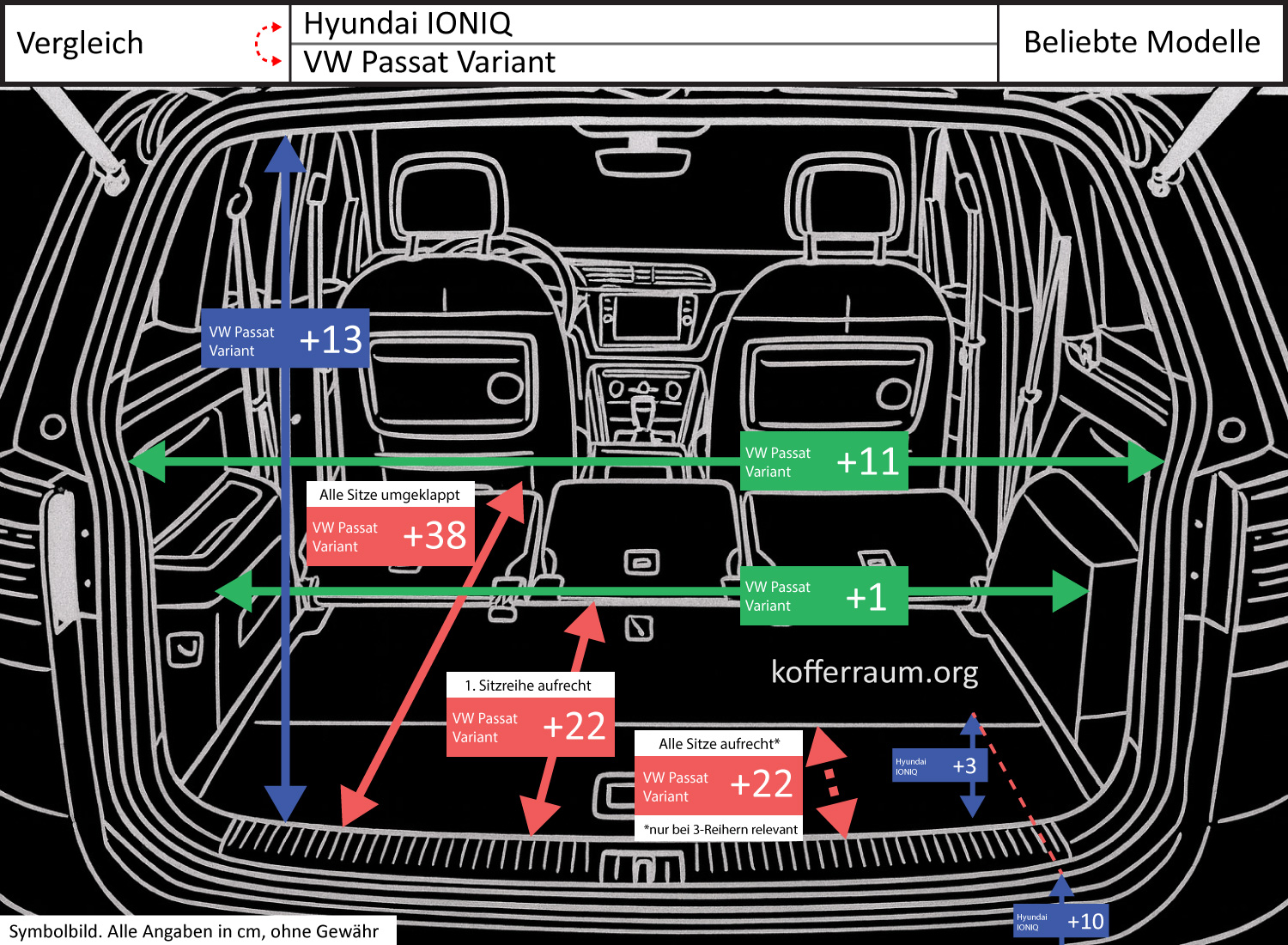
The VW Passat Wagon offers significantly more cargo length: with the seats folded down, the trunk is 15 in (+23%) longer, and with the first row of seats upright, it is 8.7 in (+24%) longer than the Hyundai IONIQ.
The trunk opening of the Passat is noticeably larger: the opening height is 5.1 in (+20%) above that of the IONIQ, and the opening width is 4.3 in (+12%) wider.
In contrast, the Hyundai IONIQ has a trunk depth (loading edge to trunk floor) that is 1.2 in (+33%) greater, and the loading edge sits 3.9 in (+16%) higher above the road. The minimum width in the trunk differs by only 0.4 in (≈1%) and is therefore negligible.
What impact do these differences have on usability?
For long or bulky items (skis, long furniture parts, slats, pipes), the Passat is clearly advantageous: the greater cargo length both with folded and upright seats plus the larger opening height and width make it easier to load, align, and store long and wide cargo.
Practically, this means less repositioning, easier pushing of longer parts fully inside, and more usable space for bulky transports.
In the Hyundai IONIQ, the greater trunk depth (loading edge → floor) provides room for slightly deeper storage of cargo directly behind the loading edge.
This allows certain items to be positioned slightly lower, can help when transporting tall items within the side walls, and increases the usable interior height at the loading edge.
However, the higher loading edge in the IONIQ makes lifting heavier items onto the loading sill more difficult; loading requires more strength and precision than the lower loading floor of the Passat.
In summary: Those who frequently transport long or wide loads or value easy loading and unloading benefit from the VW Passat Wagon.
Those who want to work with a slightly lower loading floor and slightly different loading geometries may find advantages in the Hyundai IONIQ — however, the higher loading edge and significantly shorter lengths noticeably limit its suitability for large-volume long transports.