
Trunk comparison: Hyundai IONIQ vs VW T-Cross
Key Differences
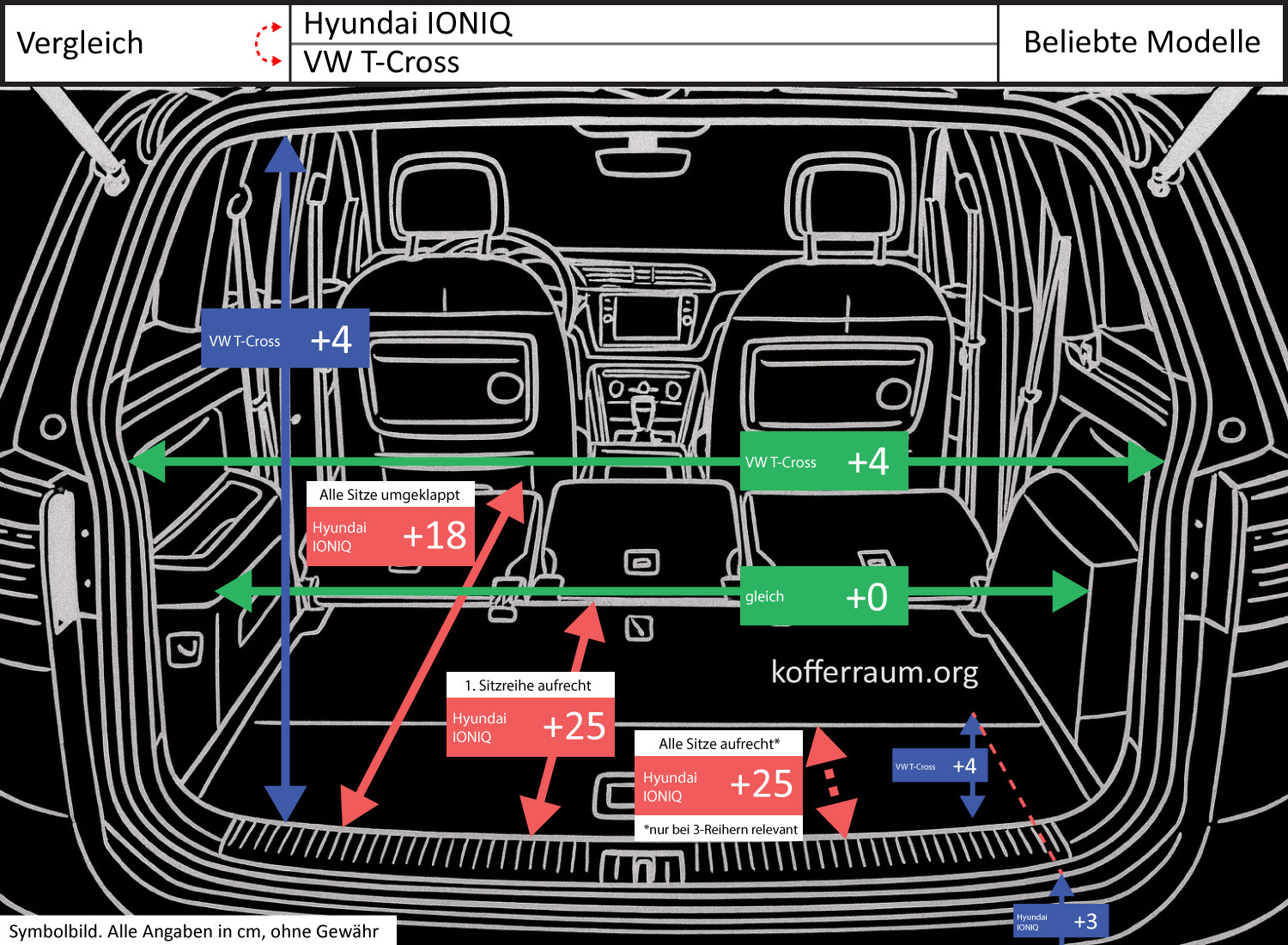
The Hyundai IONIQ offers significantly more length in the cargo space: with the seats folded down, the trunk is 7.1 in (≈12%) longer and with the first row of seats upright, even 9.8 in (≈38%) longer than the VW T-Cross.
In terms of volume profile, the T-Cross differs in depth: the distance from the loading edge to the trunk floor is 1.6 in (≈33%) greater in the VW. All other differences (e.g., opening height, loading edge height, width of the opening) are below the 10% threshold and comparatively minor.
Impact on Usability
Because the IONIQ offers a significantly longer loading surface, longer items can be transported more easily—even when the rear seats are not folded down.
This makes the IONIQ more practical for skis, slats, long boxes, or bulky luggage with passengers in the back seats. The greater length with folded seats also increases flexibility for moves or transporting long furniture pieces.
The greater depth in the T-Cross means more "depth" below the loading edge: the vehicle accommodates items better vertically (stackable bags, boxes, taller items that fit under the tailgate). However, the shorter loading length reduces suitability for very long items compared to the IONIQ.
Practical consequence: Those who frequently transport long items or often use the rear bench as an extension of the cargo space benefit from the Hyundai IONIQ.
Those who prefer more voluminous, stackable cargo and a deeper trunk floor are well served by the VW T-Cross. Smaller differences like a slightly higher opening height or a marginally higher loading edge only marginally affect daily usability.