
Trunk comparison: Hyundai IONIQ vs VW T-Roc
Key Differences
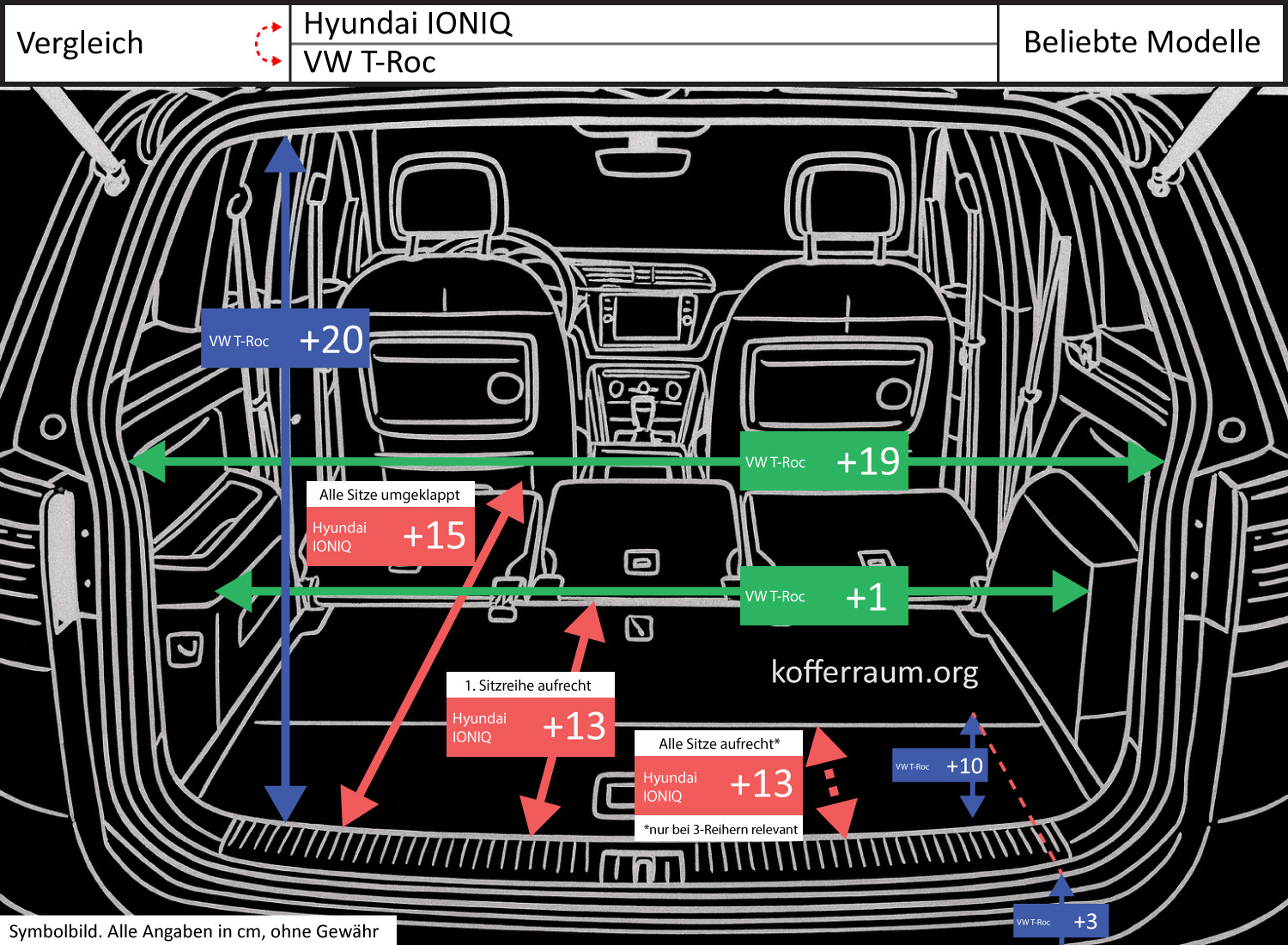
The Hyundai IONIQ offers a longer cargo area: with the front seats upright, the trunk is 5.1 in (17%) longer than in the VW T-Roc, and with the seats fully folded down, the advantage is +5.9 in (10%).
In contrast, the VW T-Roc leads in pass-through and accessibility: the height of the trunk opening is 7.9 in (30%) greater, the depth of the cargo space (loading edge to trunk floor) is 3.9 in (83%) greater, and the width of the trunk opening is 7.5 in (20%) wider.
Smaller differences: the loading edge of the T-Roc is +1.2 in (4%) higher and the narrowest interior width of the trunk is only +0.4 in (1%) larger in the T-Roc.
Impact on Usability
For long items (e.g., slats, skis, long boxes), the IONIQ is more practical: the greater depth/length of the cargo space—especially with the front seats upright—allows storing longer loads without folding seats or with minimal folding.
This makes the IONIQ more advantageous for regular transport of long, slender items.
The T-Roc, on the other hand, is better suited for bulky, tall, or wide cargo. The significantly larger height of the trunk opening and the wider opening make loading bulky or tall items and luggage easier; the greater "depth" (distance from loading edge to floor) creates additional vertical space in the cargo area.
However, a higher floor level below the loading edge makes lifting heavy items when loading somewhat more cumbersome, and the slightly higher loading edge (+1.2 in) increases the effort needed to lift items inside slightly.
In summary: Those who frequently transport long, flat loads benefit more from the IONIQ. Those who more often load wide, tall, or bulky items and value a generous opening are better served by the T-Roc.