
Trunk comparison: Hyundai IONIQ vs VW Taigo
Key Differences
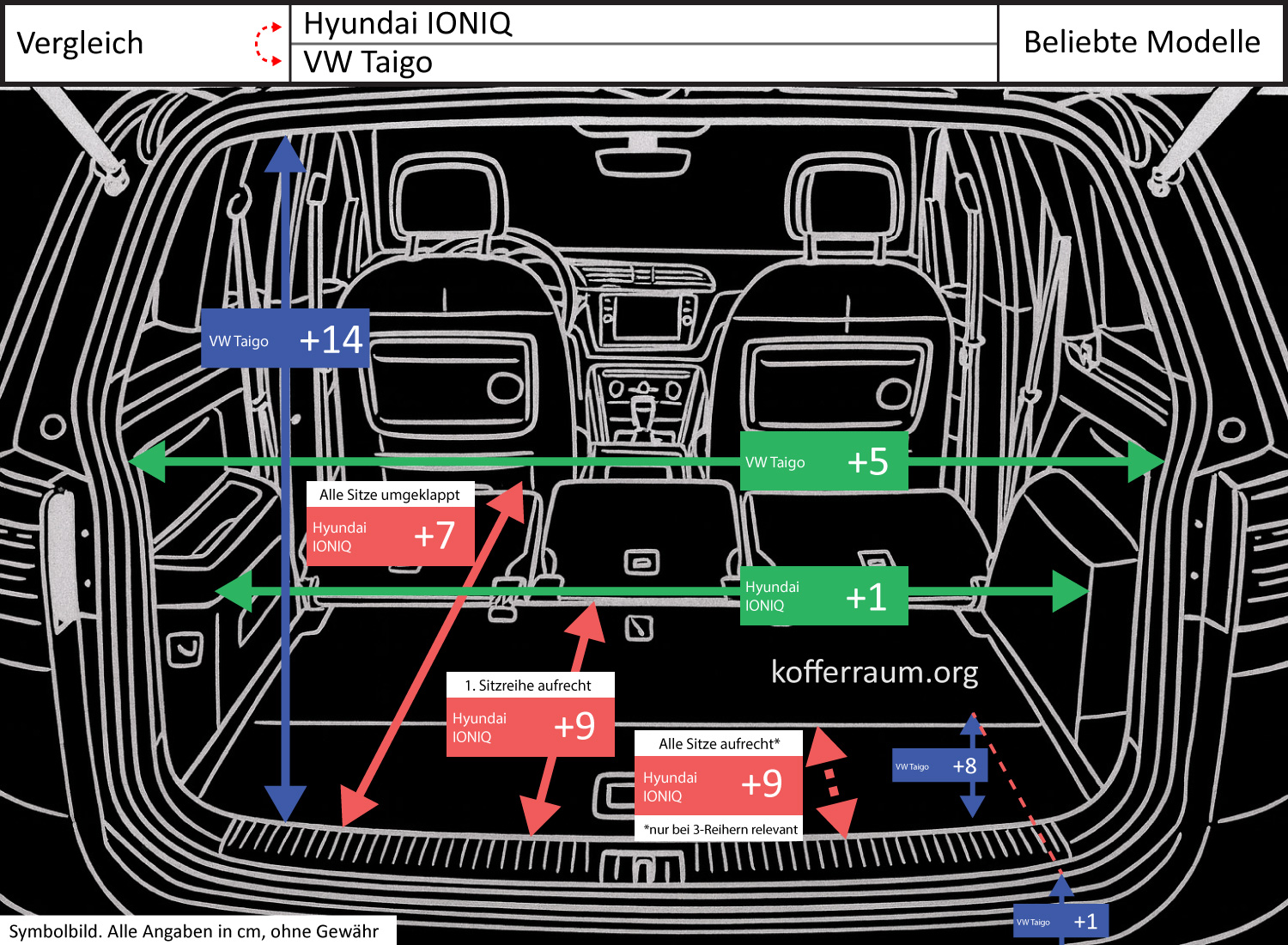
In a direct comparison, three clearly relevant differences stand out: The Hyundai IONIQ offers a cargo area that is +3.5 in (≈11%) longer with the first row of seats upright than the VW Taigo, while the VW Taigo has a significantly higher trunk opening and more space between the loading edge and the trunk floor — namely +5.5 in (≈21%) opening height and a deeper interior height of +3.1 in (≈67%) compared to the IONIQ.
The other differences are minor: the IONIQ has a +2.8 in (4%) longer cargo space with the seats folded down, the loading edge of the Taigo is only +0.4 in (1%) higher, the narrowest width is +0.4 in (1%) greater in the IONIQ, and the opening width in the Taigo is +2 in (5%) larger.
Impact on Usability
The larger values in the Taigo (opening height +21% and interior depth +67%) make it advantageous in everyday use for tall or bulky items: boxes, tall suitcases, bulky shopping loads, or bulky furniture parts can be more easily loaded through the higher opening and placed further inside without blocking the hatch.
The +2 in wider opening also supports loading wider items. The slightly higher loading edge (+0.4 in) is a minor disadvantage when lifting heavy objects but is practically negligible.
The IONIQ scores especially when long items need to be transported and the rear seats remain in use: with +3.5 in (11%) longer loading length with the first row upright, longer skis, slats, or boards can be accommodated more easily.
Its slightly lower loading edge makes lifting heavy luggage slightly more comfortable. The only marginally longer cargo space with folded seats (+2.8 in/4%) is not a major advantage over the Taigo.
In summary: For tall and bulky cargo, the VW Taigo is more practical; for longer, flat items with occupied rear seats, the Hyundai IONIQ is the better choice. Smaller differences in width and loading edge are usually negligible in everyday use.