
Trunk comparison: Hyundai Kona vs Durchschnitt Subcompact


Key Differences
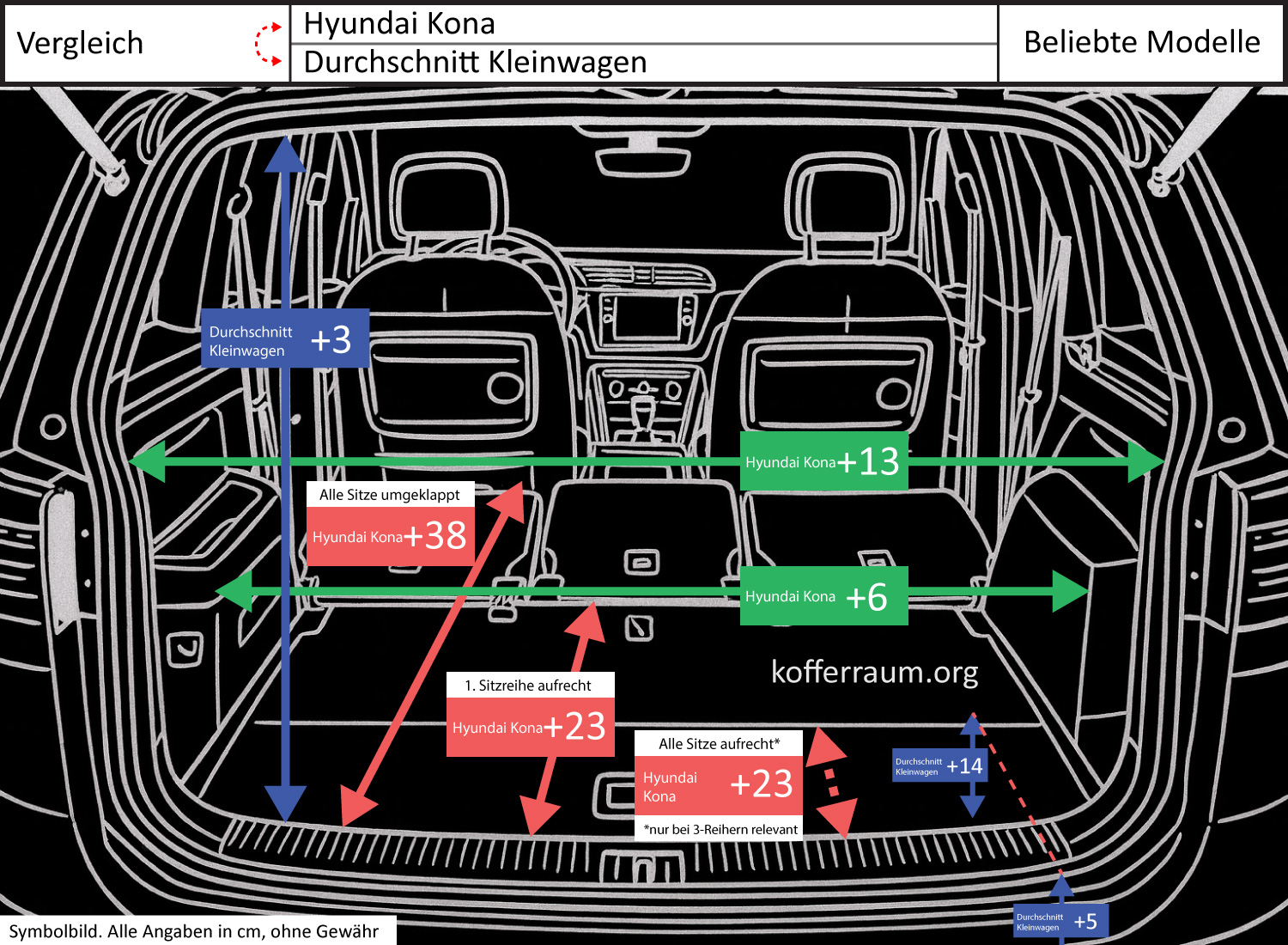
The Hyundai Kona offers significantly more usable length in the trunk: with the seats folded down, the Kona is +15 in (≈30%) longer, and with the first row upright, it is +9.1 in (≈37%) longer than the average subcompact.
The width of the trunk opening is also noticeably larger on the Kona: +5.1 in (≈14%). In contrast, the average subcompact has a significantly greater depth between the loading edge and the trunk floor: +5.5 in (≈280%) compared to the Kona.
Implications for Usability
Length advantage (Kona): The significantly larger loading surface in the longitudinal direction makes construction and everyday uses better suited for long items (e.g., furniture parts, skis, boards) and for flexible storage with folded or partially folded seats.
In everyday use, the greater length with the seats upright also means more space for suitcases, strollers, or groceries without folding the seats.
Wider opening (Kona): The 5.1 in wider trunk opening makes loading and unloading wider or bulky items much easier. Large suitcases, boxes, or furniture pieces can be more easily turned and lifted in.
Greater depth in the average (not Kona): The larger distance from the loading edge to the trunk floor in the average subcompact means the loading surface sits lower — this can create more space below the loading edge but also has disadvantages: heavy loading more often requires lowering/lifting over an edge, bulky items can catch on the edge when pulling in, and the usable flat loading surface is less comfortable for loading than the flatter Kona floor.
Smaller differences (less than 10%): Opening height (+4% in favor of the average), loading edge height (+7% in favor of the average), and narrowest width (+6% in favor of the Kona) exist but have only minor practical impact in everyday use.
Conclusion
For users who often transport long or wide items or frequently load larger quantities in daily use, the Hyundai Kona is more advantageous in practice due to its longer loading surface and wider opening.
The average subcompact offers a significantly deeper loading surface, which can create more "recessed" storage space but makes handling and loading bulky or heavy items more difficult.