
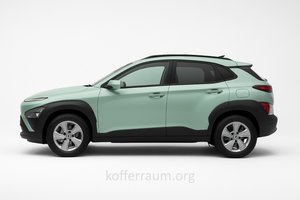
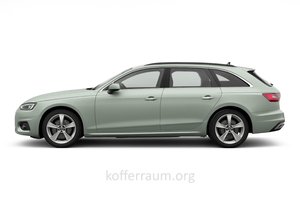
Trunk comparison: Hyundai Kona vs Durchschnitt Wagon
Summary of the Most Important Differences
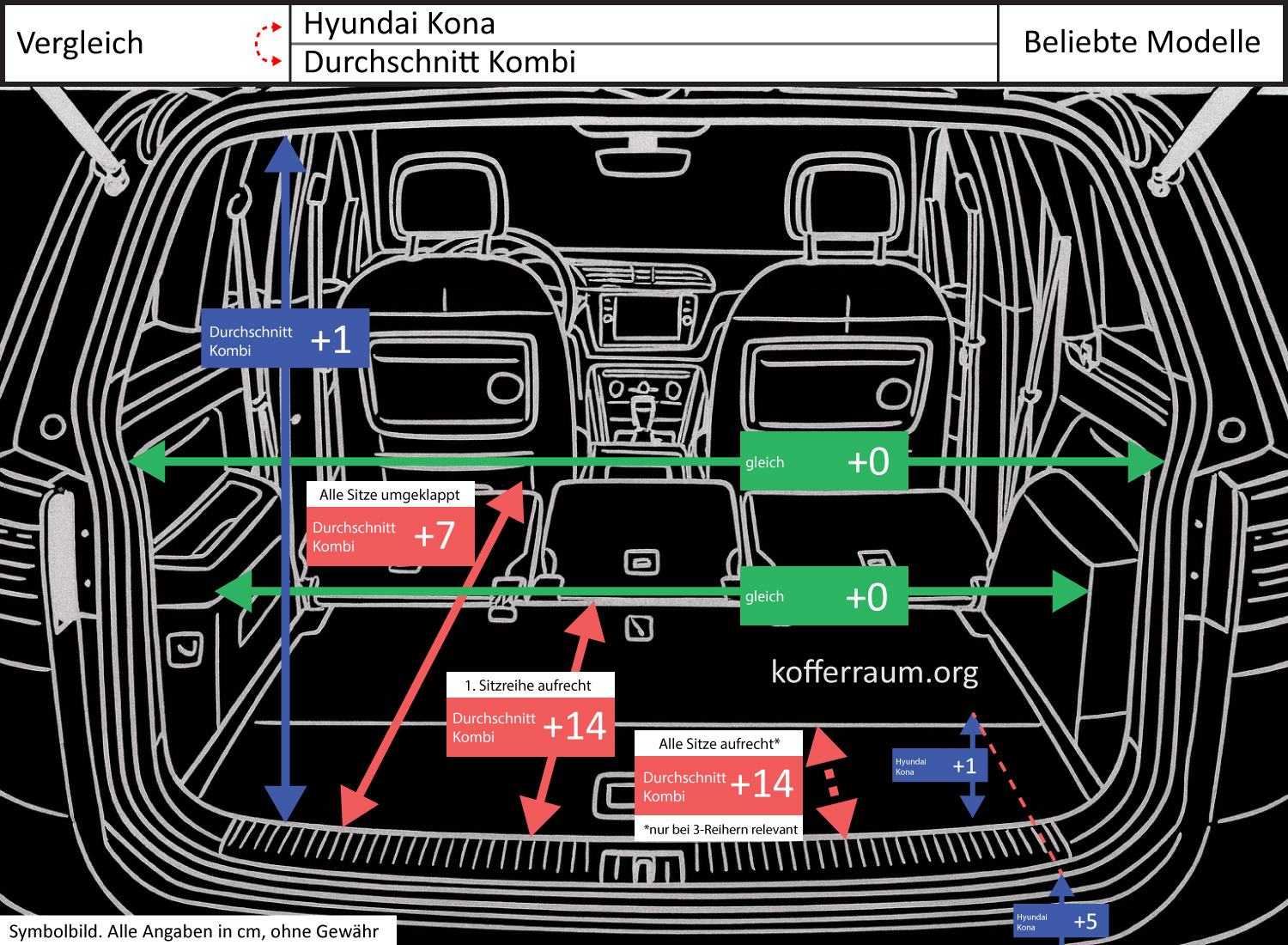
The biggest difference concerns the usable cargo space measurement with the first row of seats upright: The average wagon offers significantly more longitudinal cargo space by +5.5 in (≈16%) than the Hyundai Kona.
Conversely, the Kona has a greater interior depth measured from the loading edge to the trunk floor: the depth is +0.4 in (≈25%) higher than the average wagon (with a very small absolute difference of 0.4 in).
All other dimensions differ only minimally: with the seats folded down, the wagon is only +2.8 in (4%) longer, the opening height differs by +0.4 in (1%), and widths (narrowest point and opening) are the same. The Kona's loading edge is also +2 in (8%) higher above the road.
Impact on Usability
For everyday use with passengers in the back seats, the wagon is more practical due to the significantly longer cargo length with the seat row upright: long items (skis, slats, furniture parts) or several suitcases can be transported more often without folding down seats.
Those who regularly transport long cargo with occupied seats have a noticeable advantage in the wagon.
With the cargo floor fully folded down, the difference is very small at 4% and usually negligible in practice — here, the Kona and wagon are comparable.
The Kona offers greater depth between the loading edge and trunk floor (relative +25%, absolute only +0.4 in).
This means a bit more "recess" in the cargo area, which facilitates securely tying down smaller, taller items and makes bundling luggage easier. However, this advantage is hardly significant due to the small absolute value.
The higher loading edge of the Kona (+2 in / 8%) has a practical effect: lifting heavy items is somewhat more strenuous, especially compared to the wagon with a lower loading edge. Opening width and narrowest width are identical, and the opening height difference of +0.4 in is not relevant.
Conclusion: For longer cargo with occupied rear seats, the wagon is clearly advantageous. The Kona offers slightly more vertical depth in the cargo area but must compensate for a higher loading edge — in practice, this mainly affects handling during loading and unloading.