
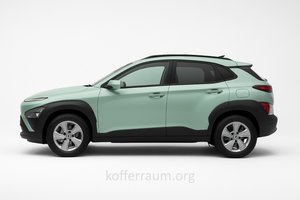
Trunk comparison: Hyundai Kona vs Durchschnitt Compact SUV

Main Differences (highlighted: >10%)
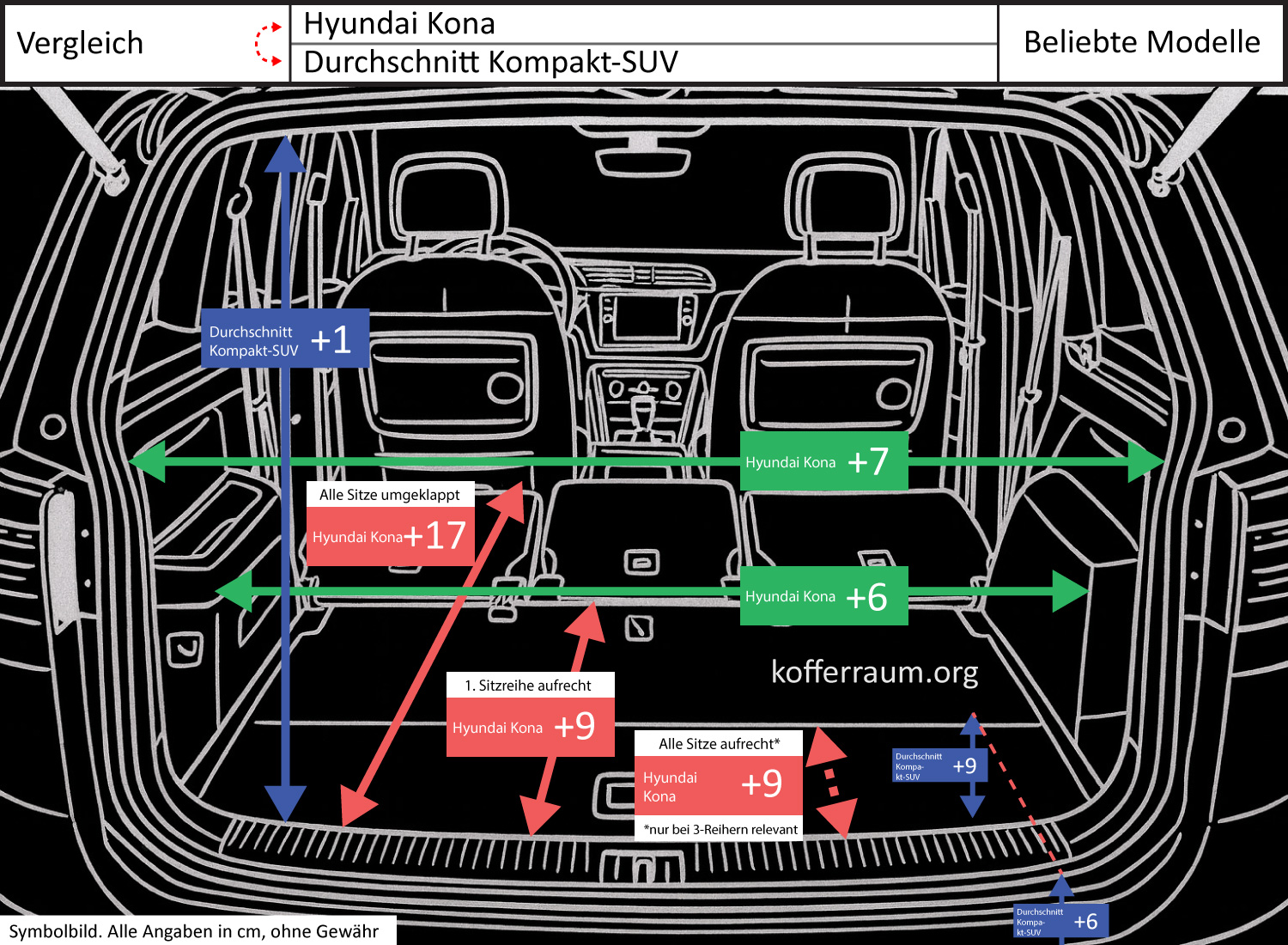
The Hyundai Kona offers a 6.7 in (≈11%) longer cargo floor with the seats folded down than the average compact SUV, and even with the first row of seats upright, the Kona's cargo floor is 3.5 in (≈12%) longer.
This means: those who want to transport long items (e.g., slats, skis, flat furniture) or carry more luggage with full seating have noticeably more cargo space lengthwise in the Kona.
A significantly different point is the depth of the trunk (measured between the loading edge and trunk floor): the average SUV is 3.5 in (≈180%) deeper here than the Kona.
Practically, this means the average SUV has a significantly deeper cargo well and thus more usable vertical volume – advantageous for bulky or unstable loads that rest lower in the trunk.
The Kona, on the other hand, has a flatter cargo floor, which makes sliding in large, flat items easier and lifting bulky loads slightly more comfortable.
Other, smaller differences and their effects
The trunk opening of the average SUV is only 0.4 in (≈1%) higher than the Kona — practically negligible.
The loading edge on the average SUV is 2.4 in (≈9%) higher above the road than on the Kona; as a result, loading is somewhat easier on the body in the Kona, especially with heavy items (this difference is just under 10%).
The minimum trunk width is 2.4 in (≈6%) larger in the Kona and the opening width is 2.8 in (≈7%) wider — both small but noticeable advantages when loading wide items.
In summary: The Kona scores with a longer cargo floor (with folded and upright seats), wider opening, and lower loading edge — making it better for long, wide items and easier loading.
The average SUV offers a deeper cargo well due to significantly greater depth and thus more vertical volume, which is advantageous for awkward or bulky loads.