
Trunk comparison: Hyundai Kona vs Durchschnitt SUV

Key Differences
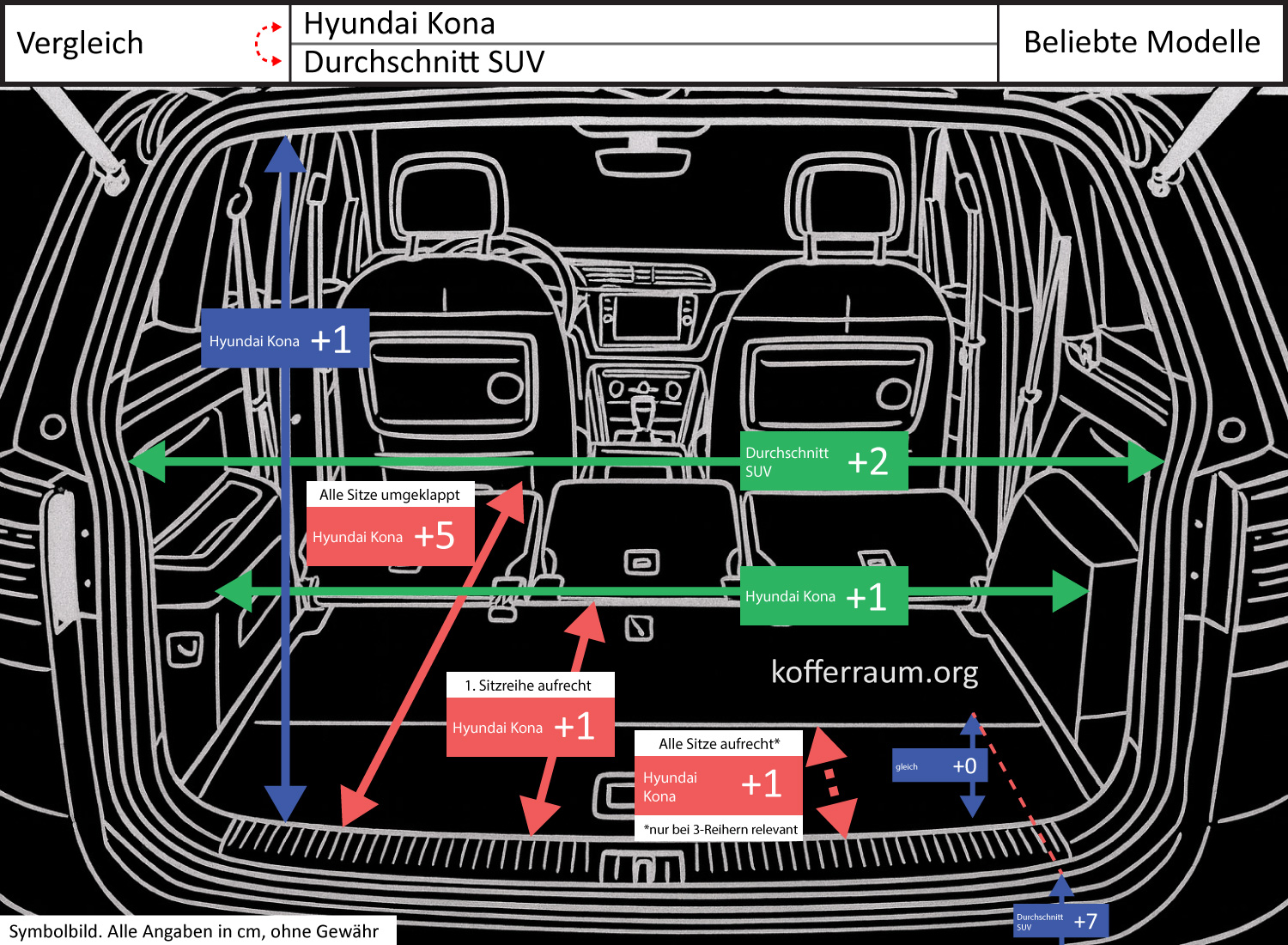
No measured value exceeds the threshold of >10%. The largest single difference is the loading edge height: The loading edge of the average SUV is 2.8 in (10%) higher above the ground than that of the Hyundai Kona – this value reaches exactly 10%, but does not exceed the required mark of >10%.
Other differences (each in favor of the Kona unless otherwise stated): trunk length with seats folded +2 in (3%), trunk length with front seats upright +0.4 in (1%), height of the trunk opening +0.4 in (1%), trunk depth (loading edge → trunk floor) equal, width at the narrowest point +0.4 in (1%) for the Kona, width of the trunk opening for the average SUV +0.8 in (2%) larger than the Kona.
Impact on Usability
The practically most important consequence is the lower loading edge of the Kona: Due to the 2.8 in lower height, loading and unloading heavy or bulky items is significantly easier – less effort when lifting, easier loading of boxes, strollers, or bicycles.
This makes the Kona more convenient in everyday use, especially when regularly transporting heavy loads.
The 2 in longer cargo area with folded seats gives the Kona a slight advantage when transporting longer items (e.g., longer boxes, skis, or furniture parts), but this is limited in scope and only moderately changes the practical cargo volume.
The 0.8 in wider opening width of the average SUV can make it somewhat easier to load very wide items; however, this advantage is largely offset by the Kona’s 0.4 in greater interior width at the narrowest point. Differences in opening height (+0.4 in) and trunk depth (equal) are negligible for everyday practicality.
Conclusion
In practice, the Hyundai Kona offers a noticeable benefit when loading and unloading mainly due to the lower loading edge. The other differences are small (mostly 1–5%) and only lead to marginal differences in usability; very wide cargo can fit slightly easier into the opening of the average SUV.