
Trunk comparison: Hyundai Kona vs Jeep Avenger Electric
Key Differences
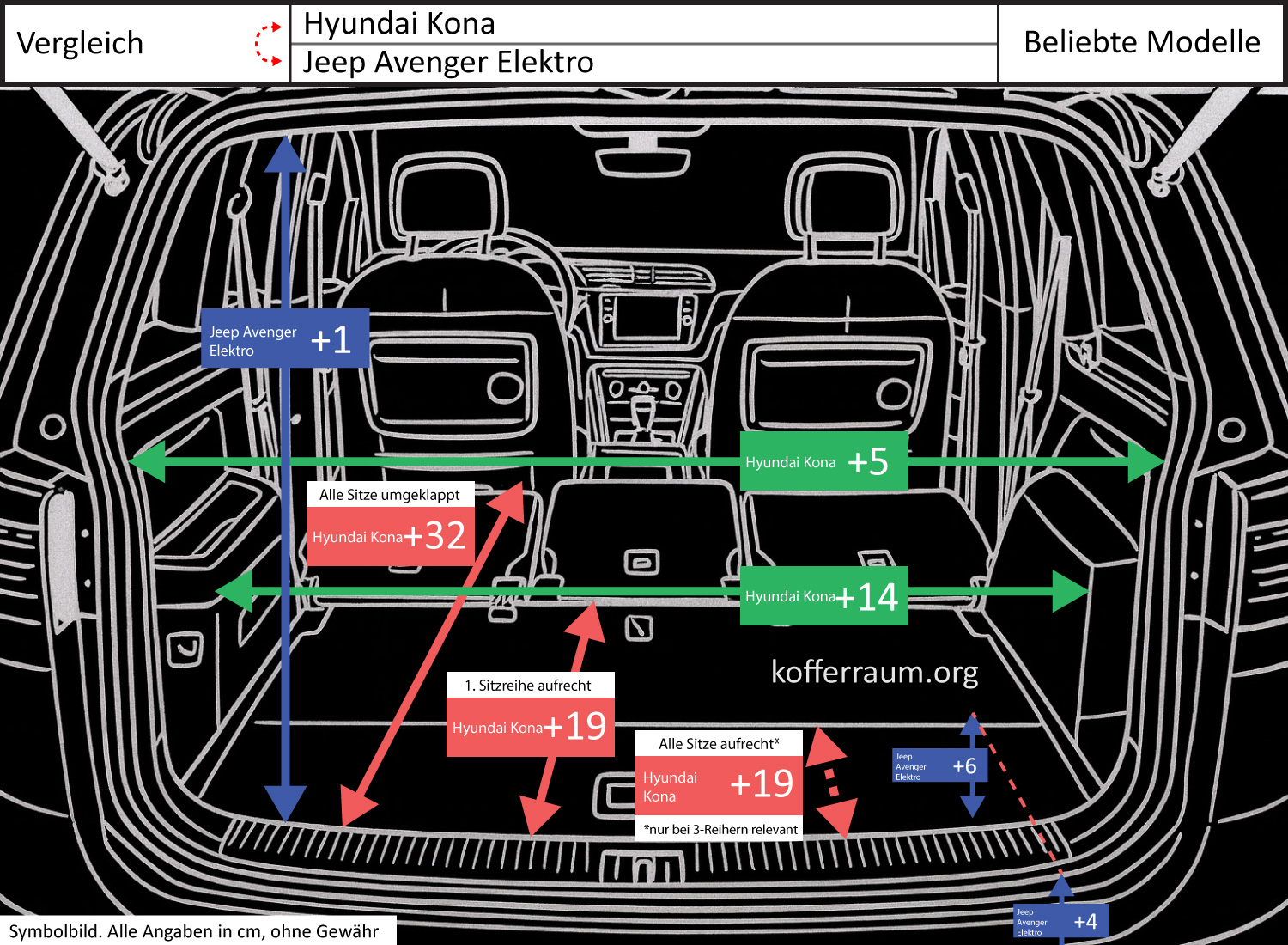
The Hyundai Kona offers significantly more cargo length: with the seats folded down, its trunk is 12.6 in (24%) longer, and with the first row of seats upright, it is 7.5 in (28%) larger than the Jeep Avenger Electric. At its narrowest point, the Kona is also 5.5 in (16%) wider.
In contrast, the Jeep Avenger has a significantly greater trunk depth (measured from the loading edge to the trunk floor): this is 2.4 in (120%) larger than the Kona.
Smaller differences: the height of the Avenger's trunk opening is only 0.4 in (1%) higher, the Avenger's loading edge is 1.6 in (6%) higher above the ground, and the width of the Kona's trunk opening is 2 in (5%) larger.
Impact on Usability
The greater cargo length of the Kona (both with folded seats and with the seat row upright) makes it more practical for long items such as slats, skis, long boxes, or flat furniture pieces.
The larger minimum interior width also increases the chance of fitting bulky or wide cargo without forcing it through the interior. Overall, the Kona is better suited for transport tasks that require area and length.
The Avenger scores with its significantly greater trunk depth (loading edge to floor). This allows for more usable vertical space inside the cargo area or a lower-lying loading compartment for items that can be stacked downward.
However, the Avenger's loading edge is higher above the ground, which makes lifting heavy items somewhat more strenuous. Since the trunk opening and height differ only slightly, loading remains similar, aside from the mentioned differences in depth and length.
Conclusion: For longer or wider cargo, the Hyundai Kona is the more practical choice; those who benefit from a deeper load floor (more interior height below the loading edge) will find the Jeep Avenger a suitable compromise but must accept a somewhat higher loading edge above the ground.