
Trunk comparison: Hyundai Kona vs Mazda Mazda CX-60

Key Differences and Usability
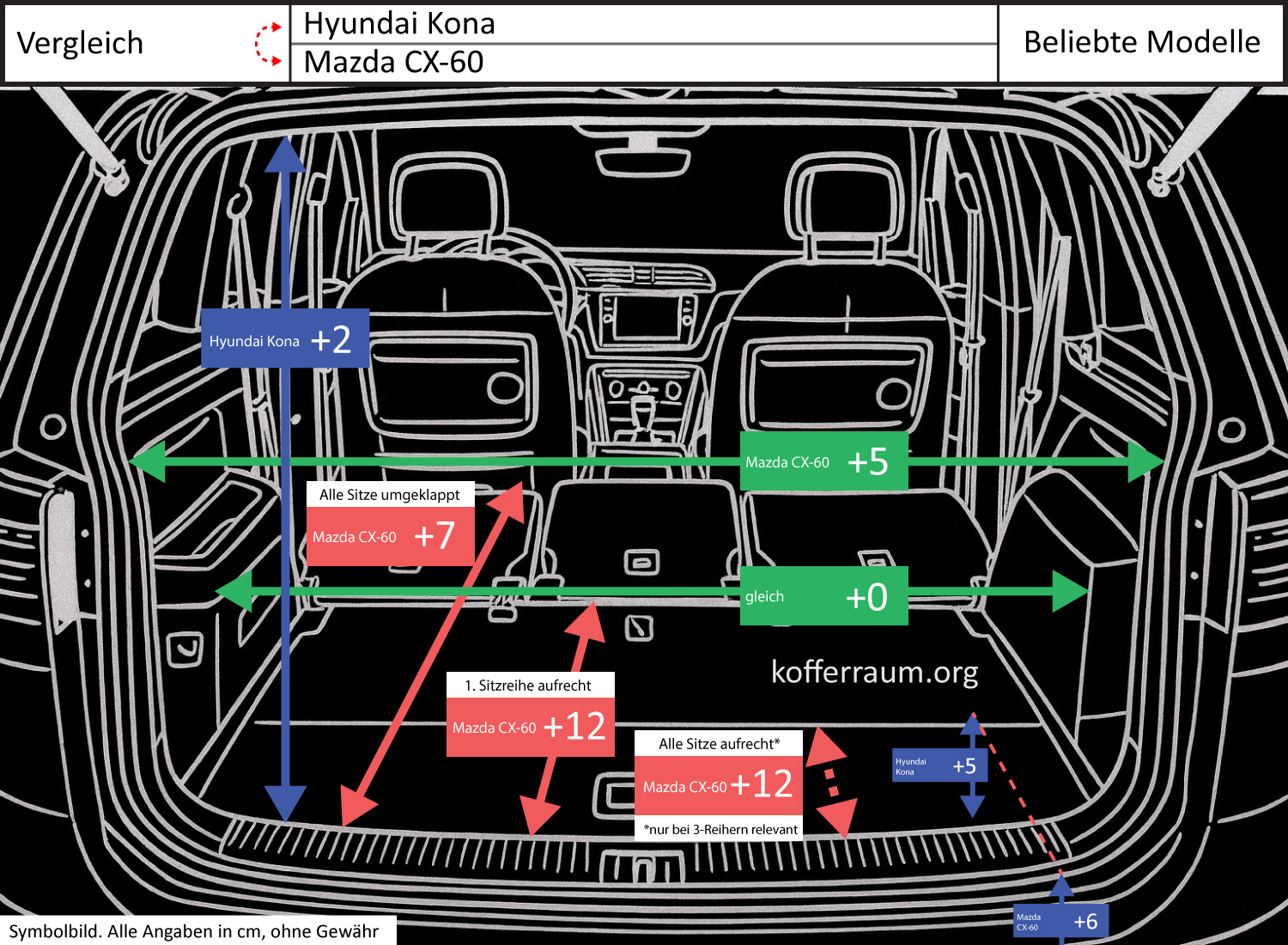
The most noticeable advantage of the Mazda CX‑60 is its longer loading length with the first row of seats upright: the CX‑60 offers +4.7 in (14%) more cargo length than the Hyundai Kona.
This makes the CX‑60 better suited when transporting longer items without folding the seats down (e.g., skis, long packages, or furniture parts), while passengers remain in the rear seats.
The Hyundai Kona, on the other hand, has a significantly greater depth between the loading edge and the trunk floor: the depth is +2 in (400%) higher in the Kona than in the CX‑60. Practically, this means more usable space behind the loading edge and usually a greater ability to store items deeper and more securely.
At the same time, greater depth can make placing heavy items somewhat more cumbersome because they have to be lifted further down.
Other differences of smaller magnitude: the loading edge of the Mazda sits 2.4 in (9%) higher above the road, making lifting heavy loads a bit more strenuous; the width of the trunk opening on the CX‑60 is 2 in (5%) larger, allowing wider items more easily; the height of the opening (+3%) and the longer loading surface with fully folded seats (+4%) are hardly noticeable.
At the narrowest point, both models are equally wide.
Conclusion: For longer cargo with occupied seats, the Mazda CX‑60 is noticeably advantageous. For deeper, possibly bulkier storage (with a simultaneously lower loading edge), the Hyundai Kona is better suited. Smaller differences in opening width and loading edge height only slightly affect everyday usability.