
Trunk comparison: Hyundai Kona vs Mercedes Benz GLB
Key Statement
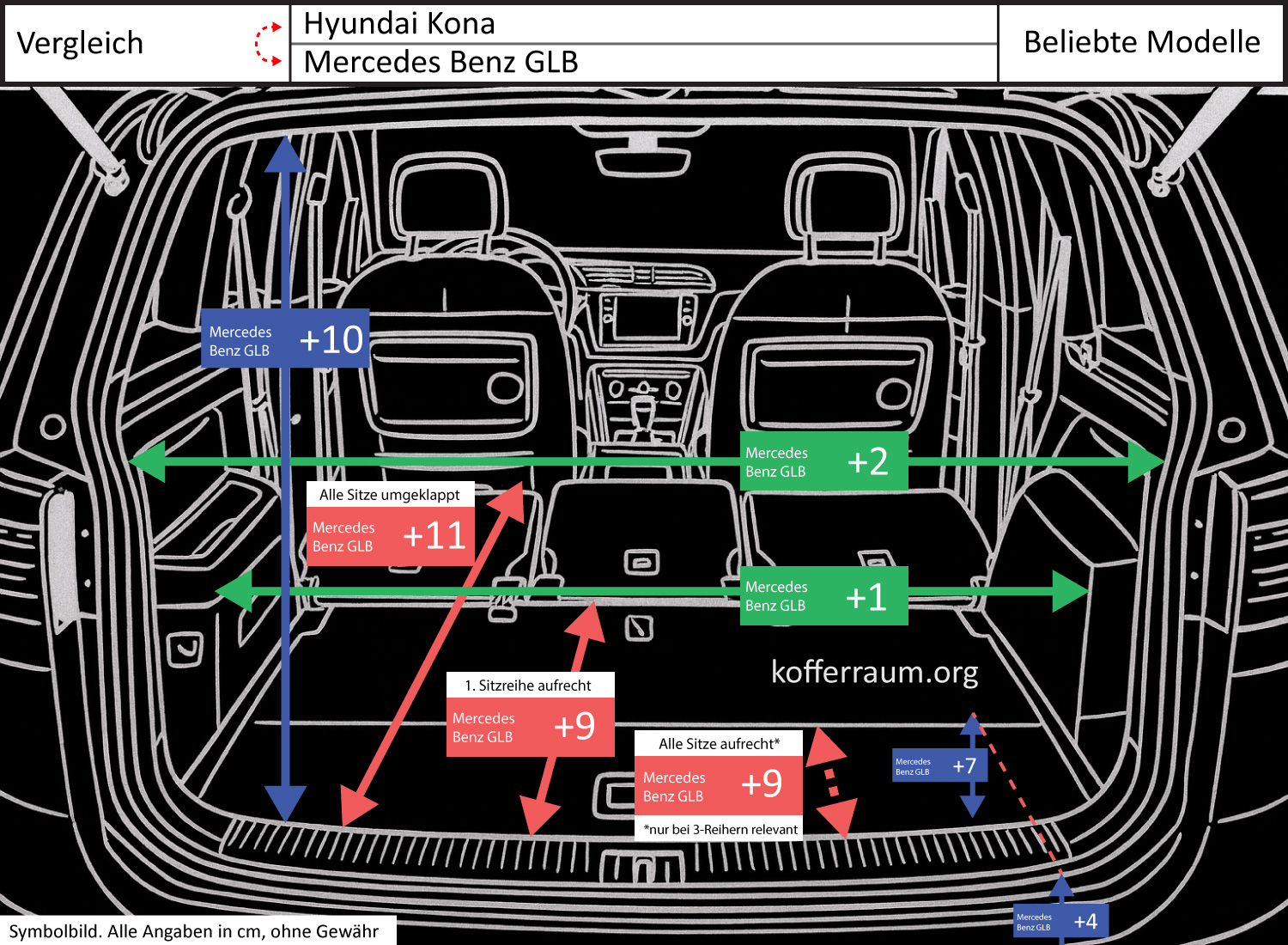
The biggest differences between the two models concern the vertical dimensions of the cargo area: The trunk opening of the Mercedes‑Benz GLB is 3.9 in larger (+13%) and the depth from the loading edge to the trunk floor is significantly greater in the GLB by 2.8 in (+140%).
What impact this has on usability
Due to the larger height of the trunk opening, significantly taller or bulkier items can be loaded more easily in the GLB — boxes, pieces of furniture, or suitcases can stand more upright.
The considerably greater interior depth (loading edge → trunk floor) creates more usable vertical space in the footwell area, which is especially helpful when transporting irregularly shaped or bulky cargo and when stacking luggage.
The length differences are moderate: the GLB offers only slightly more trunk length (+4.3 in or +3.5 in, 7–10%), and the width differences are negligible (+1–0.8 in). This means: in longitudinal and transverse directions, the vehicles are comparable in practice — longer items benefit only slightly from the GLB.
A practical compromise results from the loading edge height: the loading edge of the GLB is 1.6 in higher (+6%), which makes lifting heavy items somewhat more strenuous.
For users who regularly lift heavy loads, the lower trunk of the Kona can therefore be more convenient in everyday use, even though it offers less overall interior height and depth.
Conclusion: For tall or bulky cargo, the Mercedes‑Benz GLB is clearly advantageous (especially due to the larger opening height and significantly greater interior depth).
For lighter, frequent loading and unloading tasks with low lifting effort, the Hyundai Kona is more practical, as the loading edge is lower and the length/width differences are minimal.