Trunk comparison: Hyundai Kona vs Opel Grandland
Significant Differences (>10%)
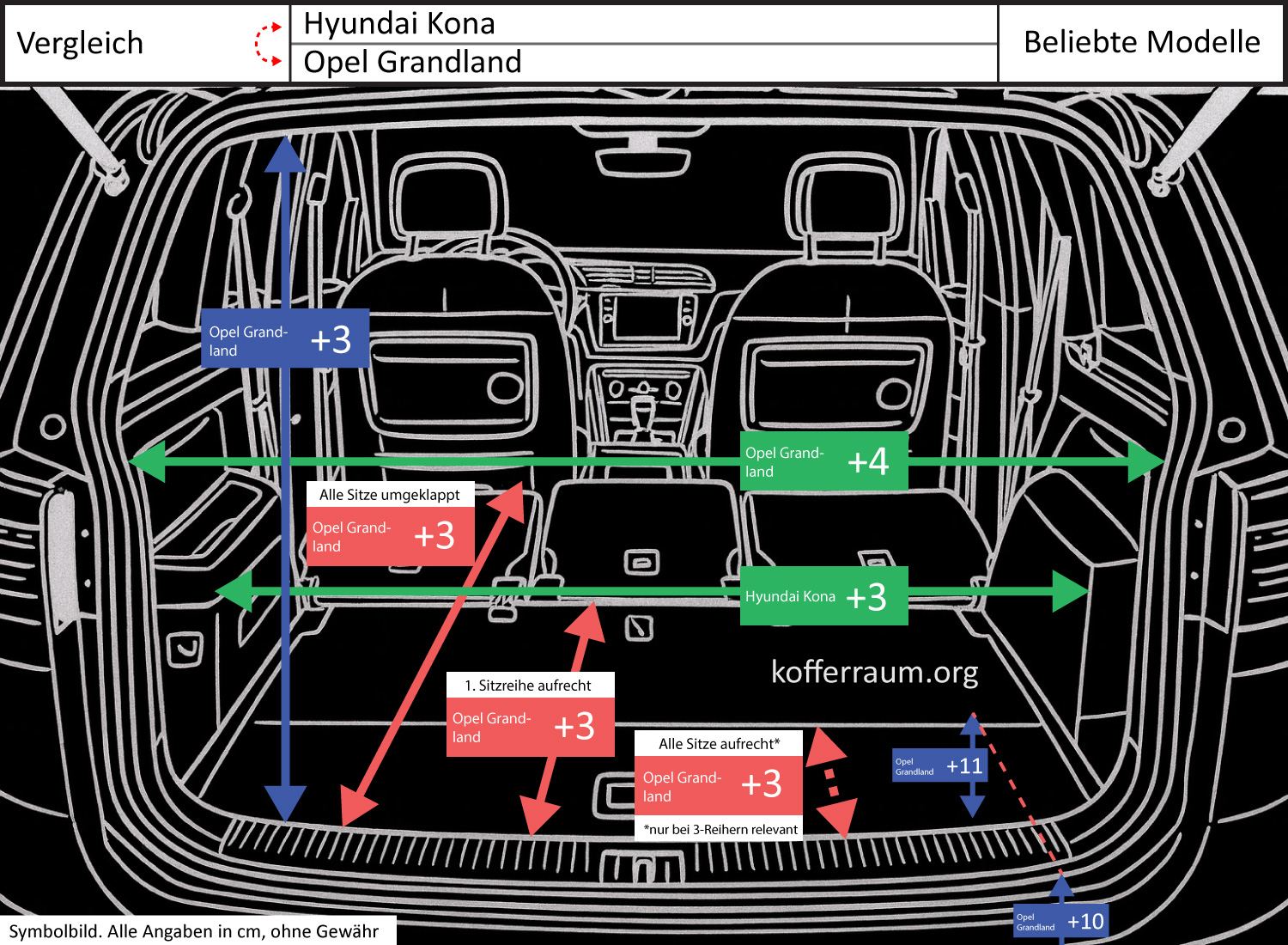
Among the measured values, two differences stand out clearly: the depth of the trunk (loading edge to trunk floor) is +4.3 in (≈+220%) greater in the Opel Grandland than in the Hyundai Kona, and the loading edge of the Grandland is +3.9 in (≈+15%) higher above the ground.
These two values have the greatest impact on everyday usability.
Impact on Usability
Due to the significantly greater depth, luggage in the Grandland sits lower and is thus more securely fixed — positive for loose or stackable cargo and for the vehicle's center of gravity.
At the same time, the higher loading edge means that items must be lifted higher to get into the trunk. This is disadvantageous for heavy or rolling suitcases: overcoming the higher threshold requires more effort, and rolling operations are less comfortable in the Grandland than in the Kona.
In short: The Grandland offers more vertical “security” and depth in the cargo area (good for stored, infrequently accessed contents), but makes lifting in and out heavy or rolling items more difficult. The Kona has the more practical loading height in this respect and thus easier handling when loading and unloading.
Other, Minor Differences
All other differences are under 10%: trunk length (folded +2%, seats upright +3%), height of the trunk opening (+4%), width at the narrowest point favoring the Kona (+3%) as well as width of the opening favoring the Grandland (+4%).
These deviations are minor and lead to only marginal differences in practice when transporting large or bulky items.