
Trunk comparison: Hyundai Kona vs Peugeot 208
Key Differences
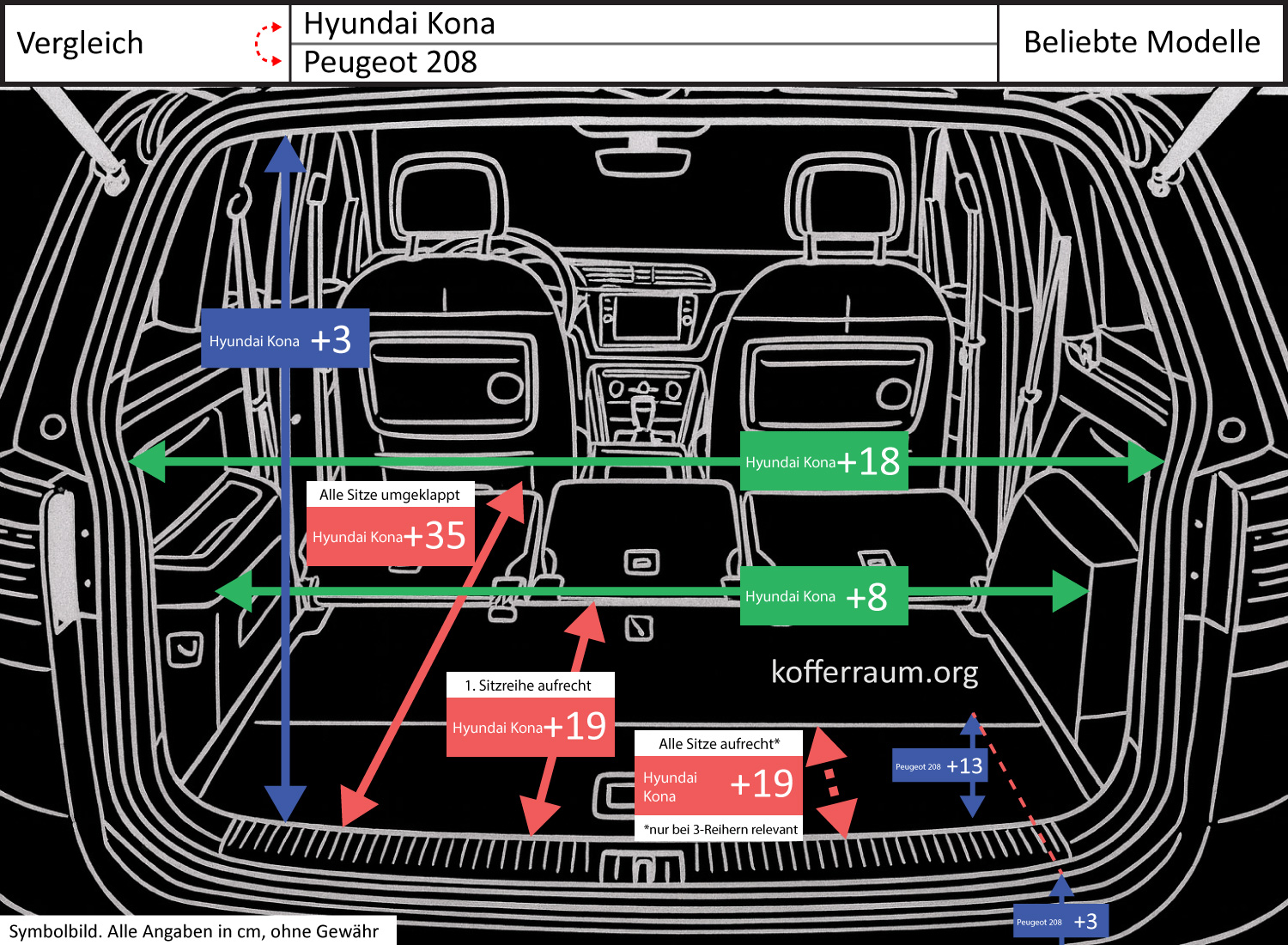
The Hyundai Kona offers significantly more length in the cargo space: with the seats folded down, it is 13.8 in (27%) longer, and with the first row of seats upright, 7.5 in (28%) longer than the Peugeot 208. The width of the trunk opening is also noticeably larger on the Kona: +7.1 in (21%).
In contrast, the Peugeot 208 has a much deeper recess between the loading edge and the trunk floor: this depth is 5.1 in (260%) greater in the 208 than in the Kona.
Smaller differences (under 10%) include a slightly higher trunk opening on the Kona (+1.2 in / 4%), a slightly higher loading edge on the 208 (+1.2 in / 4%), and a marginally greater width at the narrowest point on the Kona (+3.1 in / 8%).
What does this mean for usability?
The greater cargo length of the Kona (both with folded seats and with upright seats) makes it more practical for long items such as furniture parts, long boxes, or sports equipment (skis, paddleboards, etc.). The wider trunk opening facilitates loading wide or bulky items and reduces maneuvering when loading.
The deep recess in the Peugeot 208 means smaller items are less likely to shift or be visible, but it also creates a "low point" that can make loading large flat items more difficult — the effective usable length and handling of heavy loads suffer as a result.
Additionally, the slightly higher loading edge of the 208 requires a bit more lifting when loading and unloading; while this is a small difference, it can be noticeable with heavy items.
In summary: Those who frequently transport long or wide cargo benefit from the Kona. Those who prefer to securely store smaller, deeper items and can accept a somewhat larger trunk recess will find some advantages in the 208 — overall, however, the Kona is more practical for versatile loading.