
Trunk comparison: Hyundai Kona vs Peugeot 3008
Key Differences (>10%)
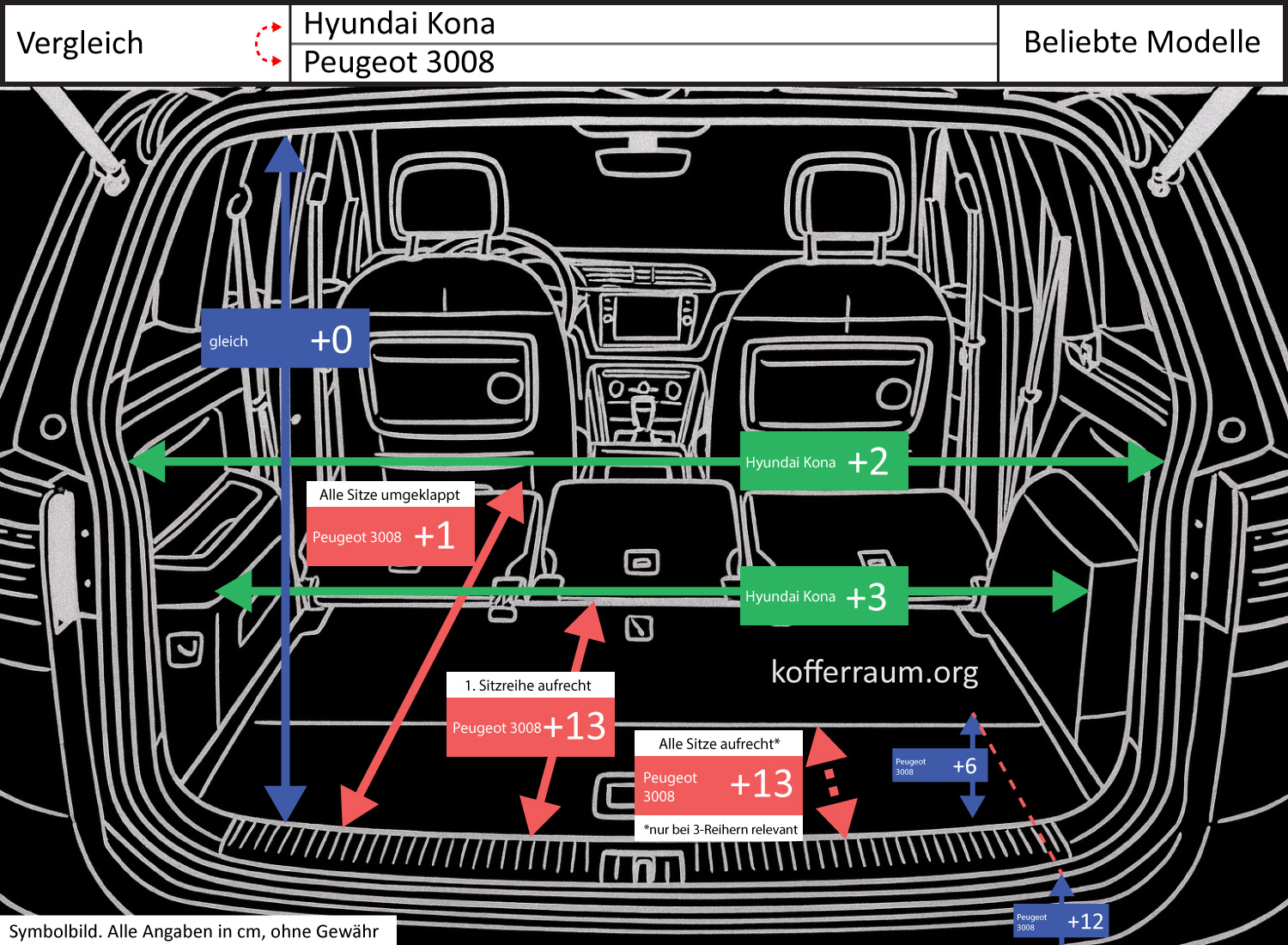
The Peugeot 3008 offers a cargo area that is +5.1 in (≈15%) longer with the front seats upright compared to the Hyundai Kona.
The trunk depth (distance from loading edge to trunk floor) is +2.4 in (≈120%) greater in the Peugeot. Additionally, the loading edge of the Peugeot is +4.7 in (≈18%) higher above the ground than that of the Kona.
Implications for Usability
More usable loading length in the Peugeot (≈15%): With the rear seats fully occupied, longer luggage or items fit more easily into the 3008’s trunk. This makes it more practical for travelers with bulky cargo or ski racks without folding down the seats.
Greater trunk depth in the Peugeot (≈120%): The increased vertical capacity allows for more stacked cargo volume and is advantageous for bulky or tall loads. Together with the longer loading area, this significantly increases the total usable space.
Higher loading edge in the Peugeot (≈18%): The higher loading edge makes lifting heavy items into the trunk more difficult and increases physical strain when loading and unloading. This can be a disadvantage for frequent handling of heavy loads or regular loading of larger items.
Small advantages of the Kona (under 10%): The Hyundai has a slightly greater width at the narrowest point and a somewhat larger opening width, which facilitates maneuvering wider items. However, these differences are minor and affect everyday usability less than the points mentioned above.
Conclusion
The Peugeot 3008 offers more usable cargo space (longer and significantly deeper), making it the better choice when volume and length with the rear seats occupied are important.
The Hyundai Kona scores with somewhat easier loading and slightly more width at critical points — beneficial for frequent handling of heavy or wide items. Those needing a lot of volume choose the 3008; those preferring a lower loading edge and easier handling choose the Kona.