
Trunk comparison: Hyundai Kona vs Seat Leon
Key Differences
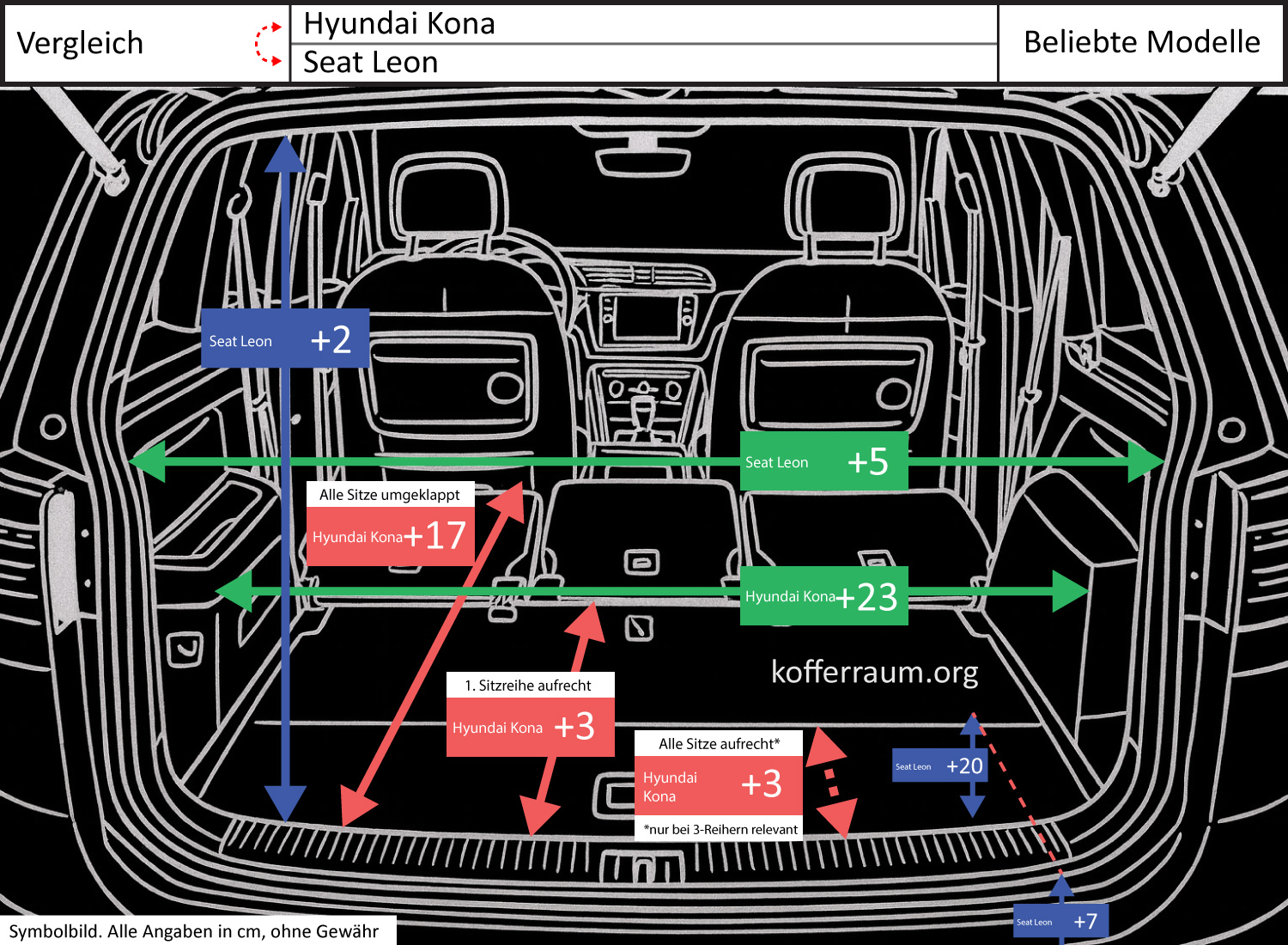
The Hyundai Kona offers a 6.7 in (≈11%) longer cargo area with the seats folded down compared to the SEAT Leon. At its narrowest point, the Kona's trunk is also 9.1 in (≈28%) wider than the Leon's.
Conversely, the SEAT Leon has a clear advantage in vertical interior shaping: the depth from the loading edge sill to the trunk floor is 7.9 in (≈400%) greater in the Leon than in the Kona.
Implications for Usability
These differences lead to distinctly different strengths: the Kona is better suited for wide or long cargo — such as furniture parts, long sports equipment, or bulky packages — especially when the rear seats are folded down.
The greater narrowest width reduces bottlenecks when loading wide items and makes it easier to store elongated loads.
The SEAT Leon, on the other hand, scores with volume- and height-oriented cargo: the significantly greater depth below the loading edge allows for more vertical storage space and is better suited for stackable boxes or bulky items that extend upward.
Additionally, items can be partially recessed deeper, effectively increasing the usable interior height for standing cargo.
Other minor differences: the Kona has slightly more cargo length with the rear seats upright (+1.2 in), while the Leon has a somewhat higher trunk opening (+0.8 in) and a higher loading edge (+2.8 in, ≈10%).
The higher loading edge of the Leon makes lifting heavy loads a bit more demanding, whereas the Kona's smaller opening dimensions can be limiting for very tall or very wide items.