
Trunk comparison: Hyundai Kona vs Tesla Model 3
Key Differences
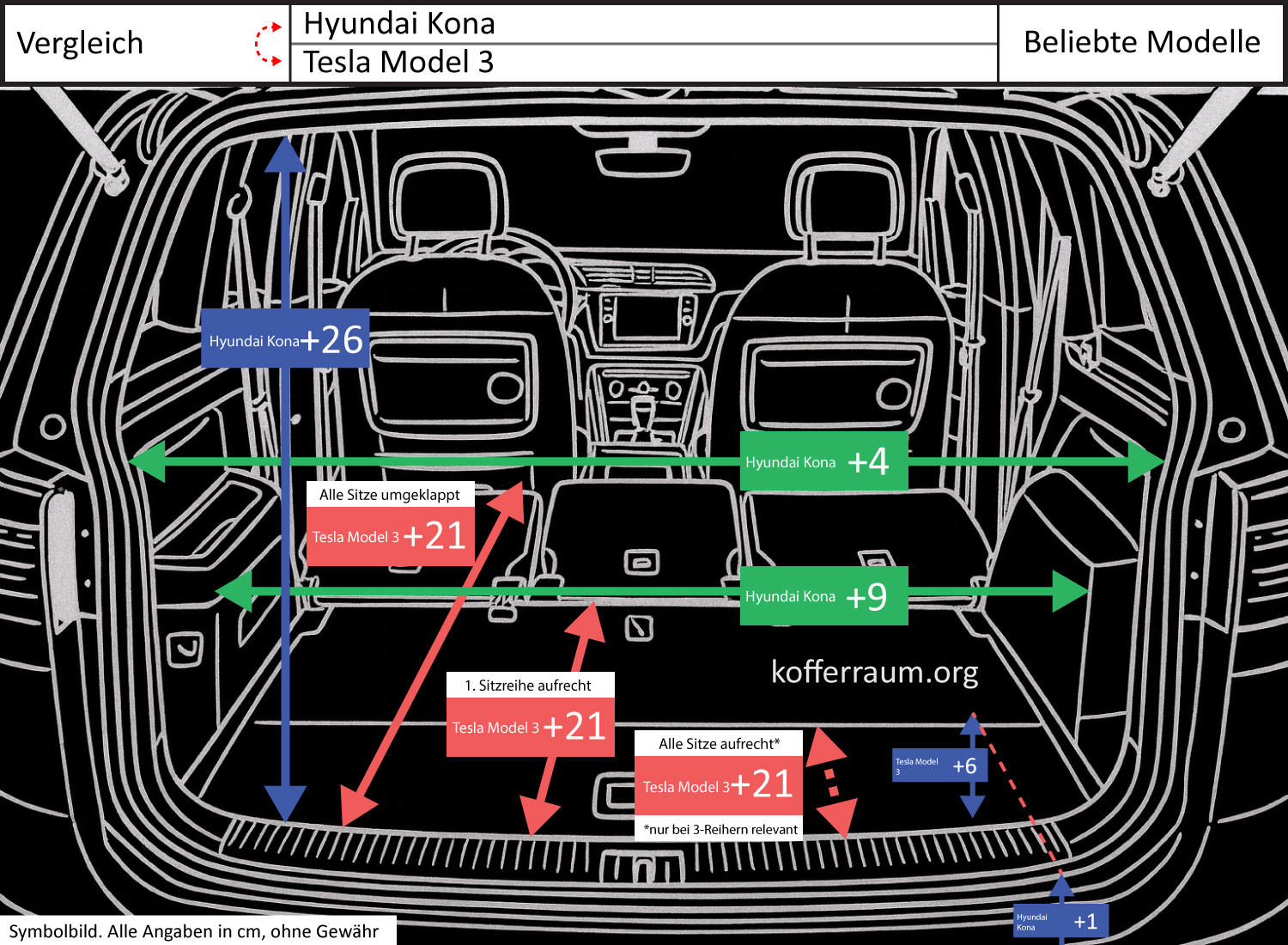
When it comes to cargo space, the vehicles lead in different areas: The Tesla Model 3 offers a significantly longer loading length both with the seats folded down and with the front row upright – +8.3 in (13% and 24%, respectively) compared to the Hyundai Kona.
The Kona’s trunk opening, on the other hand, is considerably higher: +10.2 in (50%) compared to the Model 3. Additionally, the distance from the loading edge to the trunk floor is significantly greater in the Tesla: +2.4 in (120%) compared to the Kona.
Smaller differences — such as the narrowest width (+3.5 in / 9%) and the opening width (+1.6 in / 4%) in favor of the Kona, as well as the loading edge height (+0.4 in / 1%) — are comparatively minor and not highlighted here.
Impact on Usability
The longer loading length in the Model 3 makes it more practical for long items (e.g., skis, long furniture parts, ladders): with folded seats and also with the front row upright, more length can be transported without having to completely remove seats.
The greater depth from the loading edge to the trunk floor in the Model 3 means that cargo sits deeper, allowing more volume below the loading edge to be used — this helps when storing bulky or irregularly shaped items but can slightly complicate lifting heavy items in and out.
The significantly higher trunk opening edge of the Kona makes loading tall items easier: bulky, tall parts can stand more upright through the opening, and there is more vertical clearance right at loading.
Together with the slightly greater narrowest width and somewhat wider opening (each smaller margins), the Kona is overall somewhat more accessible in situations with wider or taller cargo, even though the differences here are moderate.
Conclusion: For lengthwise-oriented loads and maximum usable depth, the Tesla Model 3 has the advantage. For loading tall or upright items and slightly better accessibility at the opening, the Hyundai Kona scores better.