
Trunk comparison: Hyundai Kona vs VW ID.4
Key Differences
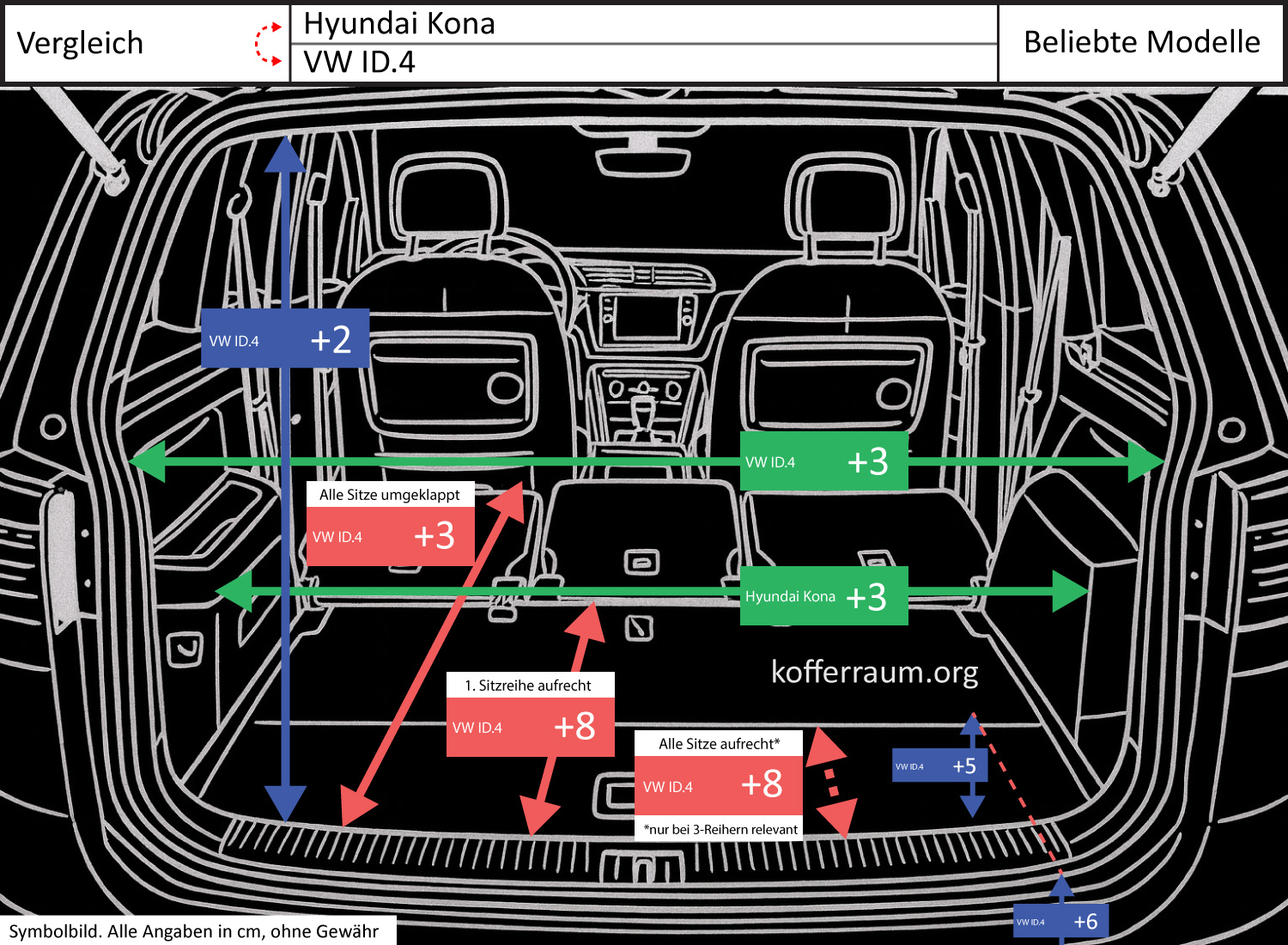
The clearest difference concerns the depth of the trunk (loading edge to trunk floor): the VW ID.4 offers +2 in (100%) more depth than the Hyundai Kona.
Other deviations are significantly smaller: the ID.4 has a 1.2 in (+2%) longer cargo area with the seats folded down and 3.1 in (+9%) more length with the first row upright.
The trunk opening of the ID.4 is 0.8 in (+3%) higher and 1.2 in (+3%) wider; the loading edge on the ID.4 is 2.4 in (+9%) higher above the road. At the narrowest point, the Kona's trunk is 1.2 in (+3%) wider than the ID.4's.
Impact on Usability
The 100% greater depth in the ID.4 practically means more usable volume near the loading edge: bulky or tall items can be stored further "inside," and loose cargo can lie deeper and more securely. This increases packing flexibility and improves the ability to accommodate voluminous items.
At the same time, the loading edge of the ID.4 is 2.4 in higher, which makes lifting heavy loads somewhat more strenuous.
Combining both factors results in only a slightly higher trunk floor compared to the Kona in practice (net about +0.4 in), because the deeper interior largely compensates for the higher loading edge.
The moderate length and width differences (each a few centimeters, under 10%) mean smaller practical effects: the ID.4 is minimally advantageous for long items (seats upright), and the slightly larger opening width helps when loading wider parts.
The Kona has slightly more clearance at the narrowest point, which helps when storing narrow, bulky items in tight trunks.
Conclusion: Those who frequently work with voluminous, deeply loaded cargo benefit significantly from the ID.4. Those who prefer lower loading edges and a bit more clearance at the narrowest point will find slight advantages in the Kona.