
Trunk comparison: Jeep Avenger Electric vs Skoda Fabia
Key Statement
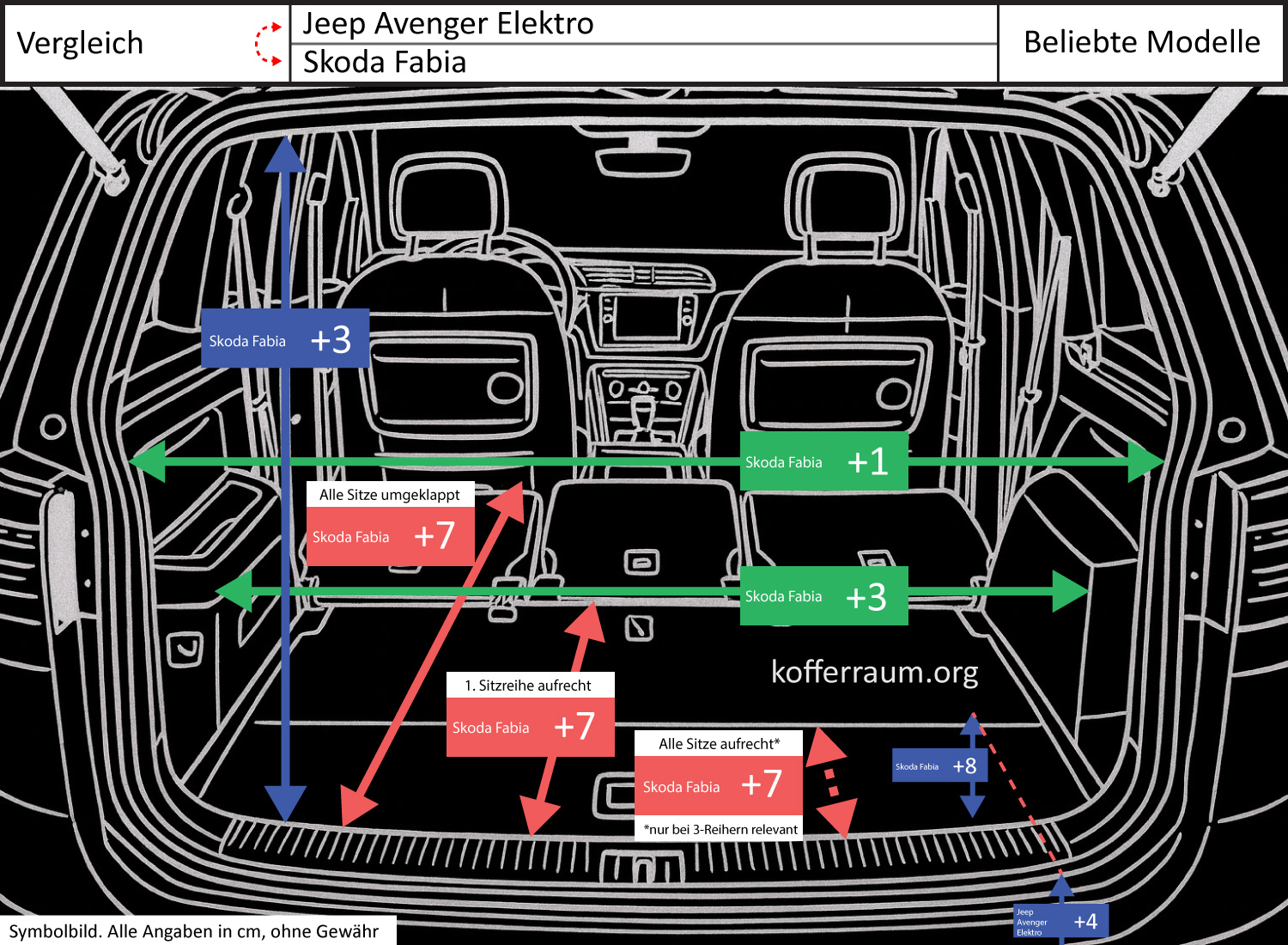
The most significant difference lies in the trunk depth (from loading edge to trunk floor): The Škoda Fabia is 3.1 in or 73% larger here than the Jeep Avenger Electric. This difference of well over 10% is the most important practical deviation and means that the Fabia offers more usable interior height behind the loading edge — it can therefore accommodate taller or bulky items better without them protruding over the edge or needing to be placed at an angle.
Other Relevant Differences and Their Consequences
The remaining differences are significantly smaller (≤10%):
- Trunk length: The Škoda has 2.8 in more length both with folded seats (+5%) and with the first row upright (+10%). This gives the Fabia a bit of extra space for longer items but is not a major advantage.
- Opening height and widths: The Fabia’s trunk opening is 1.2 in (4%) higher, the narrowest interior width is 1.2 in (3%) wider, and the opening width is 0.4 in (1%) larger. These differences slightly ease loading bulky parts but are usually unnoticeable in everyday use.
- Loading edge height above the road: The Jeep Avenger Electric’s loading edge is 1.6 in (6%) higher than the Fabia’s.
This means heavy items must be lifted a bit higher in the Avenger — a disadvantage when lifting, but possibly an advantage if the vehicle floor is higher and thus better protected against moisture or edge clearances.
Practical Conclusion
For users who frequently transport tall or bulky luggage (such as crates, boxes, or equipment), the Škoda Fabia is noticeably more practical due to its significantly larger trunk depth.
For everyday users with normal luggage volume, the differences in length, width, and opening height are rather marginal; here, trunk volume, packing organization, or rear seat configuration may play a bigger role than the small measurements mentioned.
The higher loading edge of the Jeep can make loading heavy loads somewhat more strenuous but does not offer a decisive advantage in cargo space volume.