
Trunk comparison: Jeep Avenger Electric vs Tesla Model Y
Key Differences
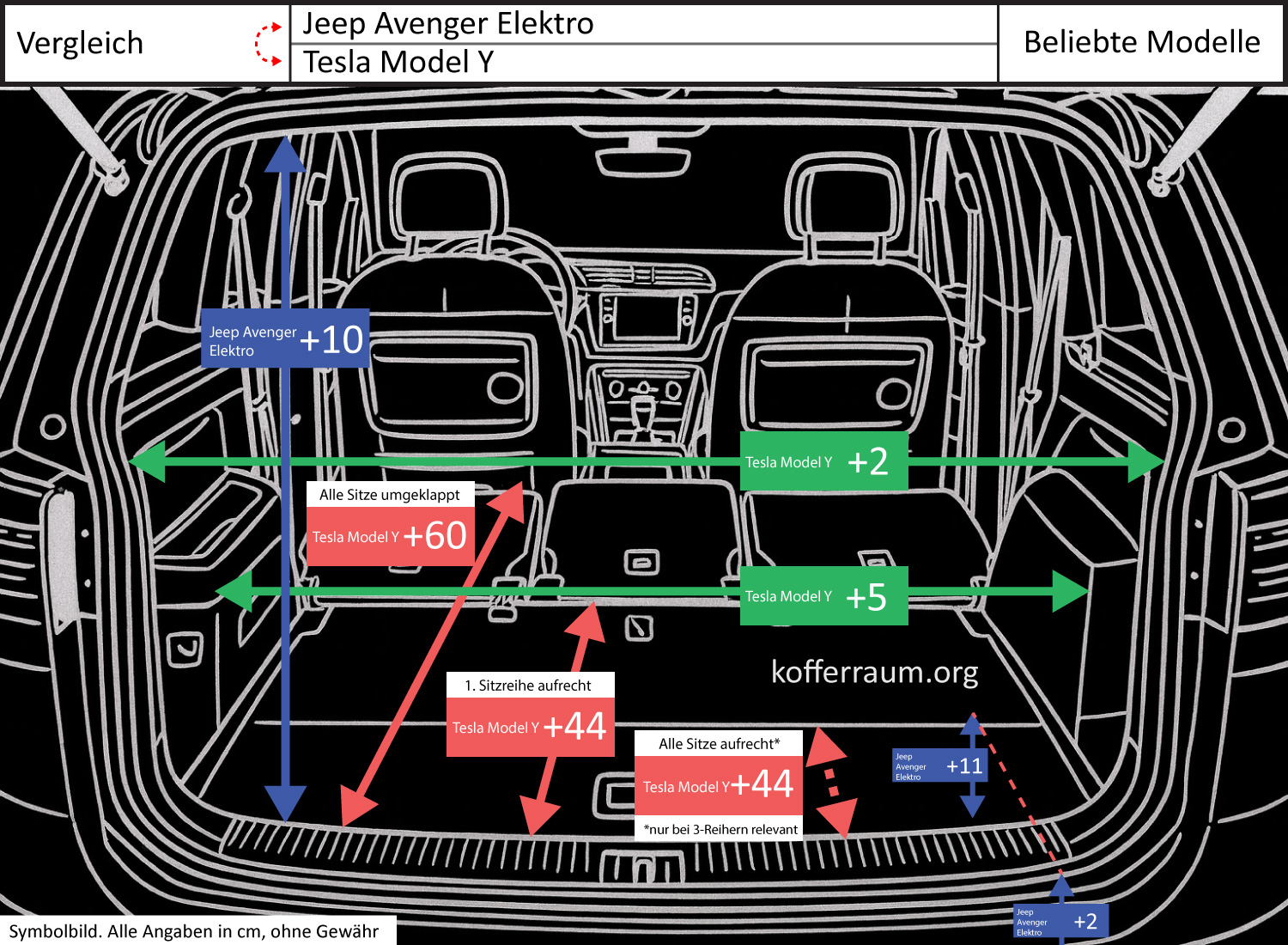
The Tesla Model Y offers significantly more cargo length: with the seats folded down, the trunk is about 23.6 in (≈45%) longer, and with the first row upright, it is about 17.3 in (≈66%) longer than the Jeep Avenger Electric.
In contrast, the Jeep Avenger has a higher cargo opening and a deeper cargo well: the height of the trunk opening is about 3.9 in (≈14%) greater, and the depth from the loading edge to the trunk floor is around 4.3 in (≈1000%) greater than in the Model Y.
Smaller differences — such as the width at the narrowest point (+2 in / 6%) or the width of the opening (+0.8 in / 2%) in favor of the Model Y, as well as the loading edge height above the road (+0.8 in / 3%) in favor of the Avenger — are below the 10% threshold and thus less significant.
Implications for Usability
The greater cargo length of the Tesla Model Y makes it clearly more suitable for long items (slats, pipes, skis, furniture parts) and for transporting large amounts of luggage with the seats folded down. Those who frequently transport long carriers or bulky, flat goods have more flexibility and space in the Model Y.
The Jeep Avenger scores points for ease of loading and handling bulky, tall, or awkward items: The higher trunk opening allows loading of greater heights, and the deeper cargo well creates more usable volume below the loading edge.
This is practical for transporting tall boxes, plants, or storing items that should not protrude above the top. However, a deeper cargo well can make bending down to retrieve or lifting heavy items somewhat less ergonomic.
In summary: For maximum loading length and flexibility with long goods, the Tesla Model Y is the better choice.
For more comfortable loading of tall/voluminous items and more “protected” storage volume below the loading edge, the Jeep Avenger is better suited. Smaller differences in width and loading edge height are usually negligible in practice.