
Trunk comparison: Jeep Compass vs Durchschnitt SUV

Key Differences
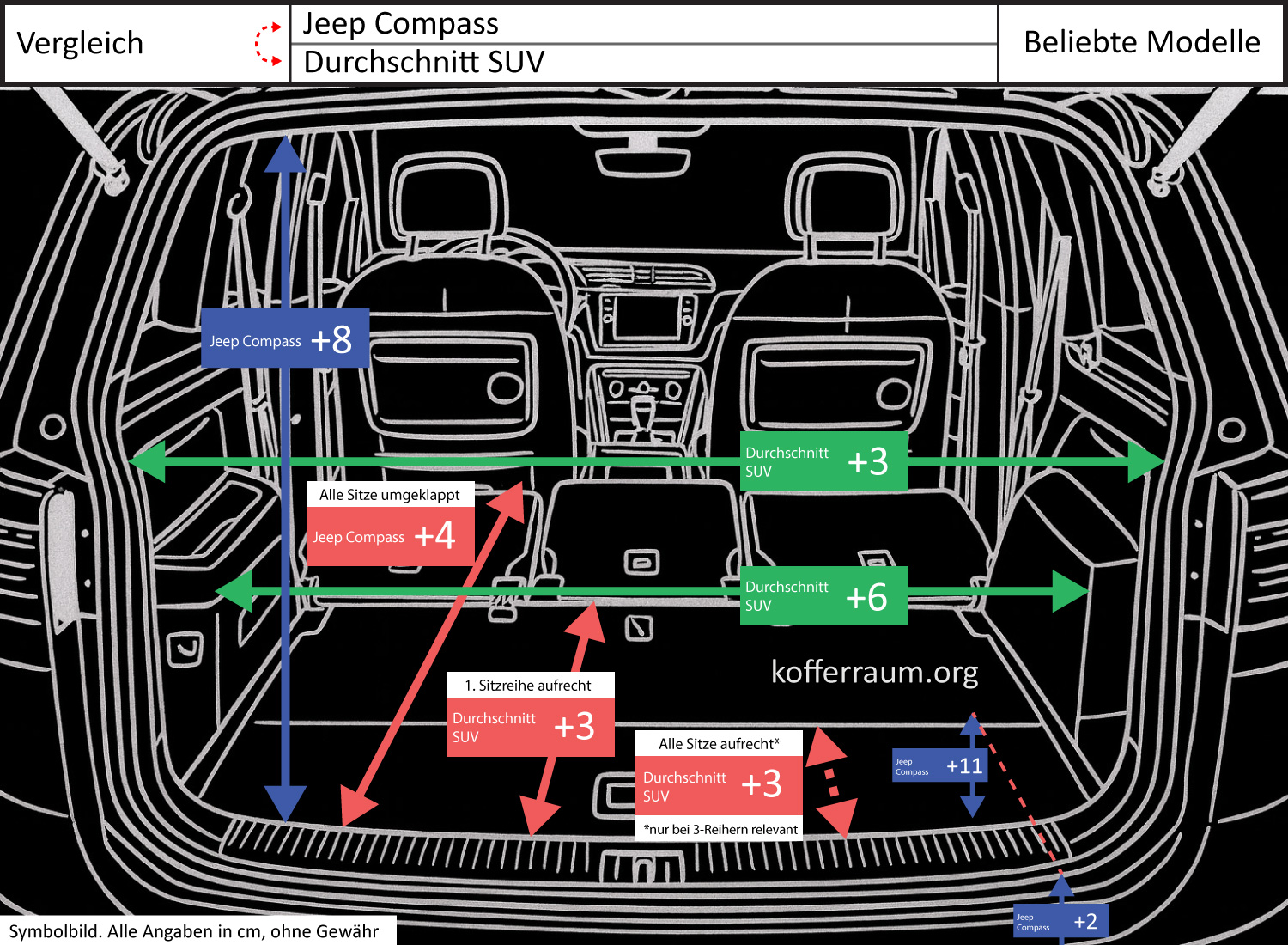
The most significant difference concerns the depth of the trunk (loading edge to trunk floor): the Jeep Compass offers 4.3 in more depth, which corresponds to an increase of 220% compared to the average SUV.
All other differences are comparatively small: the height of the Compass's trunk opening is 3.1 in (+10%) higher, and the loading edge is 0.8 in (+3%) higher above the road surface.
In terms of width, the average SUV has advantages: at the narrowest point, it is 2.4 in (+6%) wider, and the overall trunk opening is 1.2 in (+3%) wider.
The loading length differs little between the models: folded down, the Compass is 1.6 in (+2%) longer, while with the first row of seats upright, the average SUV has 1.2 in (+4%) more length.
Impact on Usability
The significantly increased trunk depth in the Compass practically means considerably more usable vertical space behind the loading edge: bulky or tall items can be lowered further down, and the loading area is better suited for stacking or for deep luggage.
This increases the practical capacity especially for irregularly shaped or tall cargo.
At the same time, the 0.8 in higher loading edge in the Compass slightly negatively affects loading and unloading heavy items—they have to be lifted a bit higher. The 3.1 in higher trunk opening supports loading tall items and partially compensates for this disadvantage.
For particularly wide cargo, the average SUV has advantages: the greater width at the narrowest point and the somewhat wider opening make it easier to load wide items.
Those who frequently transport long cargo with the rear seat upright benefit slightly from the longer loading space of the average SUV; folded down, the Compass offers slightly more length. Overall, these length and width differences are small and only become decisive when space is very limited.
Conclusion: The Jeep Compass is especially better suited for deeper, stackable, or tall cargo. The average SUV has a slight advantage with very wide cargo and when used with the rear seat upright. Apart from the significantly greater trunk depth, the differences are usually minor in practice.