
Trunk comparison: Jeep Compass vs Mazda Mazda CX-60
Key Differences
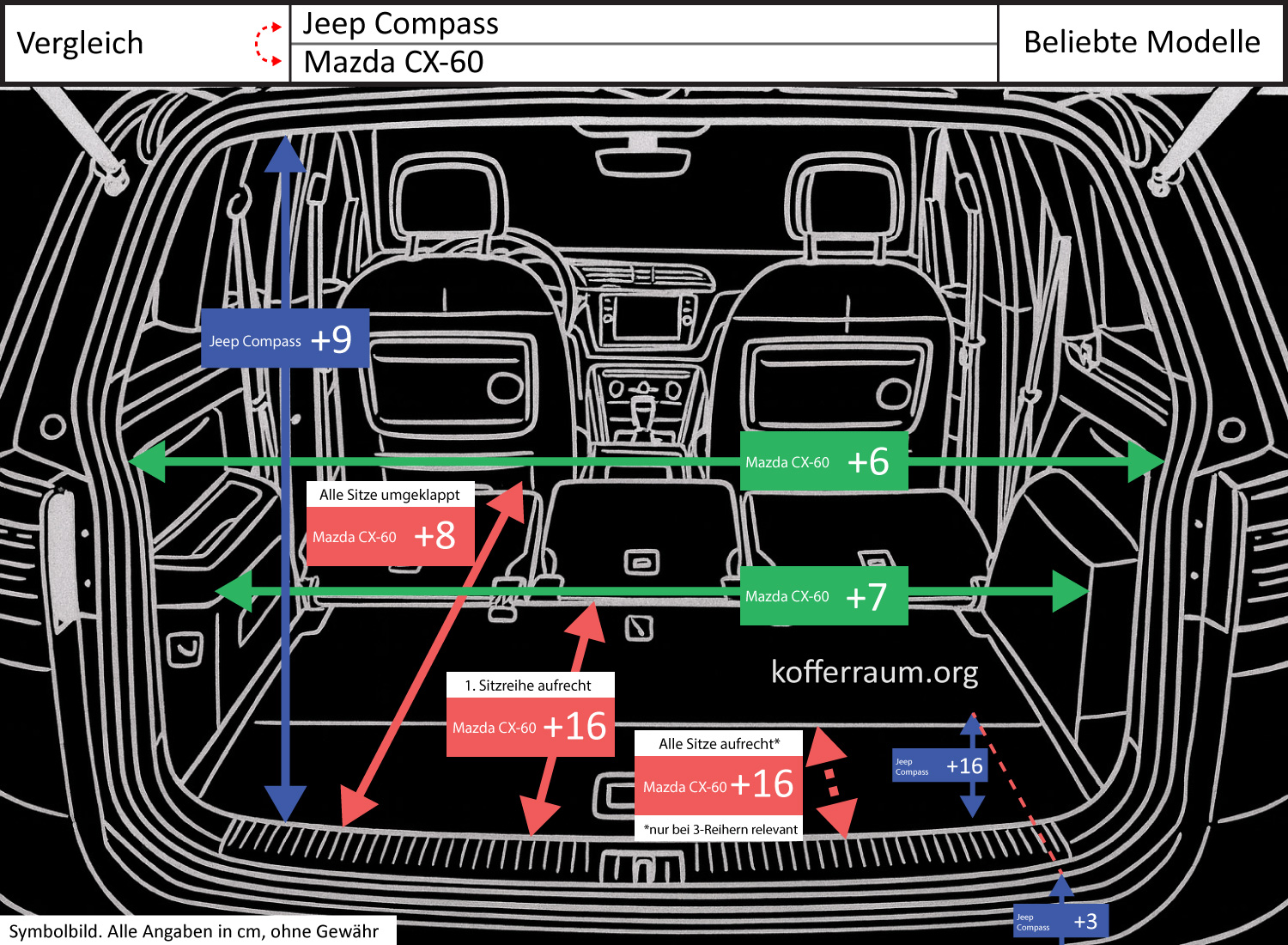
Three differences stand out from the available data: The Mazda CX‑60 offers a trunk floor length that is +6.3 in (≈+20%) longer with the rear seats upright than the Jeep Compass.
The Jeep Compass has a trunk opening height that is +3.5 in (≈+12%) larger, and the trunk depth (measured from the loading edge to the trunk floor) is +6.3 in (≈+1500%) greater in the Compass. These three values exceed the 10-percent mark and most strongly determine practical usability.
Implications for Usability
The longer trunk floor of the CX‑60 with the rear seats upright makes it better suited for long items you want to transport without folding down the rear seats (e.g., skis, long boards, or furniture parts).
This saves time and increases everyday practicality when regularly carrying longer cargo with full seating occupancy.
The higher trunk opening of the Jeep Compass makes it easier to load tall or bulky items because the aperture provides more vertical space.
Combined with the significantly greater depth (loading edge → floor), the Compass has a deeper cargo compartment: This increases usable volume and allows luggage to be stored deeper and partially out of sight.
For bulky, voluminous, or heavy cargo, however, this can also be inconvenient because items must be lifted higher or reached further down—especially since the loading edge height is only slightly higher in the Compass (+1.2 in or 4%).
In summary: If you frequently need to transport long loads without folding seats, the Mazda CX‑60 is more advantageous for everyday use. If you need more concealed volume and a larger opening height for tall, bulky cargo, the Jeep Compass offers the more practical features.
Smaller advantages of the CX‑60 in opening width and at the narrowest point (each <10%) support loading wider items but are less decisive than the differences mentioned above.