
Trunk comparison: Jeep Compass vs Renault Austral
Key Differences
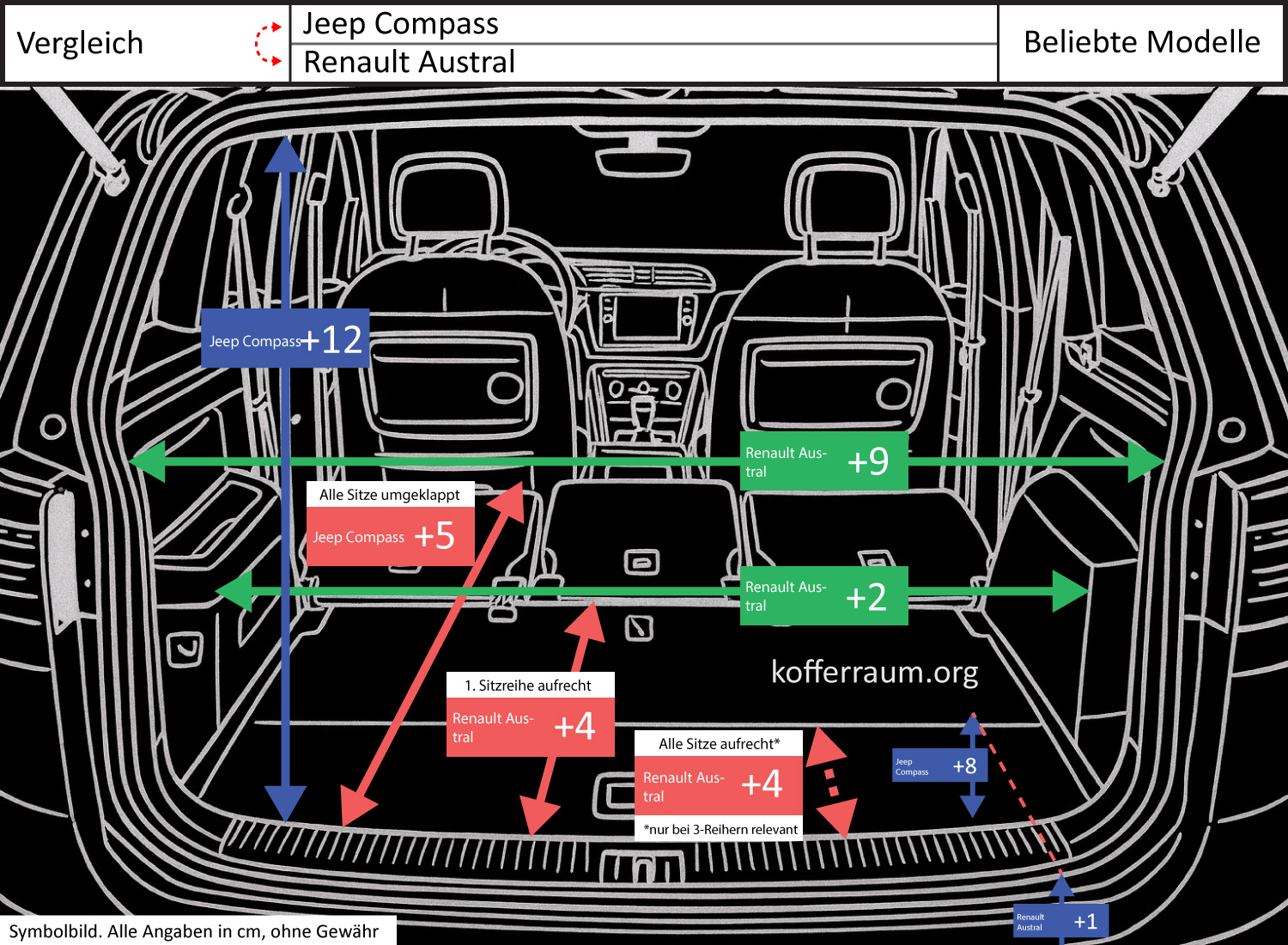
There are only small length differences in trunk volume and dimensions: With the seats folded down, the Jeep Compass is 2 in (≈3%) longer, while with the first row of seats upright, the Renault Austral is 1.6 in (≈5%) longer.
The width at the narrowest point is 0.8 in (≈2%) greater in the Renault, and the width of the trunk opening is 3.5 in (≈9%) larger in the Renault. The loading edge of the Renault is 0.4 in (≈1%) higher above the road than that of the Jeep.
Two values stand out clearly for the Jeep Compass: The height of the trunk opening is 4.7 in (≈16%) greater in the Jeep, and the depth of the trunk (distance from loading edge to trunk floor) is 3.1 in (≈100%) greater in the Jeep.
Impact on Usability
The greater height of the trunk opening in the Jeep makes loading tall items (e.g., boxes, plants, bulky furniture parts) easier because more vertical clearance is available when sliding them in.
The significantly greater depth (loading edge → floor) in the Jeep increases the usable installation depth behind the loading edge and thus the capacity for bulky or stackable items; combined with the higher opening, this makes the Compass more practical for tall or bulky cargo.
The Renault, on the other hand, scores points for width and usable length with the first row of seats upright: the wider opening and the slightly greater narrow width make it easier to load wider items (e.g., wide furniture panels, larger boxes).
The slightly longer loading floor with the seats upright becomes noticeable when folding down the seats is not possible or desired.
Practical conclusion: Those who frequently transport tall or deeply loaded, bulky items (e.g., plants, stacked goods, bulky boxes) have a clear advantage with the Jeep Compass.
Those who more often need to slide wide, flat, or longer objects through the loading opening and value a wider opening are better served by the Renault Austral. Smaller differences (3–9%) are usually less decisive in everyday use.