Trunk comparison: Jeep Compass vs Renault Clio

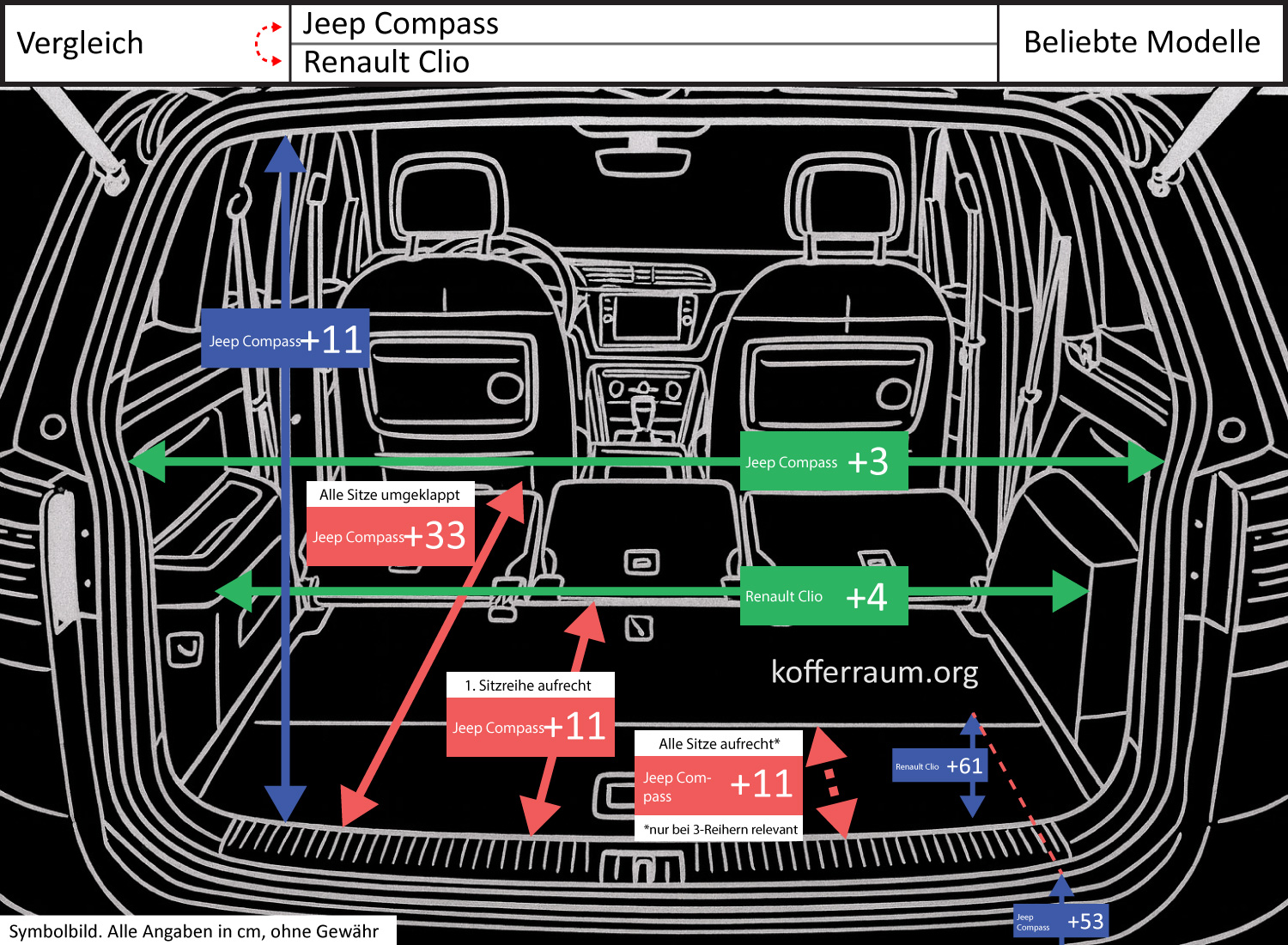
Key Differences (highlighted: >10%)
The Jeep Compass offers a longer cargo area: with seats folded down +13 in (25%) more length and with the front row upright +4.3 in (15%) more than the Renault Clio. The trunk opening of the Compass is also +4.3 in (15%) higher.
On the other hand, the Renault Clio has a significantly greater depth between the loading edge and the trunk floor: +24 in (381%) compared to the Compass.
Additionally, the loading edge of the Jeep Compass is +20.9 in (221%) higher above the road than that of the Clio. Smaller width differences (Clio at the narrowest point +1.6 in/4%, Compass opening width +1.2 in/3%) are comparatively negligible.
Impact on Usability
Due to the greater length (depending on seat position) and the higher opening, the Jeep Compass is better suited for longer or somewhat taller items like skis, ladders, or furniture parts — they can be loaded more easily and protrude less into the interior.
However, the significantly higher loading edge of the Compass makes lifting heavy loads more strenuous: heavy cargo must be lifted higher.
The Renault Clio scores with the very large depth under the loading edge: items lie deeper and thus more securely hidden, low, bulky goods can be well recessed.
Because the loading edge in the Clio is significantly lower than in the Compass, lifting heavy items is easier in practice — despite the deeper trunk floor. For frequent loading and unloading of heavy loads or for users with limited strength, the Clio is often more comfortable.
In summary: For longer, taller cargo and more usable length, the Jeep Compass is advantageous; for low, securely recessed luggage in the trunk well and easier lifting, the Renault Clio is more practical. Width differences hardly matter in everyday use.