Trunk comparison: Jeep Compass vs VW Passat Wagon
Key Differences
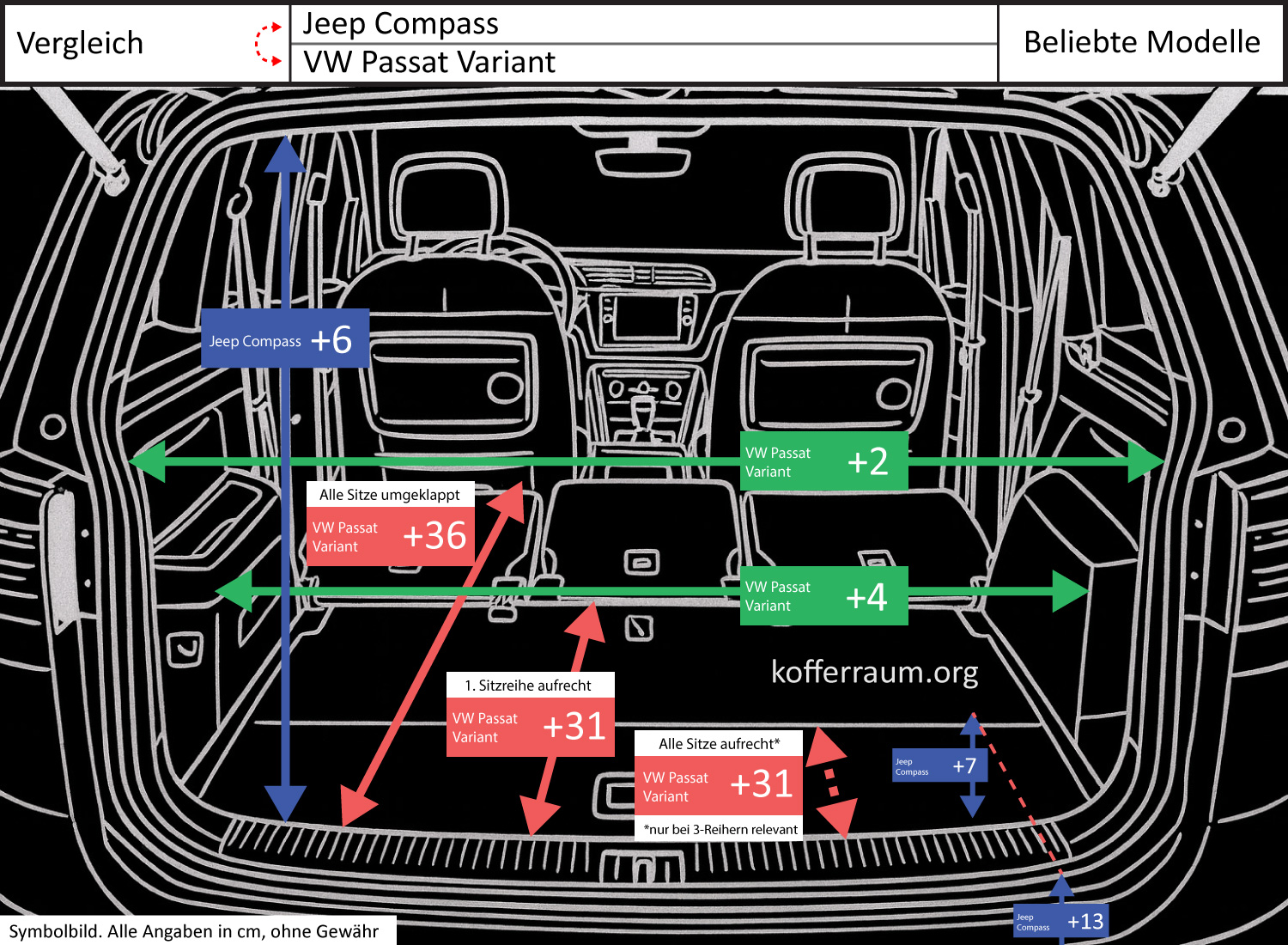
The VW Passat Wagon offers significantly more cargo length: with the seats folded down, the trunk is 14.2 in (22%) longer, and with the front seats upright, the advantage is even 12.2 in (38%).
Different values stand out for the Jeep Compass: the depth of the trunk (loading edge to trunk floor) is 2.8 in (78%) greater, and the loading edge is 5.1 in (20%) higher than in the Passat.
Smaller differences in width and opening width (4% and 2%, respectively) play hardly any practical role and are not highlighted here.
Implications for Usability
For transporting long items (e.g., slats, furniture parts, long boxes), the Passat Wagon is clearly advantageous: the significantly greater cargo length allows longer, flat-lying loads without awkwardly pushing into the rear seat row or compromising positioning.
For items that must fit along the vehicle's longitudinal axis, this reduces effort and increases practicality.
The Compass, on the other hand, offers a deeper trunk well due to the greater trunk depth. This can help store bulky or unevenly stacked items more securely because there is more depth before the load protrudes over the edge.
However, the 5.1 in higher loading edge makes loading and unloading more difficult, especially with heavy or awkward loads: more frequent exertion and poorer ergonomics compared to the lower Passat loading floor.
Practically, this means: if you often transport long, flat parts or value easy loading and unloading, the VW Passat Wagon is the better choice.
If, however, you benefit from a deeper trunk well (e.g., for securely holding irregular cargo) and the higher loading edge is not a dealbreaker, the Jeep Compass can be advantageous.