
Trunk comparison: Jeep Renegade vs Durchschnitt SUV

Key Differences and Impact on Usability
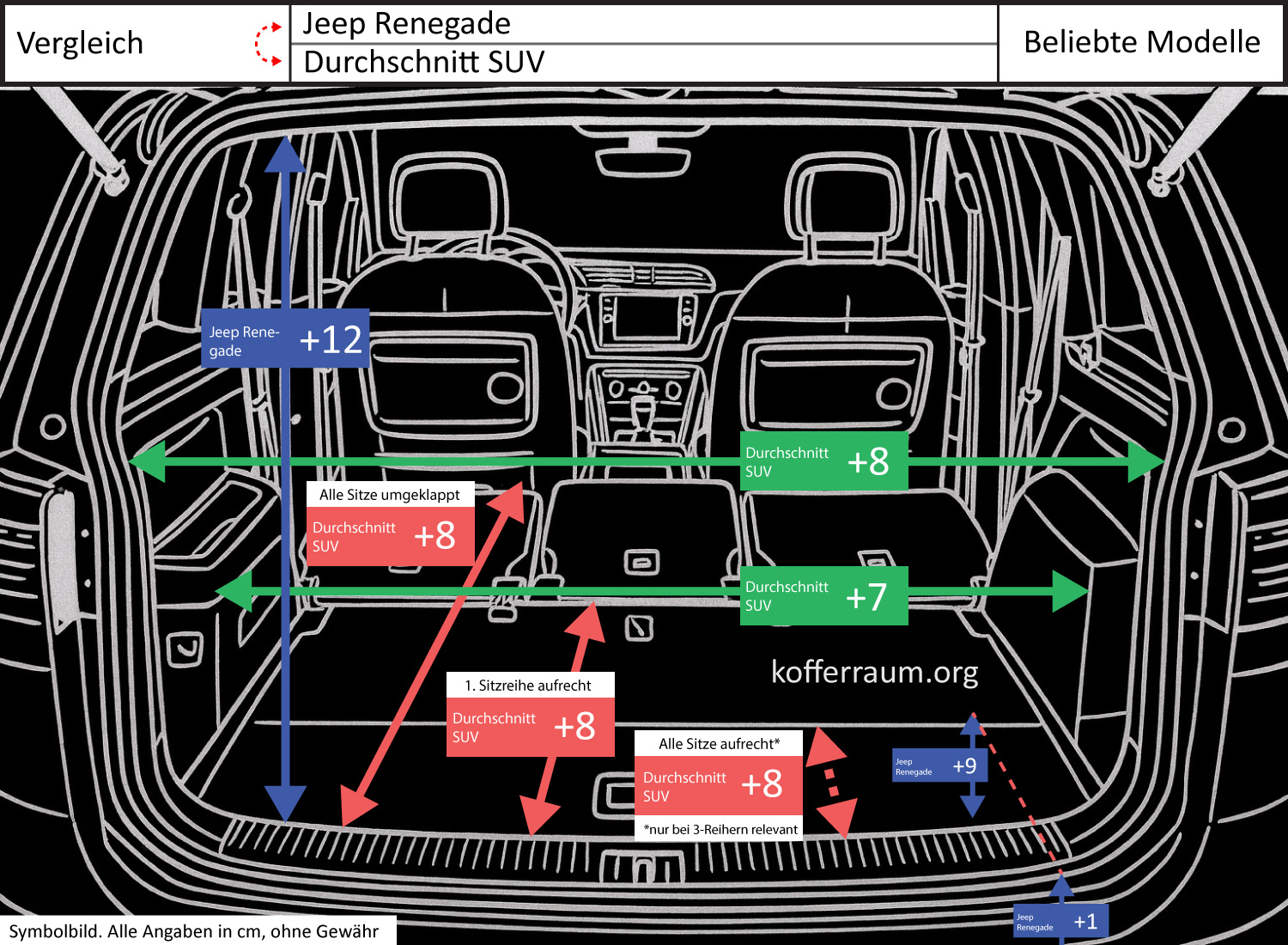
Two major differences stand out in favor of the Jeep Renegade based on the measurements: the height of the trunk opening is 4.7 in (±16%) larger and the depth of the trunk (loading edge to trunk floor) is 3.5 in (±180%) greater than the average SUV.
These features practically mean that taller or bulkier items fit more easily through the opening in the Renegade and can be stored deeper in the cargo space.
Especially bulky or tall loads (e.g., tall boxes, equipment, or sports gear) are easier to load because the loading height is greater and more interior height is available.
However, the greater depth (deeper trunk floor relative to the loading edge) can make storing heavy items somewhat more cumbersome: after overcoming the loading edge, items must be lowered further down, which may require more strength or repositioning when lifting and placing.
The loading edge height above the road differs by only +0.4 in (≈1%) and hardly affects the effort needed to lift items.
The average SUV, on the other hand, has a slight advantage in length and width: it offers +3.1 in longer cargo space with folded seats (+5%) and +3.1 in longer cargo space with the first row upright (≈+10%), plus the narrowest cargo width is +2.8 in (+7%) larger and the opening width is +3.1 in (+8%) wider.
This makes the average SUV more advantageous for very long or comparatively wide items (e.g., long slats, furniture parts, wide boxes). However, these differences are moderate and in many everyday situations only decisive when maximum length or width really matters.
In short: For tall and bulky loads, the Jeep Renegade offers clear advantages (larger opening height and deeper usable interior). For especially long or wide loads, the average SUV is slightly better suited. The choice therefore depends on the primary use: height/volume vs. length/width.