
Trunk comparison: Kia Ceed vs Durchschnitt Subcompact
Key Differences
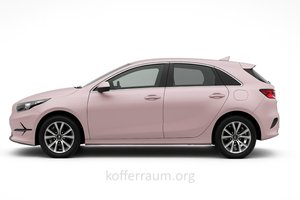
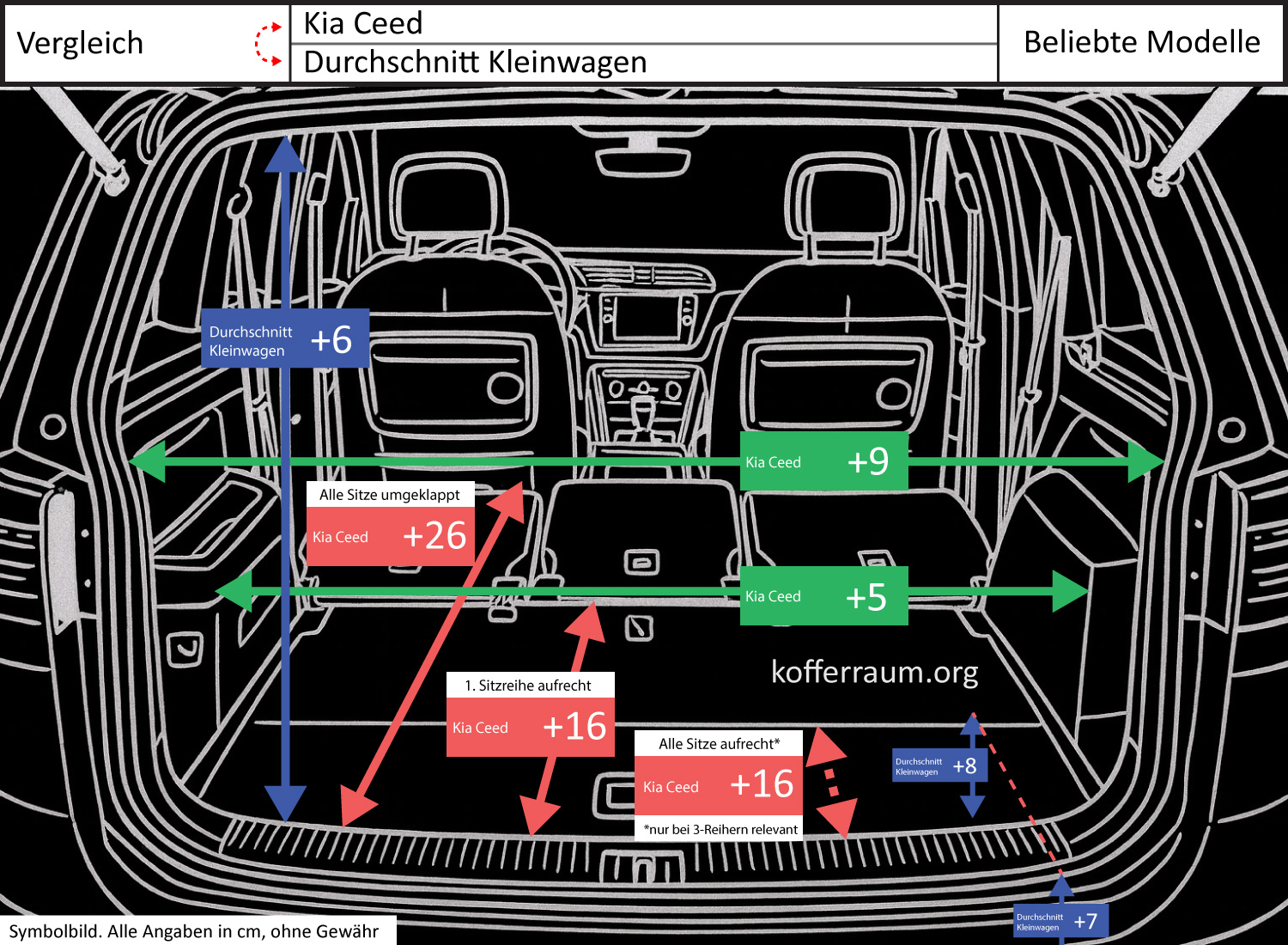
The Kia Ceed offers advantages in cargo volume especially in length: when all seats are folded down, the cargo area is 10.2 in (20%) longer and with the front seats upright, 6.3 in (25%) longer than the average subcompact.
In contrast, the average subcompact has a significantly greater trunk "depth" between the loading edge and trunk floor: 3.1 in (73%) deeper than the Ceed.
Additionally, the loading edge of the average car is 2.8 in (11%) higher above the ground than that of the Kia Ceed.
Smaller differences that do not reach the >10% threshold are: the narrowest trunk width of the Ceed is 2 in (5%) wider and the trunk opening of the Ceed is 3.5 in (10%) wider; the opening height of the average is 2.4 in (8%) higher.
Implications for Usability
The longer cargo area of the Kia Ceed (20% and 25% longer respectively) makes it practically superior for long or flat items like furniture parts, slats, skis, or longer boxes: such items can be transported much more easily and without tilting when the rear seats are folded down.
Even in everyday use, more usable length remains with the rear seats upright for suitcases or shopping bags.
The greater depth of the average subcompact (73% more) means more vertical volume below the loading edge — useful when items are stored in the "trunk well" or when making small, tall stacks.
However, this often comes with a higher loading edge: the average sits 11% higher above the ground, which makes lifting heavy loads over the loading edge more difficult. The Kia Ceed benefits here from the lower loading edge; heavy loading and unloading is more ergonomic.
In practical summary: for long, flat, or bulky cargo, the Kia Ceed is the better choice; for additional depth-usable volume (with less focus on easy lift height) the average subcompact has advantages. Width-related differences are minor and only moderately affect everyday usability.