Trunk comparison: Kia Ceed vs Durchschnitt SUV

Quick Overview of the Differences
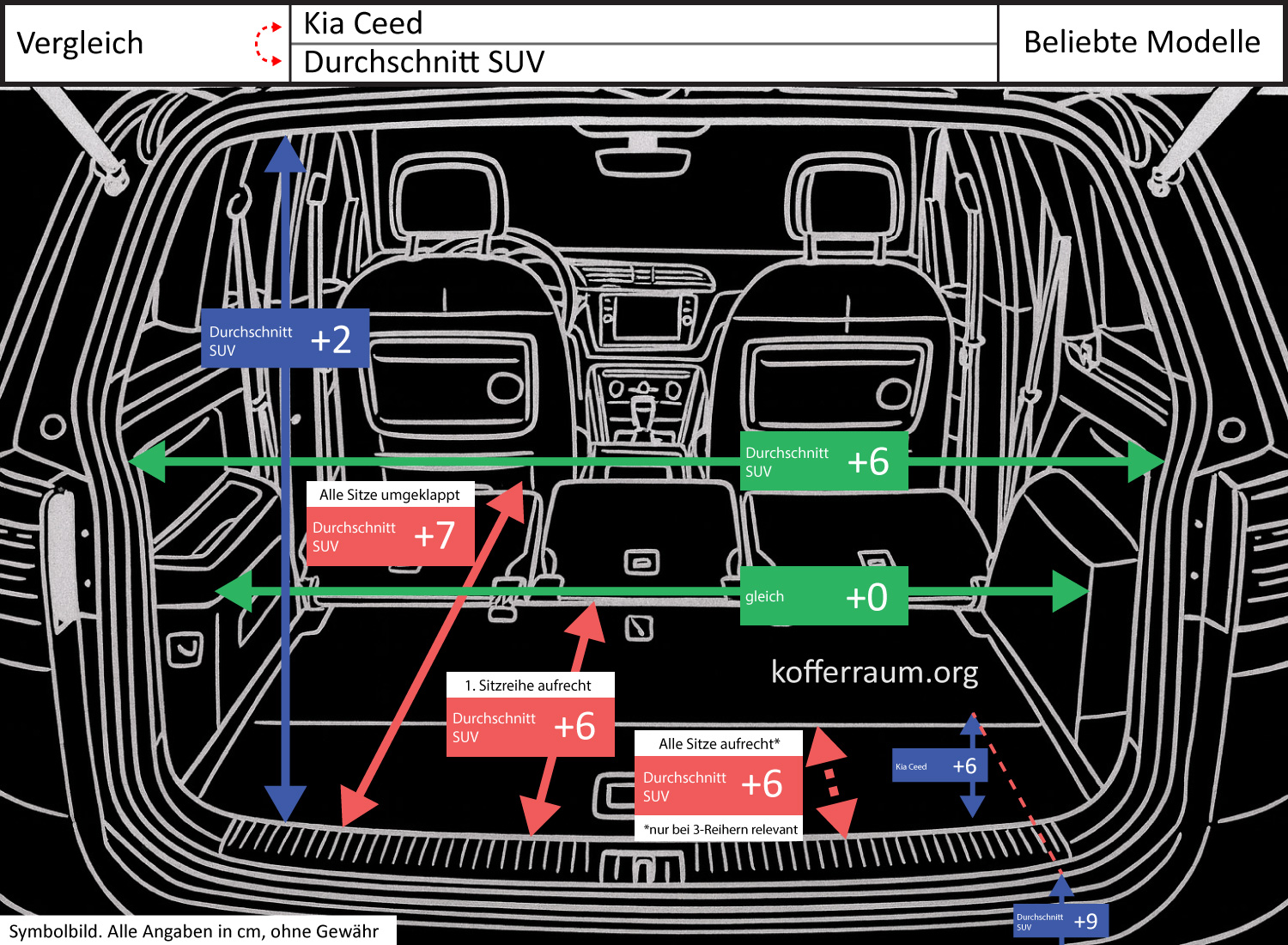
Most dimensions are close: The average SUV has a cargo area that is 2.8 in (+5%) longer with the rear seats folded down and 2.4 in (+8%) longer with the front seats upright than the Kia Ceed.
The trunk opening of the SUV is 0.8 in (+3%) higher and 2.4 in (+6%) wider than that of the Ceed. The narrowest width in the trunk is the same for both models.
Key Differences and Their Impact on Usability
The depth of the trunk (distance from loading edge to trunk floor) is 2.4 in — equivalent to +120% — greater in the Kia Ceed than in the average SUV. Practically, this means: In the Ceed, the floor lies significantly lower below the loading edge, creating more space beneath the loading edge.
This increases the usable volume for taller or stacked items and prevents small objects from easily protruding over the loading edge. Downsides include slightly more bending when loading and a higher lip where dirt or water can accumulate.
The loading edge of the average SUV is 3.5 in (14%) higher above the ground than that of the Kia Ceed. In practice, this means: Lifting heavy loads into the Ceed’s trunk is noticeably easier (lower lift height).
For the SUV, the higher loading edge increases the effort required to load bulky or heavy items; however, a higher loading edge can offer protection against splash water and dirt intrusion on uneven terrain or high curbs.
Conclusion — What Are the Effects of These Differences?
The most significant practical effects come from the combination of a deeper trunk floor and lower loading edge in the Kia Ceed: easier lifting of loads plus more storage space below the loading edge.
The average SUV, on the other hand, offers a slightly greater length and opening width (both under 10% difference), which gives it a slight advantage for very long, flat loads, but the higher loading edge makes loading heavy items more difficult.