
Trunk comparison: Kia Ceed vs Mazda Mazda CX-60
Summary of the biggest differences (only >10% highlighted)
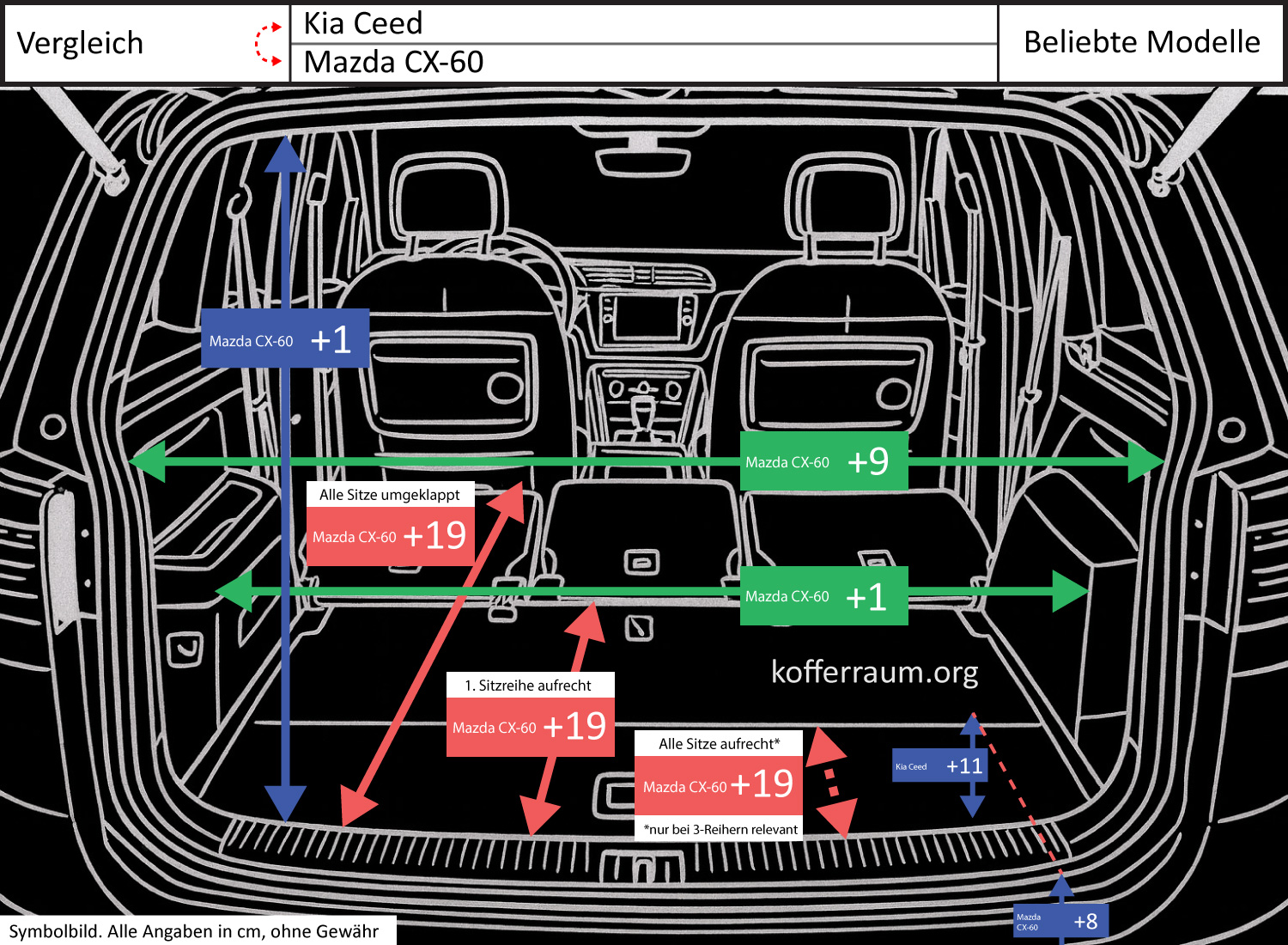
Mazda CX‑60: Trunk length with seats folded +7.5 in (+12%) — the CX‑60 offers noticeably more cargo length with the seats folded down.
Mazda CX‑60: Trunk length with front row upright +7.5 in (+24%) — even with the front seats in normal position, the CX‑60 remains significantly longer.
Kia Ceed: Trunk depth (loading edge → floor) +4.3 in (+1000%) compared to CX‑60 — the trunk floor in the Ceed is significantly lower than the loading edge (large relative difference).
Mazda CX‑60: Loading edge +3.1 in (+12%) higher above the road — the loading opening of the CX‑60 is higher above street/ground level.
What practical consequences arise from this?
1) Longer loading surface in the CX‑60 (with seats folded and with front row upright): This makes the CX‑60 better suited for long items (e.g. slats, furniture parts, bicycle with front wheel removed) and for significantly more usable lying surface once rear seats are folded.
For moves, longer sports equipment, or when regularly loading bulky cargo crosswise, the CX‑60 is clearly advantageous.
2) Higher loading edge in the CX‑60 (+3.1 in): The higher loading edge increases the lift when loading heavy items. This makes lifting boxes, furniture, or heavy luggage more difficult compared to the Ceed.
For frequent loading and unloading of heavy goods or with limited physical mobility, the Ceed is therefore more practical.
3) Significantly greater depth in the Ceed (+4.3 in relative to the CX‑60): Because the trunk floor in the Ceed lies further below the loading edge, a deeper cargo space is created.
This can have two effects: on one hand more usable volume for low, bulky items and a better holding effect (items sit deeper), on the other hand handling when lifting over the loading edge can feel slightly different.
Combined with the lower loading edge of the Ceed, this results overall in an easier, more ergonomic loading process for heavy or flat goods.
4) Width and height differences small: Differences in trunk opening height (+0.4 in), narrowest width (+0.4 in), and opening width (+3.5 in / 9%) are minor and hardly affect everyday usability.
Conclusion
Those who frequently transport long or bulky items and need maximum cargo space benefit from the Mazda CX‑60 due to the significantly longer loading surface.
Those who often load and unload heavy, flat, or bulky items and prefer more ergonomic handling benefit from the Kia Ceed: deeper cargo well and lower loading edge make loading and unloading easier.