Trunk comparison: Kia Ceed vs Peugeot 308 SW 3-row
Key Differences and Their Impact on Usability
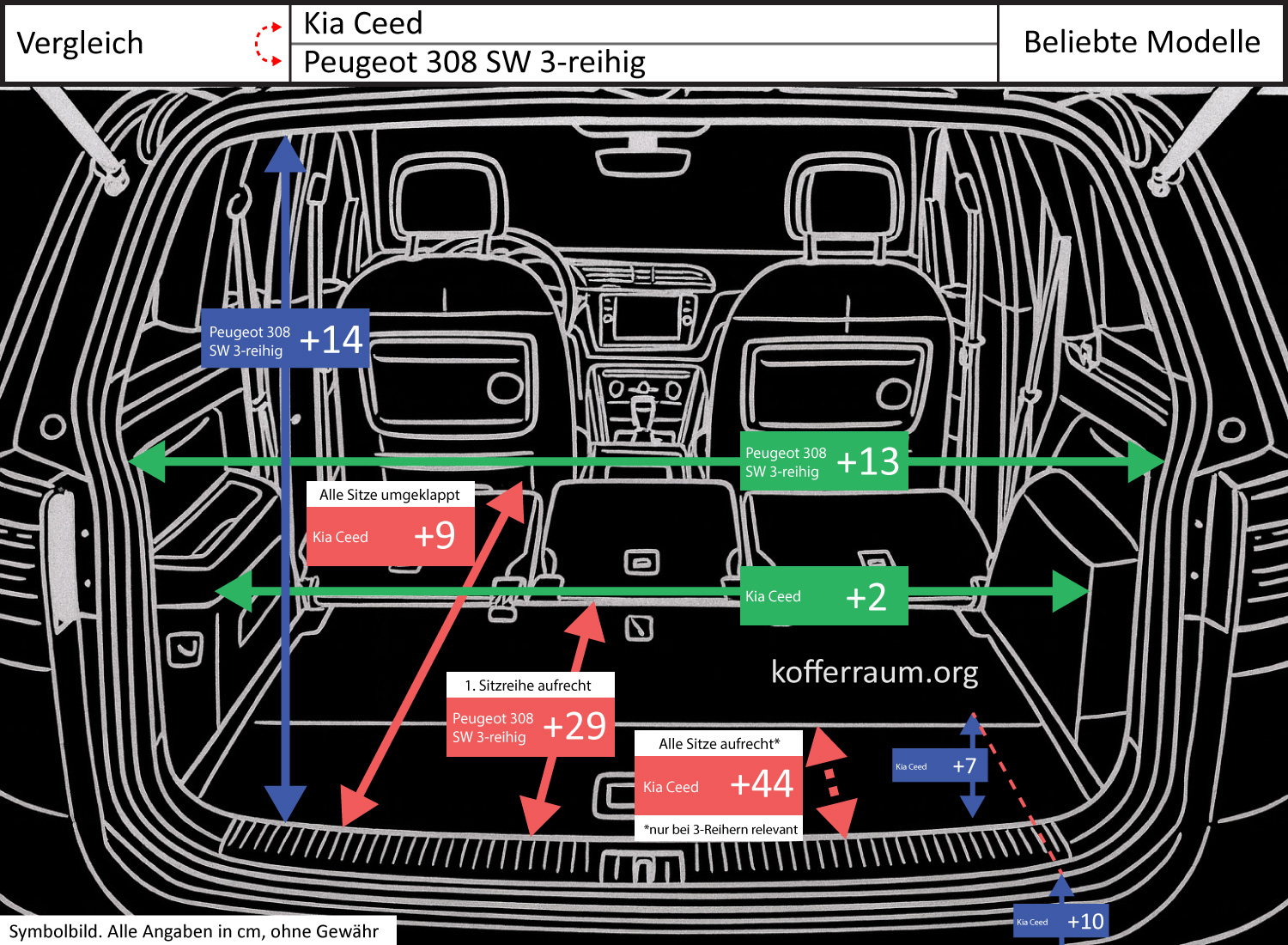
With the seats folded down, the difference is small: the Kia Ceed offers only +3.5 in (6%) longer trunk space compared to the Peugeot; here both models are practically equally good for longer cargo. More significant differences arise when the seats remain upright or when the opening and loading height become relevant.
The Peugeot has a noticeably longer cargo area with the first row of seats upright: +11.4 in (37%), which clearly gives it an advantage when transporting long items behind the front seats.
Conversely, the Kia offers +17.3 in (126%) more trunk space with all seats fully upright, making it significantly more practical when all passenger seats are used and a lot of luggage still needs to be carried.
Regarding shape and accessibility, the vehicles score differently: the Peugeot's trunk opening is +5.5 in (19%) higher, which makes loading tall items easier; additionally, the Peugeot's opening width is +5.1 in (13%) larger, allowing bulky cargo to fit through the hatch more easily.
In contrast, the Kia has a significantly greater trunk depth height (loading edge to trunk floor) of +2.8 in (175%), meaning a deeper interior behind the loading edge, and a higher loading edge height above the road of +3.9 in (18%).
Practically, this means: the Kia's loading edge sits higher, which can make lifting heavy items onto it more strenuous, but at the same time, the space behind the loading edge is deeper, allowing tall items to be pushed further forward.
The narrowest width in the trunk differs by only +0.8 in (2%) in favor of the Kia and is therefore negligible.
In practice, this results in the following picture: those who frequently travel fully occupied with lots of luggage benefit from the Kia (significantly more volume with all seats upright).
Those who more often load individual long or tall items, for example behind the first row of seats or through a larger opening, are better served by the Peugeot.
The Peugeot facilitates loading tall/bulky items through a higher and wider opening; the Kia offers more usable depth inside but a higher loading edge that can make lifting more difficult.