
Trunk comparison: Kia Ceed vs Renault Austral
Key Differences (highlighted: >10%)
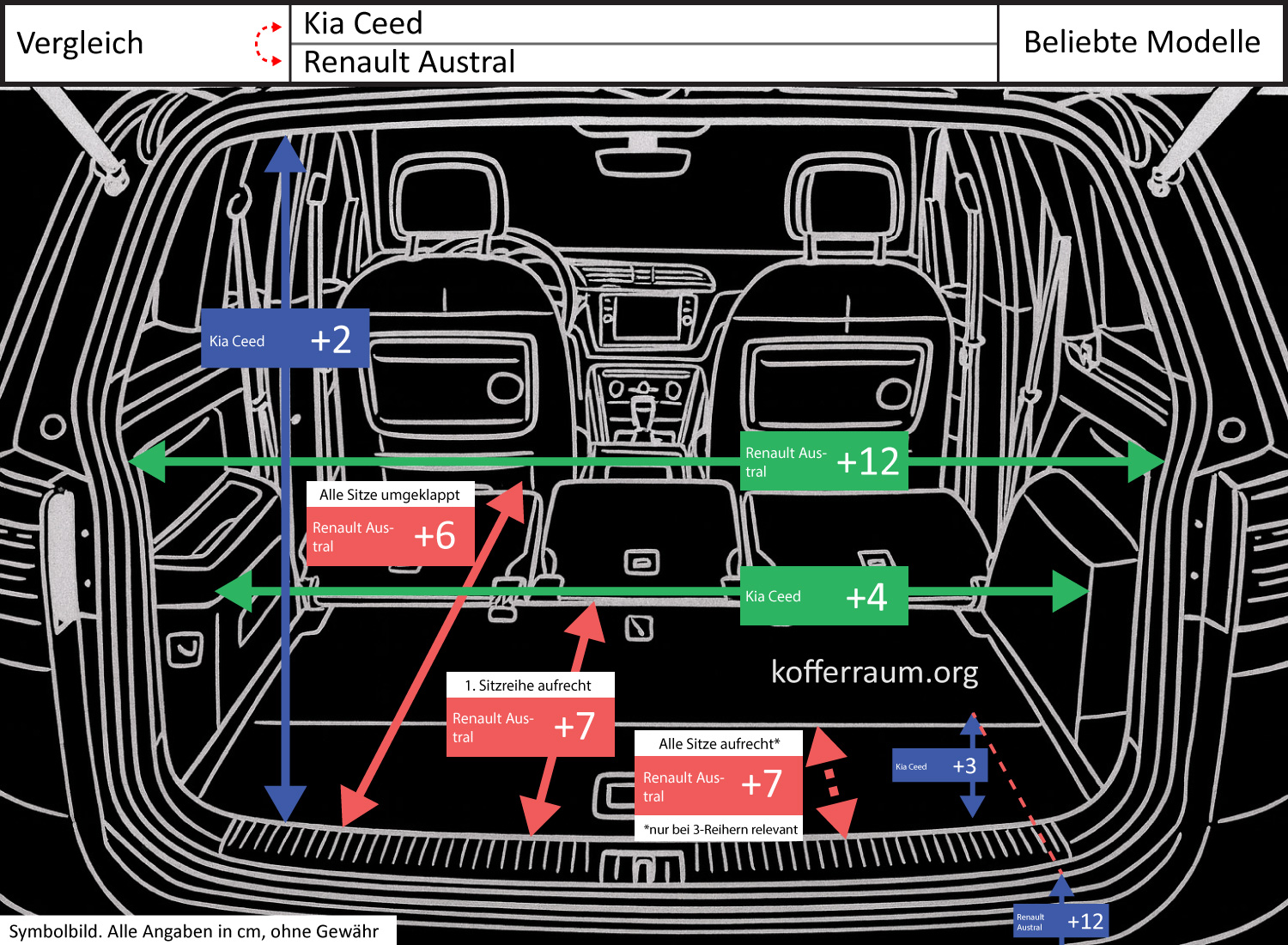
Three significant differences stand out from the measurements: The depth of the trunk (loading edge to trunk floor) is +1.2 in (38%) greater in the Kia Ceed than in the Renault Austral.
The loading edge of the Renault Austral is +4.7 in (18%) higher above the road than that of the Kia Ceed. The width of the trunk opening of the Renault Austral is +4.7 in (12%) larger than that of the Kia Ceed.
Impact on Usability
The greater trunk depth of the Kia Ceed practically means more usable volume below the loading edge: bulky or taller items can be placed further down without protruding over the loading edge.
Combined with the lower loading edge in the Ceed (since the Austral’s loading edge is significantly higher), the Ceed has a clear advantage when loading and unloading heavy or awkward loads — less effort and better access to the trunk floor.
In the Renault Austral, the significantly wider trunk opening makes it easier to fit wide items through the opening. This facilitates loading wide-surfaced items (e.g., furniture parts or large boxes), despite the shallower trunk depth.
However, the +4.7 in higher loading edge makes lifting heavy loads more difficult; wide but heavy parts may fit in terms of space but require more lifting effort.
Smaller differences (length with seats folded +4% and +9%, narrowest width +4%, opening height +3%) exist but only slightly affect everyday use: the Austral offers slightly more length with folded seats and a larger opening width, while the Ceed provides somewhat more interior width at the narrowest point and a slightly higher opening.
In summary: For frequent loading and unloading of heavy or tall items, the Kia Ceed is more practical due to its deeper load floor and lower loading edge. For loading wide, bulky parts, the Renault Austral is advantageous because of the larger opening width but is hindered by the higher loading edge.